
Same-day & Next-day Delivery

Quality Guaranteed

Unlock Your Welcome Offers: FREE Delivery | Up to 80% OFF | Free 30-day JoyPlus trial
Download the APP
Choosing a new 65x65 pillow might seem simple, but it often turns into a real headache. How many times have you invested in a model that seemed perfect in the store, only to wake up with a stiff neck? Or what about that pillow with a promising loft that went as flat as a pancake after just a few weeks?
As a product expert at Joybuy, my role is to guide you through this jungle of options and help you avoid the common pitfalls. Forget the flashy packaging: let's focus on the criteria that truly matter for a restorative sleep.
The marketing jargon in the bedding industry can be confusing. Here are the two most common mistakes that take a heavy toll on your comfort (and your wallet).
For an informed choice, three parameters must be scrutinised: the filling, the firmness, and the certifications.
The type of filling directly affects comfort, support, and ease of care.
The ideal firmness depends mainly on your sleeping position.
The Oeko-Tex certified pillow label is a guarantee of safety. The STANDARD 100 by OEKO-TEX label ensures that every component of the product (fabric, thread, filling, accessories) has been tested and certified to be free of harmful substances. This is your assurance that your pillow contains no unwanted chemical residues—a crucial point for a product that is in direct contact with your face for hours on end.
Rather than an exhaustive list, we've matched sleeper profiles with products that precisely meet their needs.
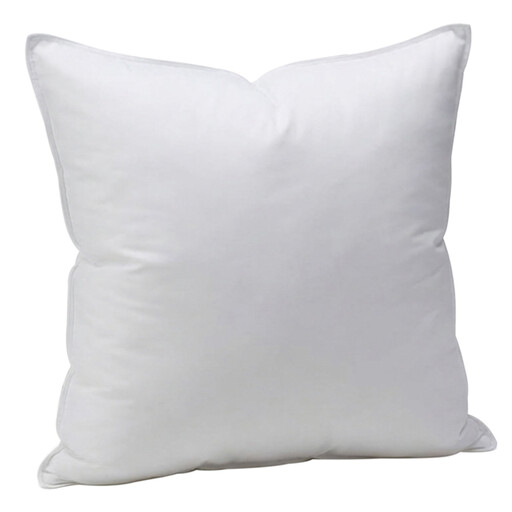
Why we chose it: Ideal for outfitting a double bed without breaking the bank. This set of 2 pillows offers uniformity and simplicity, with a synthetic filling that suits most sleepers and is easy to maintain.
Sold as a set of 2 pillows, it provides a cost-effective and consistent solution. Its hypoallergenic filling is designed to be both soft and supportive, adapting to different sleeping positions and thus avoiding the "niche pillow" trap, where it might be unsuitable for one partner.
Its hypoallergenic nature and versatility (for back, side, and stomach sleepers) make it a reliable and practical choice for a couple or for furnishing a guest room.
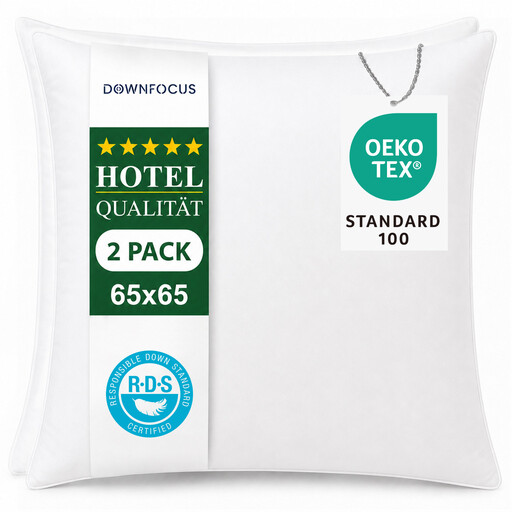
Why we chose it: For those who swear by the authentic comfort and breathability of natural filling. This model bets on premium materials, with certifications that speak for themselves regarding its origin and composition.
It doesn't just rely on the "hotel quality" label; it proves it with a 100% cotton cover and a 100% feather filling of 1200g—a weight that signals good density and therefore better durability over time.
The Oeko-Tex and RDS (Responsible Down Standard) certifications guarantee that it is free from harmful substances and that animal welfare standards have been respected, respectively. These are compelling arguments for a discerning customer.
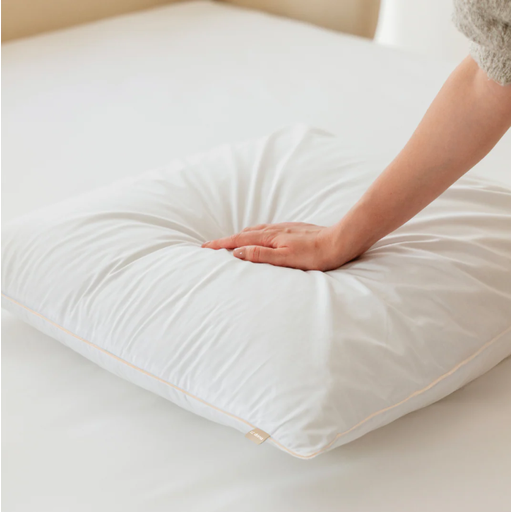
Why we chose it: For those who love the comfort of natural materials but prioritise hygiene and allergen control. This model, although a 60x60 size (a very common alternative to the square format), boasts multiple certifications for maximum peace of mind.
It backs up its claims with a rock-solid list of certifications (Oeko-Tex, CertiPUR-US, Sanitized, ISO 9001). The Sanitized treatment, in particular, is a recognised standard for its anti-dust mite and antimicrobial properties.
The blend of 90% feathers and 10% down offers firm support with a touch of softness. Its 20 cm thickness ensures good support, and it's machine washable for hassle-free maintenance.
We have compiled a comprehensive, up-to-date selection of products that meet our strict selection criteria and current safety standards.
A pillow's lifespan depends on its filling and how it's cared for. As a general rule, it's advisable to replace it every 2 to 3 years. A high-quality feather and down pillow may last a bit longer, whereas an entry-level synthetic model will show signs of flattening after just one year. A simple test: fold your pillow in half. If it doesn't spring back to its original shape, it's time for a replacement.
Contrary to popular belief, many feather pillows are machine washable. It is crucial to follow the manufacturer's instructions to the letter. Use a delicate cycle at a low temperature (30 or 40°C) with a mild detergent. The most critical step is drying: it must be thorough to prevent mould and odours. Ideally, use a tumble dryer on a low heat setting with dryer balls (or tennis balls) to help the pillow regain its full loft. Remember to also fluff and air it out very regularly.