
Livraison le jour même ou le lendemain

Qualité garantie

Débloquez vos offres de bienvenue: Livraison GRATUITE | Jusqu'à -80 % | 30 jours d'essai gratuits à JoyPlus
Téléchargez l'application
The widespread adoption of USB-C as a universal charger is excellent news, but it has paradoxically turned choosing one into a genuine headache. Faced with a sea of options, it's easy to end up with a 65W USB-C charger that doesn't live up to its promises. A model that's too slow, incompatible, or fails after a few months is a source of frustration and a waste of money.
Before you buy, it's crucial to know how to navigate the pitfalls of often-confusing marketing. Understanding these key points will help you choose a power adapter that truly meets your daily needs, with no unpleasant surprises.
To avoid these pitfalls, a few technical specifications make all the difference. They are the true indicators of a charger's quality and performance.
A 65-watt output is perfect for powering a wide range of devices, from smartphones to laptops. But be warned, this raw power is useless if not managed intelligently. This is where the Power Delivery (PD) charger protocol, most often in its 3.0 version, comes in. This standard allows the charger and your device to "talk" to negotiate the optimal voltage and current. A good 65W PD 3.0 charger can thus recharge a laptop at full speed, while also adapting to provide a gentler charge to wireless earbuds, without any risk of damaging them.
Compare a recent charger to a model from a few years ago: the size difference is striking. The secret to this miniaturisation? GaN (Gallium Nitride) technology. GaN components replace traditional silicon, resulting in better energy efficiency and less heat generation. The result: a GaN charger is not only smaller and lighter (a huge plus for travel), but it also wastes less energy.
The number and type of ports determine your charger's versatility. A dual-port USB-C and USB-A charger remains a very effective, all-purpose setup. The main USB-C port is usually the one that delivers the full 65W, while the USB-A port is for older devices or small accessories. Be sure to check the spec sheet to understand how power is distributed when multiple ports are used simultaneously. Some more advanced models offer two USB-C ports, an attractive option if all your devices are modern.
Forget the endless lists. We've selected specific models for specific needs, based on the performance and reliability criteria we've just covered.
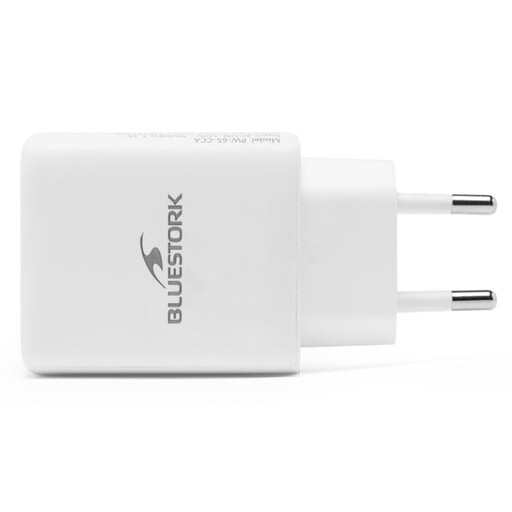
Why we chose it: Ideal for those who already have their preferred cables or want to choose a custom length. Its compact size and dual-port design make it a perfect travel companion for lightening your bag.
This model focuses on the essentials: delivering 65W via its USB-C PD 3.0 port. Sold without a cable, it (positively) forces you to ensure you're using a suitable cable, eliminating the bottleneck risk.
Supports PD 3.0 and QC 3.0 protocols for maximum compatibility. Smart power distribution optimises charging when both ports are in use.
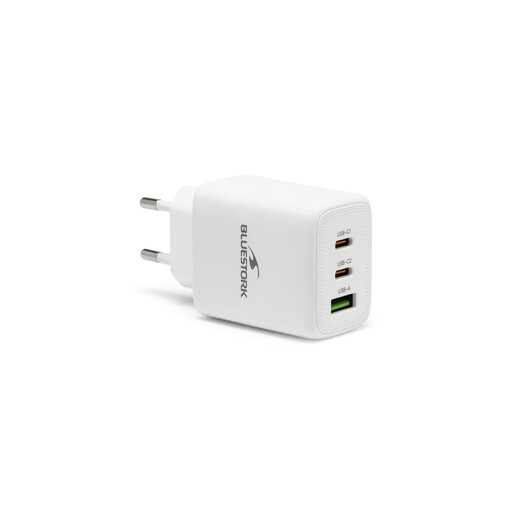
Why we chose it: For those who want a solution that's ready to use "out of the box". This kit includes a high-performance charger and a certified cable, guaranteeing optimal fast charging right from the start, hassle-free.
By including a cable designed for 65W, this bundle completely eliminates the bottleneck risk. It's your guarantee of getting the maximum charging speed the charger can deliver.
An all-in-one, cost-effective, and reliable solution. Compatibility between the charger and cable is guaranteed by the manufacturer, for total peace of mind.
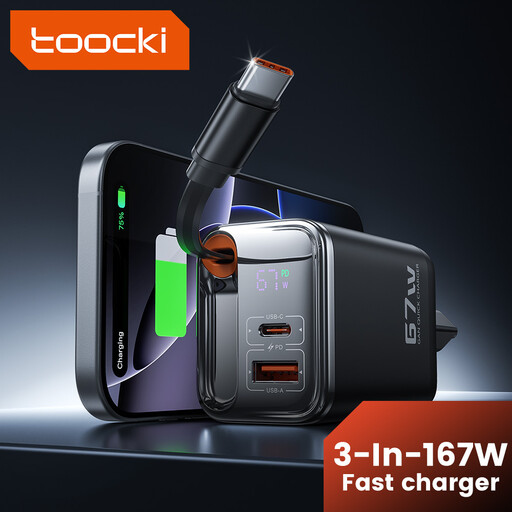
Why we chose it: The ultimate weapon against tangled cables. The integrated retractable USB-C cable and additional ports make it an ultra-compact charging station for the office, home, or travel.
No more forgotten cables or power drops when charging multiple devices! Its smart distribution technology ensures efficient charging even with several devices plugged in, and the main cable is always within reach.
Unique 3-in-1 design with a retractable cable. A slightly higher power of 67W and the ability to charge multiple devices at once. This makes it an excellent, versatile 65w fast charger.
We've put together a complete selection of products that tick all the boxes in our guide and meet European safety standards.
No, there's absolutely no risk. Thanks to the Power Delivery (PD) standard, the charger and your device "communicate" to determine the maximum power the device can safely receive. The charger adapts automatically and will only deliver the exact power needed (e.g., 20W for your phone), even though it can go up to 65W.
The main difference lies in the semiconductor material. Classic chargers use silicon, while GaN chargers use gallium nitride. The latter conducts electricity better and can handle higher voltages. In practical terms, for the same power output, a GaN charger will be smaller, lighter, and generate less heat than a silicon-based one. This makes it much more convenient to carry and use daily.
Yes, it's absolutely essential. To take full advantage of 65W, you need a USB-C to USB-C cable explicitly designed to handle that power (look for an "e-marked" chip or a 100W/5A rating). Using a standard cable rated for 15W or 30W will throttle your computer's charging speed and make your investment almost pointless.