
Livraison le jour même ou le lendemain

Qualité garantie

Débloquez vos offres de bienvenue: Livraison GRATUITE | Jusqu'à -80 % | 30 jours d'essai gratuits à JoyPlus
Téléchargez l'application
Juggling separate chargers for your laptop, smartphone, and tablet is a daily headache. The promise of a single, fast, and compact charger is an appealing one. The problem? The market is saturated with models that often fail to deliver. As the head of product selection at Joybuy, my mission is to help you decode the spec sheets and make the right choice, cutting through the often-misleading marketing hype.
But before you take the plunge, let's review the three classic pitfalls that too often turn a great deal into a frustrating experience.
To sidestep these traps, a few technical specifications need to be examined closely. These are your safeguards. Mastering them is your guarantee of choosing a 65W power adapter that truly lives up to its promises.
The total raw wattage isn't everything. What really matters is how it's distributed. A good multi-port charger must transparently display the maximum power per port (when used alone) and the various distribution scenarios when multiple ports are occupied.
For example, for a 65W GaN charger with two USB-C ports, a quality configuration should look like this:
This information is crucial to know if you can efficiently charge your laptop and your smartphone at the same time.
For charging that is both fast and safe, compatibility with the Power Delivery (PD 3.0) protocol is an absolute prerequisite. It's the standard adopted by nearly all modern devices, from iPhones to Dell and HP laptops.
For owners of recent Android smartphones, especially the latest Samsung models, support for the PPS (Programmable Power Supply) protocol is a real bonus. It allows for even finer adjustments of voltage and current to shave off precious charging minutes while limiting heat buildup. A fast USB-C charger that integrates both standards offers maximum versatility.
Gallium nitride (GaN) is the semiconductor material that has completely changed the game in the charger market. For the same power output, a GaN charging block generates far less heat than a traditional silicon-based charger. This improved thermal efficiency allows for the design of radically smaller and lighter chargers. For anyone who travels a lot, choosing a compact GaN travel charger is no longer an option—it's a necessity.
Rather than an endless list, we've matched specific models to real-world use cases, based on the performance and reliability criteria we've just discussed.
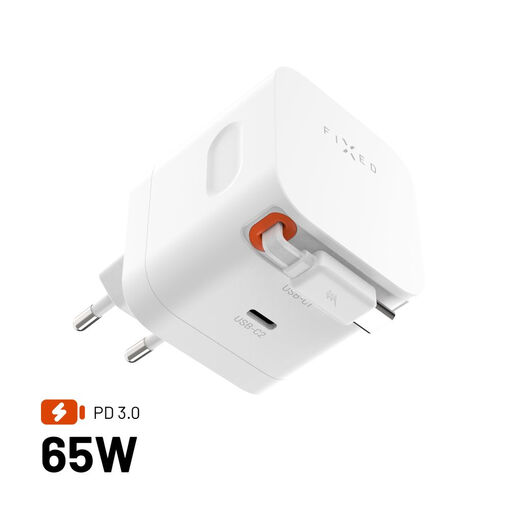
Why it's a match: The ideal companion for mobile professionals and students. Compact, with two USB-C ports and, most importantly, a built-in retractable cable, it lets you power a laptop and a smartphone without getting tangled in wires. The very definition of a well-designed travel charger.
Its GaN technology ensures a tiny footprint without overheating. PD 3.0 compatibility guarantees fast and safe charging for all compatible devices.
Built-in retractable cable: No more forgotten cables at the bottom of your bag. GaN technology: Mini format and minimal heat.
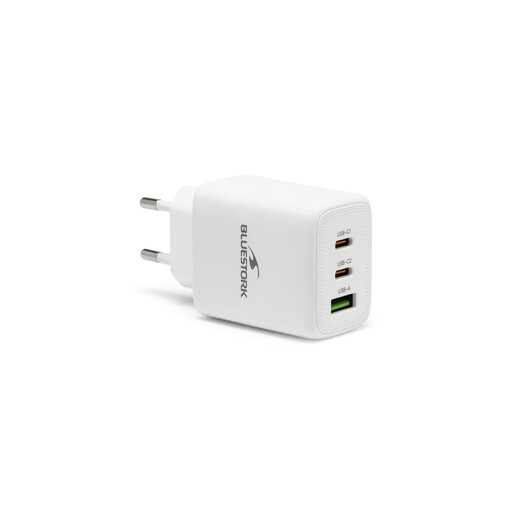
Why it's a match: For those who want a reliable, all-in-one solution for the office and home. It delivers 65W, enough for a laptop, while retaining a USB-A port for compatibility with older devices. The included cable makes it a ready-to-use kit.
It offers smart power distribution and supports both PD 3.0 and QC 3.0 protocols, avoiding the pitfall of limited compatibility. Its power remains ample for a laptop, even with a second device charging.
Complete kit: Charger and fast-charging cable included. Port versatility: The combination of USB-C (PD) and USB-A (QC 3.0).
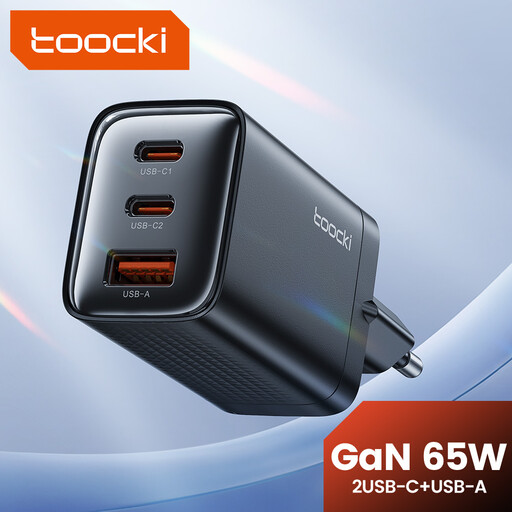
Why it's a match: The perfect ally for those who need to charge a laptop, smartphone, and earbuds all at once. With its two USB-C ports and one USB-A port, it makes the most of every power outlet, whether on a desk or in a hotel room.
Its spec sheet is transparent about power distribution depending on the ports in use, which clears up any confusion about the actual output. GaN technology allows it to remain compact despite its three outputs.
Three charging ports: Maximum flexibility to plug everything in. Port-to-size ratio: A champion of compactness thanks to GaN.
We have put together a complete and up-to-date collection of chargers that meet our demanding selection criteria and European safety standards.
No, as long as you choose a quality charger that complies with current standards. Thanks to protocols like Power Delivery, the charger and your device "communicate" to agree on the optimal charging power. A 65W charger will only deliver the 20W requested by a smartphone that cannot accept more. This means charging is as fast as possible, but always 100% safe.
The lifespan of a GaN charger is similar to that of a conventional model, which is several years under normal use. Even better, by generating less heat, GaN technology reduces thermal stress on internal components, which can potentially extend its lifespan. Ultimately, the quality of manufacturing is what will make the biggest difference.
Yes, it's essential to take full advantage of its power. For 65W charging, you must use a USB-C to USB-C cable that is certified for that wattage. These cables include an "e-marker" chip that informs the charger of their ability to handle such high power. Using a basic, non-certified cable will throttle the charging speed, even with the best charger in the world.