
Livraison le jour même ou le lendemain

Qualité garantie

Débloquez vos offres de bienvenue: Livraison GRATUITE | Jusqu'à -80 % | 30 jours d'essai gratuits à JoyPlus
Téléchargez l'application
A 60 cm cooker hood matches the width of many hobs and kitchen units in France. However, compatible width alone does not guarantee a successful installation. Misunderstood airflow rates, unsuitable filters or approximate measurements can quickly turn a bargain into an unexpected expense.
Before choosing a wall-mounted cooker hood, a 60 cm under-cabinet hood or an angled model, take the time to check the following points.
The airflow rate shown in m³/h generally refers to a measurement taken under specific conditions. Once the hood is installed with ducting, every bend, reducer or excessive length can reduce the airflow. In recirculation mode, the air must also pass through a charcoal filter, which changes how the appliance operates and requires regular maintenance.
So compare the different airflow levels available, rather than relying solely on the maximum figure highlighted in the product title.
A quiet cooker hood is not simply one with a low noise level measured at the first speed. Check the decibel figures given for each setting. An appliance rated at 63 or 64 dB at full power may remain acceptable in an enclosed kitchen, but become noticeably louder in an open-plan room.
A cooker hood with a charcoal filter requires the filters to be replaced periodically, depending on how often it is used and the recommendations in the instruction manual. With external extraction, the grease filter remains essential. A model fitted with a washable aluminium grease filter reduces the need for replacements, provided it is cleaned regularly.
A 60 cm cooker hood should be compared with the actual dimensions of the hob, unit or cabinet. Models described as measuring 60 cm sometimes have an actual width of 596 or 595 mm, making them easier to integrate. However, their depth can vary considerably.
Also check the adjustable chimney height for a 60 cm wall-mounted cooker hood. The distance between the hob and the hood must comply with the manufacturer’s recommendations, as well as the requirements associated with the type of cooking appliance. Installing the hood too high may reduce extraction efficiency.
The choice between an extraction or recirculation cooker hood depends primarily on your home:
Check whether the charcoal filter is included, available as an optional extra or linked to a specific reference.
A cooker hood with LED lighting improves visibility above the cooking area, particularly beneath a cabinet or when ambient light is limited. Mechanical push-button controls are simple and reliable, while touch controls give the front panel a sleeker appearance.
For easier maintenance, choose removable, washable metal filters. Depending on your cooking habits, cleaning every two to four weeks may be necessary. Always unplug the appliance before carrying out any work and follow the instructions in the manual.
The energy label makes it possible to compare models using a common method. A class A++ cooker hood may offer lower annual consumption, but this figure should be considered alongside the airflow rate, noise level and features you actually need.
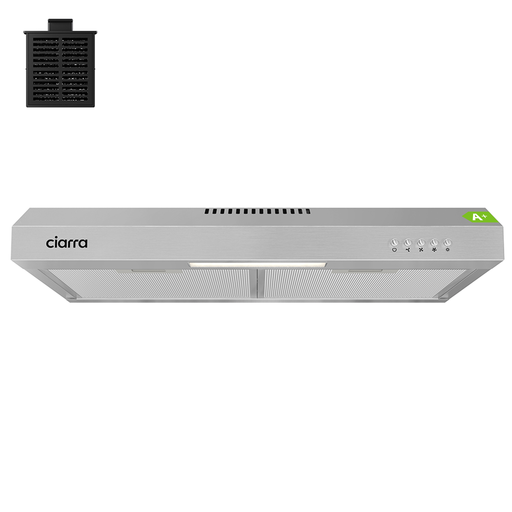
Why this choice suits this profile: measuring 596 × 440 × 85 mm, it fits easily into a small kitchen or beneath a base unit. The push buttons and integrated lighting are particularly easy to use.
It works in both extraction and recirculation modes and has two washable aluminium metal filters. However, you will need to check the availability of the CBCF009 charcoal filter to use recirculation mode.
A+ energy rating, maximum stated noise level of 61 dB and stated maximum airflow of 184 m³/h.
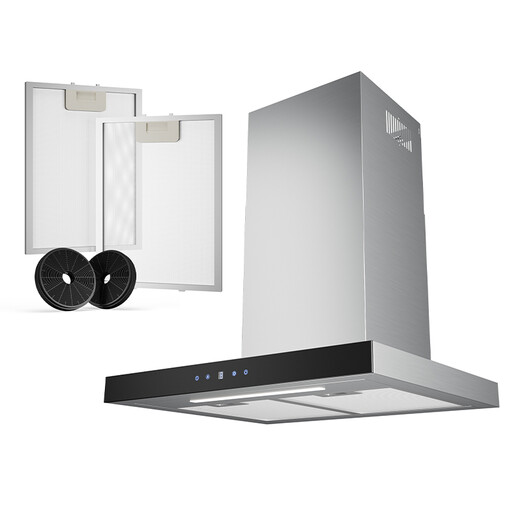
Why this choice suits this profile: its stainless steel finish, digital display and touch controls are a perfect fit for a renovated kitchen where style matters just as much as equipment.
Both ventilation modes are supported, and the kit states that a charcoal filter is included. The five-layer aluminium filter is also described as dishwasher-safe.
60 cm width, LED lighting, A++ energy rating and stated airflow of 611 m³/h.

Why this choice suits this profile: its angled front leaves more space in front of your face. It is well suited to open-plan kitchens and to people who cook frequently, switching between several power levels.
Its aluminium filter is removable and dishwasher-safe. Compatibility with both extraction and recirculation means your project is not limited to a single configuration.
Stated maximum airflow of 580 m³/h, three speeds, LED lighting and A+ energy rating.
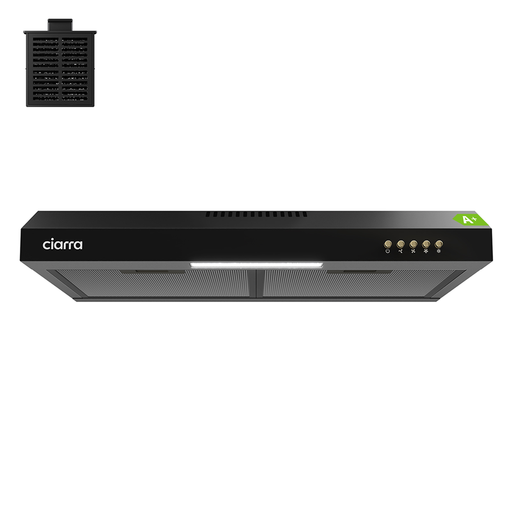
Why this choice suits this profile: its under-cabinet or wall-mounted installation and 440 mm depth make it easy to fit into a flat or a shallow kitchen.
Its two ventilation modes allow it to adapt to homes with or without external ducting. Both grease filters are washable.
A+ energy rating, maximum stated noise level of 61 dB and separate controls for ventilation and lighting.
We have brought together a complete, real-time updated selection of products that meet these demanding criteria and European safety standards.
It is suitable for hobs and cookers of a similar width, but you should also check the depth, installation height and motor position. With a wider hob, a hood of the same width may not cover the side areas as effectively.
Extraction is preferable when suitable external ducting can be installed. Recirculation is better suited to flats, rented accommodation and kitchens without an available outlet. In this case, remember to purchase and regularly replace compatible charcoal filters.
Clean the grease filter every two to four weeks, depending on how often you use the hood, wipe the surface with a soft cloth and regularly check the condition of the ducting. In recirculation mode, replace the charcoal filter in line with the manufacturer’s instructions. Regular maintenance limits grease build-up and helps the hood maintain consistent performance.