
Livraison le jour même ou le lendemain

Qualité garantie

Débloquez vos offres de bienvenue: Livraison GRATUITE | Jusqu'à -80 % | 30 jours d'essai gratuits à JoyPlus
Téléchargez l'application
Choosing a 60cm wall-mounted extractor hood?? It seems simple on the surface. In reality, it's a minefield where technical jargon and marketing hype can quickly lead to disaster?: a kitchen with lingering odours, a deafening racket, or hidden maintenance costs. Our mission?? To arm you with the knowledge to decipher product specs and make the only choice that matters?: the one that's perfectly suited to your kitchen and your daily life.
Before you pull out your credit card, here are the 3 traps to avoid at all costs?:
To avoid falling into the trap, focus on this trio of features. They, and they alone, define a hood's true performance.
These two specs are two sides of the same coin. The airflow indicates the volume of air the hood can process in one hour. To be effective, it must be proportional to the volume of your kitchen.
But be warned, high airflow is useless if the hood is deafening. The noise level in decibels (dB) is therefore just as crucial. A quiet hood worthy of the name should stay below 60 dB at full power. Above 65 dB, especially in an open-plan kitchen, the noise quickly becomes disruptive. Your quest?: to find the best power-to-silence ratio.
Here, your home makes the decision.
The good news is that most hoods today are convertible. Just check if the recirculation kit (with the famous filters) is included or, if not, that it's easy to find and reasonably priced.
The energy class (from A+++ to D) is not a gimmick?: it directly impacts your electricity bill. A model rated A (or better) is an investment that quickly pays for itself. Also, consider the lighting?: LEDs are almost essential to see what's simmering without driving up the bill. Finally, don't overlook ergonomics?: easy-to-clean touch controls or more robust push buttons? A fingerprint-resistant stainless steel finish or a designer black hood? These details shape your daily experience.
Here are a few options that meet specific needs, taking into account performance and practicality criteria.
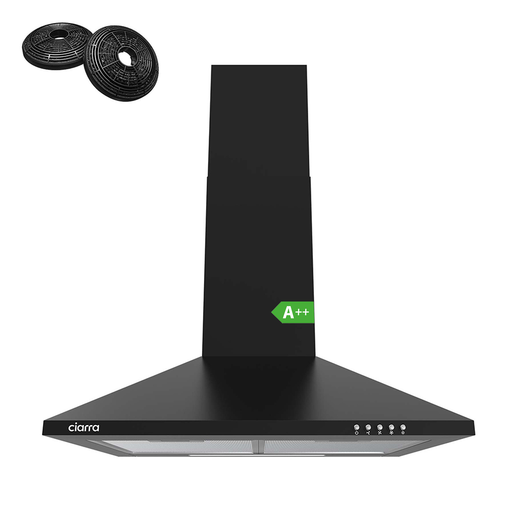
Editor's take : Perfect for a first-time installation or for replacing an old clunker. Its 367 m?/h airflow is perfectly calibrated for standard kitchens (up to 14 m?). We appreciate its push-button controls, a mark of simplicity and durability.
Thanks to its dual compatibility (ducted or recirculating), it's impossible to make a mistake when buying. Its specs are honest and consistent with its price, without any flashy marketing.
Its installation versatility and the reliability of its mechanical controls. Its excellent energy class (A++) is the icing on the cake for your wallet.
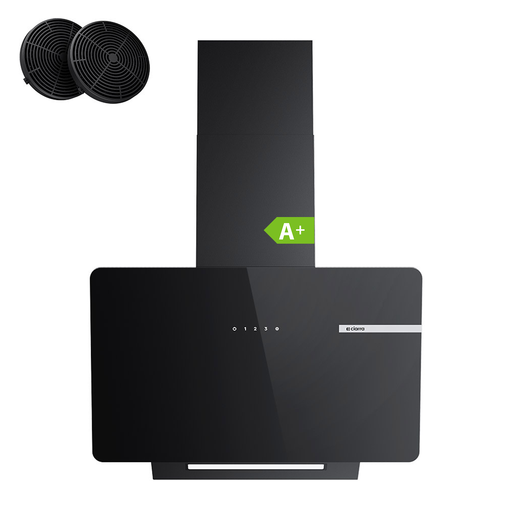
Editor's take : Its angled design and black glass front work wonders in a modern kitchen that opens into the living room. With 580 m?/h under the hood, it can handle large spaces, and its touch controls enhance its minimalist look.
This model strikes the right balance between powerful extraction and contained noise (64 dB max). No more "effective but deafening" hood dilemma. Bonus : its angled design frees up your line of sight and prevents you from bumping your head.
Its sleek aesthetic with an ultra-easy-to-clean touch panel. Its power is tailor-made for open-plan kitchens and fans of frying and grilling.
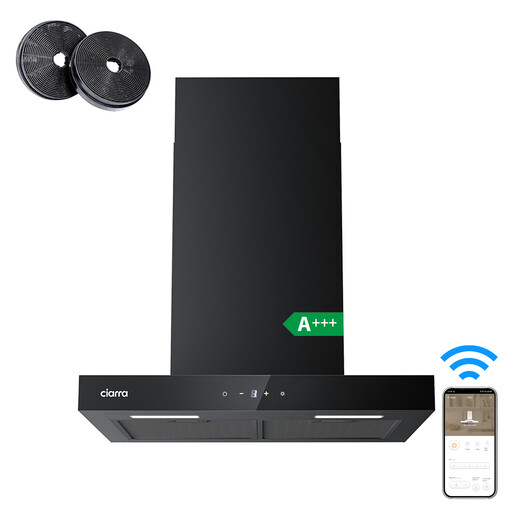
Editor's take : The model for those who want the best, without compromise. Its A+++ class makes it the king of energy savings. Its 650 m?/h airflow, with a booster mode for critical situations, leaves no chance for smoke. The Wi-Fi control via the app is the modern touch that changes everything.
It pulls off the feat of combining massive extraction power with a very low noise level (59 dB). As for its A+++ class, it's the guarantee of an electricity bill that stays in check.
Its record-breaking A+++ energy efficiency, its smart control, and its simply stunning performance-to-noise ratio.
Discover our full selection of extractor hoods that meet our criteria for performance and reliability.
The pro tip?: multiply your kitchen's volume (length x width x height) by 10. This will give you the minimum airflow (in m?/h) for effective extraction. For a 10 m? room with a 2.5 m ceiling (which is 25 m?), you'll need a hood with at least 250 m?/h.
On a recirculating hood, the charcoal filter is the key component for odour control. Its lifespan varies depending on your cooking habits, but generally, plan to replace it every 3 to 6 months for optimal efficiency. Tip?: some filters are washable and reusable, a long-term calculation worth making!
Although noise perception is subjective, there's a good benchmark. A quiet hood should not exceed 60 dB at its maximum speed. The holy grail? A model that runs below 50 dB at cruising speed, a must-have for open-plan kitchens. This is a spec you must check on the product sheet before any purchase.