
Livraison le jour même ou le lendemain

Qualité garantie

Débloquez vos offres de bienvenue: Livraison GRATUITE | Jusqu'à -80 % | 30 jours d'essai gratuits à JoyPlus
Téléchargez l'application
Choosing the right cooker hood when you don't have an external vent can often be a daunting task. Between marketing jargon and confusing spec sheets, it's easy to make a mistake. A 60 cm recirculating cooker hood is often the preferred solution for apartments or during a renovation. However, a few common pitfalls can turn this smart purchase into a real source of frustration.
To save you from disappointment, let's review the three most common mistakes that prove costly in the long run:
To make the right choice, you need to focus on pragmatic criteria—the ones that truly matter in the kitchen.
To ensure you don't go wrong, focus on these three fundamental technical aspects. They are the true measure of your future hood's performance and durability.
The principle of a recirculating hood is simple in theory: air laden with grease and odours is drawn in, passes through a grease filter (often metallic and washable), and then through a charcoal filter that neutralises odours, before being reinjected, purified, into the kitchen.
The entire effectiveness of the system depends on the quality and surface area of this crucial charcoal filter. Our advice: check its part number and availability before you buy. Standard filters are not only cheaper but also easier to find. Plan on replacing it every 3 to 6 months, depending on the intensity of your use.
Airflow, expressed in m?/h, is the crucial factor: it measures the hood's extraction capacity. For a kitchen of 10 to 20 m?, an airflow of 300 to 400 m?/h at a normal operating speed is more than sufficient. A "booster" mode reaching 650 m?/h is a real bonus for handling peaks of smoke (from frying or grilling).
But this power shouldn't come at the expense of your acoustic comfort. A truly silent hood in normal use operates at around 50-55 dB. Be wary of figures below 45 dB, which are almost always measured at the minimum speed that is rarely ever used.
The energy label is non-negotiable. Choosing an A+++ rated hood is a guarantee of real savings over the appliance's lifespan. Its annual consumption (in kWh/year) is the most reliable indicator of its efficiency.
As for "modern" features, they can genuinely simplify daily life. A touch control hood offers a sleek, easy-to-clean interface. For smart home enthusiasts, a Wi-Fi connected hood allows you to control everything from an app: adjust the power, schedule a delayed shutdown, or manage the lighting from your smartphone. Finally, design matters too: a 60 cm black hood integrates elegantly into most contemporary kitchens.
Rather than drowning you in a list of products, we've selected one model that meets our strict criteria for performance, efficiency, and practicality.
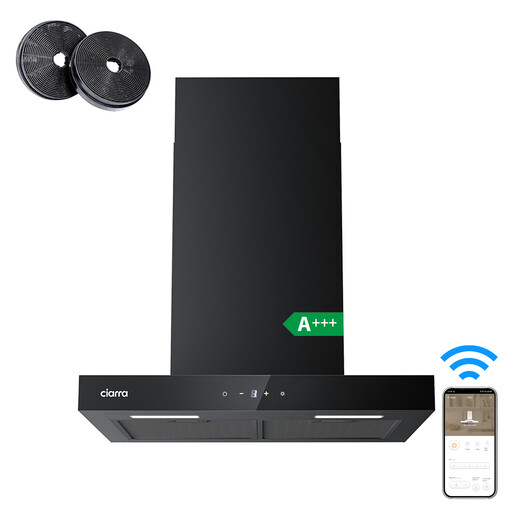
Why it stands out: This wall-mounted hood is for those who refuse to compromise on performance, energy savings, and technology. Its 60 cm size, black finish, and touch panel fit perfectly into a modern kitchen. The Wi-Fi control is a real bonus for managing ventilation remotely, even when you're not in the kitchen.
Its energy class A+++ (only 12 kWh/year) protects you from soaring electricity bills. The power levels are well-staggered, with a booster mode at 650 m?/h for intense cooking, and its charcoal filters (ref. CBCF003) are standard and therefore easy to find.
The combination of very high energy efficiency (A+++) and smart control via a Wi-Fi app—a duo rarely seen in this price range.
For a secure and durable wall-mounted installation, choosing the right fittings is crucial. Discover our selection of standard-compliant accessories.
On average, a charcoal filter should be replaced every 3 to 6 months. This frequency depends on your habits: if you frequently fry foods or cook rich sauces, a replacement every 3 months is recommended to maintain impeccable odour filtration. Some hood models even include a saturation indicator that alerts you when the filter needs to be changed.
Yes, a peak power of 650 m?/h is perfectly suitable for a kitchen that opens into a living area, as long as the kitchen space itself does not exceed 25 m?. For daily use, the lower speeds will suffice, but the "booster" function will prove invaluable for clearing out stubborn smoke and odours in an instant, preventing them from filling the entire living room.
Installing a wall-mounted kitchen hood requires some precision. First, you must securely fix its support bracket to the wall, respecting the height recommended by the manufacturer (usually between 65 and 75 cm above the hob). Be sure to use wall plugs and screws appropriate for your wall type (plasterboard, brick, concrete). Once the body of the hood is in place, all that's left is to install the filters (grease and charcoal) and plug it into a standard-compliant electrical outlet. The major advantage of a recirculating model is that the lack of an external duct significantly simplifies the operation.