
Livraison le jour même ou le lendemain

Qualité garantie

Débloquez vos offres de bienvenue: Livraison GRATUITE | Jusqu'à -80 % | 30 jours d'essai gratuits à JoyPlus
Téléchargez l'application
Choosing a 60cm cooker hood might seem trivial, but it's a purchase that dictates the comfort and cleanliness of your kitchen for years to come. The wrong choice guarantees a noisy, inefficient appliance or one that's a nightmare to clean. To ensure your investment truly simplifies your life, it's crucial to avoid the most common pitfalls.
As a product expert at Joybuy, I'll break down the mistakes to avoid and the essential criteria for making the right choice.
To avoid these traps, here are the technical points you must check to find the hood that's right for your needs.
The airflow rate measures the hood's ability to refresh the air in your kitchen. A simple rule helps estimate your needs: Kitchen Area (m?) x Ceiling Height (m) x 10 = Minimum Required Airflow (m?/h)
For a 15 m? kitchen with a 2.5 m ceiling, the calculation is: 15 x 2.5 x 10 = 375 m?/h. A model offering around 400 m?/h will therefore be more than sufficient.
However, this power shouldn't come at the expense of acoustic comfort. For a kitchen that opens into a living room, a quiet extractor hood is essential. A noise level below 65 decibels (dB) at maximum speed is a good benchmark for maintaining a pleasant atmosphere.
This is the most critical factor, as it depends entirely on your home's layout.
The standard 60cm width fits most hobs. The choice then comes down to style:
To put theory into practice, we've analysed several models based on typical user profiles.
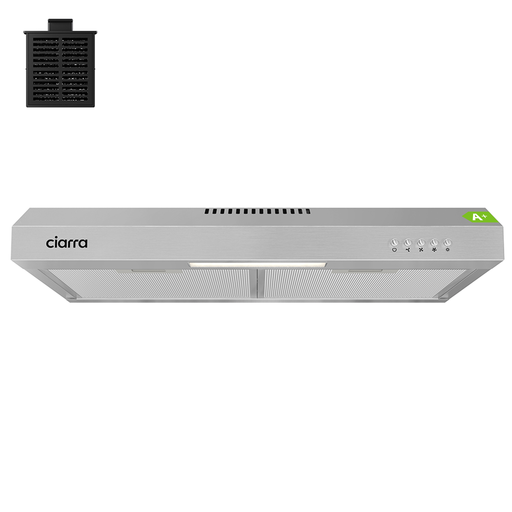
Why it's a match: Perfect for studios, apartments, or kitchens where every centimetre counts. Its ultra-slim design fits neatly under a wall unit, freeing up visual space while ensuring effective ventilation for everyday cooking.
This model avoids the trap of unnecessary power with an airflow rate suited for smaller rooms. It is natively convertible (ducted/recirculation), which eliminates any installation surprises.
A+ energy rating and simple, durable push-button controls. Its aluminium grease filters are washable, which greatly simplifies maintenance.
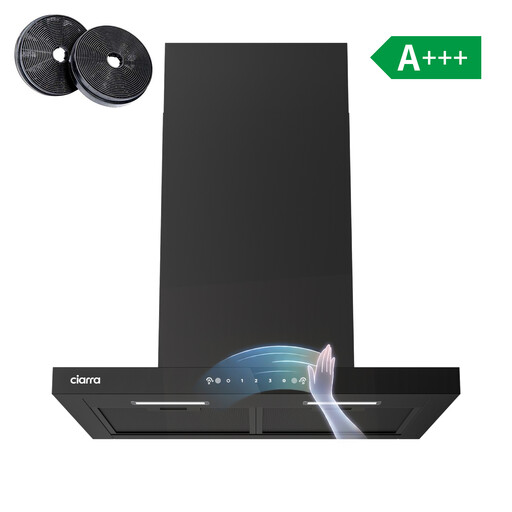
Why it's a match: For those who seek performance without compromising on aesthetics. Its 40mm ultra-slim black glass panel and touch or gesture controls integrate seamlessly into a sleek, modern kitchen that opens into a living area.
It successfully balances a high extraction rate (650 m?/h) with a controlled noise level (59 dB), thus avoiding the "deafening hood" trap. Its smooth glass surface and touchless controls make cleaning effortless.
A+++ energy rating for minimal consumption. The "Wave Control" gesture feature allows you to operate it with a simple hand movement—a function that's as practical as it is hygienic.
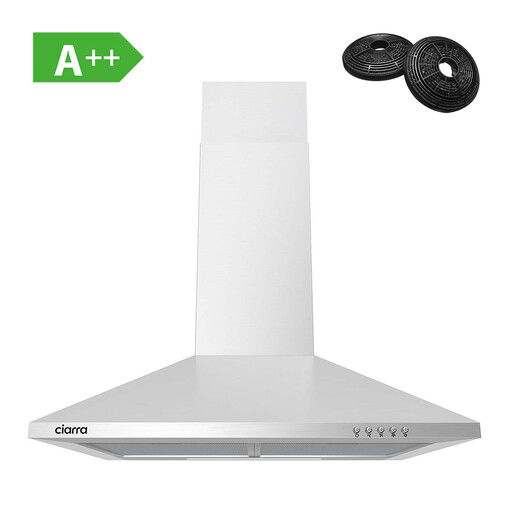
Why it's a match: This is the sensible choice for those who want an effective, durable, and no-frills 60cm wall-mounted hood. Its classic stainless steel design fits into most kitchens, and its mechanical controls are built to last.
It offers an excellent balance with a 367 m?/h airflow rate, sufficient for a standard-sized kitchen without being overly noisy. Convertible and equipped with washable filters, it checks all the boxes for a practical and reliable model.
An excellent energy performance (A++ Class) for a model in this range. Its ease of use and robust construction make it a safe bet.
Explore our full selection of models that meet our quality standards and current safety regulations.
1. What airflow rate (m?/h) is recommended for a 60cm hood? The power doesn't depend on the hood's width, but on your kitchen's volume. Use the formula: (Area in m? x Height in m) x 10. For a standard 12 m? kitchen, an airflow rate of around 300 m?/h is a good starting point. Increase this figure if your kitchen is open-plan or if you often cook fried foods or dishes that generate a lot of steam.
2. How often should you change the charcoal filter on a recirculation hood? For a recirculation cooker hood, the charcoal filter is essential for neutralising odours. Its lifespan depends on how often you use it. On average, it's advisable to replace it every 3 to 6 months. Some newer charcoal filters are washable and reusable, which represents a significant long-term saving.
3. Is a recirculation hood really effective? A ducted hood is technically more efficient at removing moisture. However, a high-quality ductless cooker hood, equipped with clean grease filters and an effective activated charcoal filter, delivers excellent results in eliminating grease and cooking odours. It is a perfectly functional and very common solution, especially in apartments.