
Livraison le jour même ou le lendemain

Qualité garantie

Débloquez vos offres de bienvenue: Livraison GRATUITE | Jusqu'à -80 % | 30 jours d'essai gratuits à JoyPlus
Téléchargez l'application
A 5 × 5 squared notebook is suitable for a wide range of uses: taking notes, creating tables, plans, diagrams or a bullet journal. But not all models are equal. The format, paper weight, binding, perforations and build quality all have a direct impact on ease of use.
Before buying, three common pitfalls are worth keeping in mind. A fine grid does not necessarily mean greater precision if the lines are too faint or irregular. A hard cover may appear more durable, but can prove bulky in a bag. As for the number of pages, it does not guarantee that the paper will suit your pen or markers.
Here are the main criteria to consider when choosing a small-grid notebook for everyday use in France.
The format determines both how much information you can organise and how easy the notebook is to carry.
Also consider the orientation of the binding. A side binding is well suited to conventional note-taking. A top binding can be more convenient when writing with one hand or taking notes on the move.
Expressed in g/m², paper weight indicates the weight of the paper and gives you an initial idea of its sturdiness. Paper weighing 70 to 80 g/m² is generally suitable for pencils and ballpoint pens. At 90 g/m², the sheet feels more substantial and often offers a smoother surface.
The 90 g/m² Clairefontaine Velin Velouté paper used in some models is described by the manufacturer as smooth. This surface can be pleasant to use with a fountain pen, rollerball or pencil. However, the result always depends on the type of ink and the amount applied.
For a notebook intended for drawing, check whether the pages are squared or blank. A squared notepad helps structure a technical sketch, while white paper leaves you more freedom for illustrations.
The binding affects how well the notebook stays open, as well as whether the sheets can be archived.
The 5 × 5 mm purple grid is common on Rhodia pads. It is suitable for tables, plans and structured drawings. For personal note-taking, however, some people may prefer more discreet lines.

Why this choice suits this type of user : This pack of four A7 notebooks lets you separate subjects, lists or projects without having to buy several different products. Their compact size slips easily into a pocket or small bag.
The pack means you do not have to rely on a single notebook that may be too small for every purpose. The top spiral binding also makes writing on the move easier.
A7 format, four notebooks, 50 sheets per notebook and flexible covers in coordinating colours.
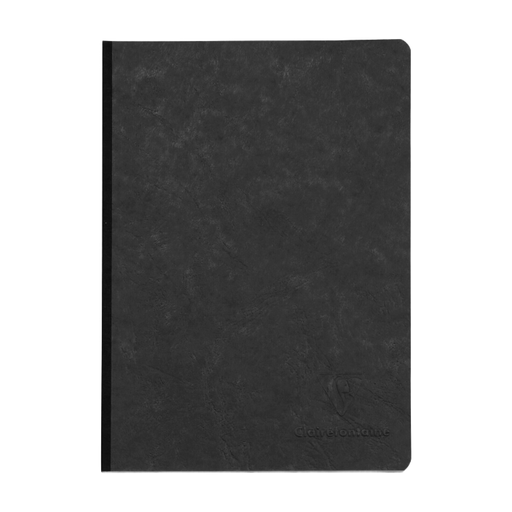
Why this choice suits this type of user : Made in France, this notebook combines an A5 format, a cover that is coloured throughout and 192 pages of 90 g/m² Clairefontaine paper. It is suitable for journalling, professional notes and everyday sketches.
The lay-flat opening minimises discomfort at the centre of the notebook. The paper weight is clearly stated, making it easier to choose according to the writing instruments you use.
A5 format, 192 pages, 90 g/m² paper, 5 × 5 grid and PEFC certification stated by the manufacturer.
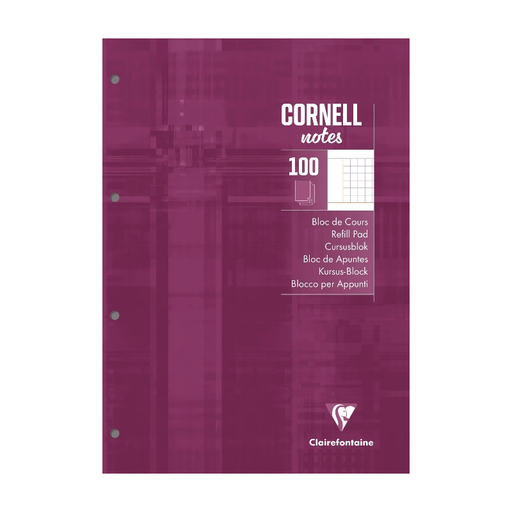
Why this choice suits this type of user : Its A4 format and 200 pages are ideal for students, engineers and professionals who accumulate detailed notes. The sheets can then be torn out and filed.
The laminated cover and rigid cardboard backing are well suited to use on the move. The micro-perforated sheets and four holes allow you to keep notes securely in a ring binder over the long term.
A4 format, 90 g/m² Clairefontaine paper, 200 detachable pages and organisation inspired by the Cornell method.
For large diagrams, the Rhodia N° 18 A4 offers 80 micro-perforated sheets with a 5 × 5 mm grid, plus a rigid cardboard backing. The N° 20 model adds four-hole perforation, which is useful for filing documents in a folder or ring binder.
If you are looking for a blank surface for drawing, the Clairefontaine Zap Book R.I. A4 offers 160 sheets of 80 g/m² recycled paper without a grid, with a spiral binding that allows it to open flat. For a more structured drawing notebook, choose a squared model and check that it is compatible with your felt-tip pens.
Journalling enthusiasts can also consider a Moleskine notebook with a dotted or squared grid. Hard-cover models typically feature an elastic closure, a bookmark and an inner pocket. However, their advertised 70 g/m² paper is better suited to pens and pencils than to heavily saturated inks.
We have put together a complete, real-time updated list of products that meet these demanding selection criteria and European safety regulations.
It helps you align your writing, size tables, draw graphs and organise diagrams. It is also suitable for bullet journalling if you want to structure your pages without reaching for a ruler.
The A5 format is easy to carry and suitable for everyday notes. For lessons involving lots of calculations, maps or detailed diagrams, an A4 squared notebook provides a more comfortable working area.
Store it away from moisture and direct sunlight. Avoid overfilling the inner pocket and choose a binding suited to how often you open the notebook. For sheets you want to keep, choose a perforated notepad or a four-hole model so that you can file them in a folder or ring binder.