
Livraison le jour même ou le lendemain

Qualité garantie

Débloquez vos offres de bienvenue: Livraison GRATUITE | Jusqu'à -80 % | 30 jours d'essai gratuits à JoyPlus
Téléchargez l'application
A cluttered garage, poorly organised cellar or workshop overrun with boxes can quickly become difficult to use when everything ends up on the floor. A 5-tier metal storage shelving unit helps you reclaim space, but not all models are created equal or designed for the same needs.
Before placing your order, three common mistakes are worth avoiding:
For heavy-duty garage shelving, the load supported by each shelf is more useful than the total capacity shown. A model with five tiers rated at 175 kg per tier therefore has a stated total static load of 875 kg. This figure assumes an evenly distributed load and a correctly assembled structure : it does not refer to weight concentrated at a single point.
Before storing paint tins, machinery or boxes, check the following:
A heavy-duty shelving unit is only useful if its capacity genuinely suits your intended use. In a warehouse or professional workshop, also consider how often items will be handled and the weight of the largest objects.
Powder-coated steel is a common choice for storage intended for garages, sheds and workshops. It provides a structure suited to storage, while medium-density fibreboard shelves — or MDF — offer a flat surface for boxes and equipment.
An adjustable steel shelving unit offers greater flexibility when items are different heights. Repositionable tiers allow you, for example, to reserve one space for bulky crates and another for small tools. Also examine the reinforcing crossbars : they help maintain the rigidity of each tier as the load increases.
Measure the intended location precisely, taking skirting boards, pipes, doors and the space needed to move around the unit into account. A 90 cm-wide shelving unit does not only require 90 cm of clear space : also allow enough room to assemble it and access its contents easily.
A boltless, slot-together system can speed up assembly, but the instructions must be followed to the letter. Wear protective gloves and check that every component is properly engaged. For a shelving unit with an anti-tip kit, the wall fixing must be carried out using plugs compatible with the type of wall. The supplied kit does not remove the need to choose suitable fixings.
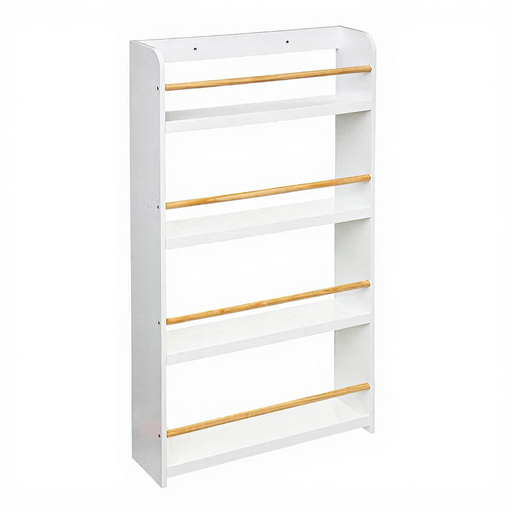
Why this choice suits this profile : For storing lightweight items in a bedroom, home office or reading corner, this compact unit is an affordable solution. However, it is not intended to replace a genuine metal garage shelving unit.
Its stated maximum load of 12 kg per shelf clearly defines its limits and prevents it from being chosen for heavy equipment.
Four tiers, dimensions of 55 × 15 × 112 cm, and a wooden and fibreboard design for light indoor use.
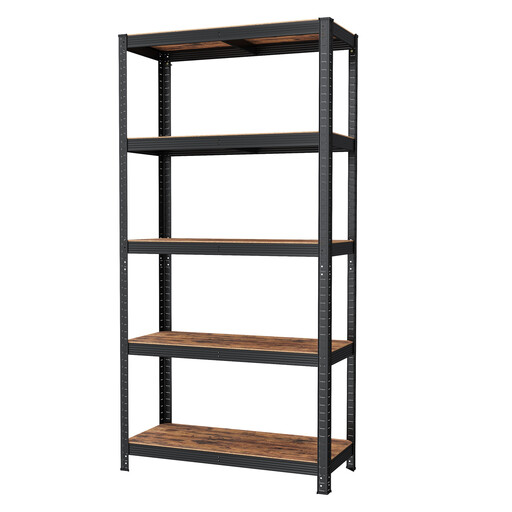
Why this choice suits this profile : This format is ideal for anyone looking to organise a garage or shed with five adjustable tiers and a stated total capacity of 875 kg.
The product details clearly distinguish the 175 kg per tier from the total 875 kg capacity, making it easier to compare with the weight of your equipment.
Dimensions of 40 × 90 × 180 cm, powder-coated steel structure, adjustable tiers, the option to convert it into two units and an anti-tip kit included.
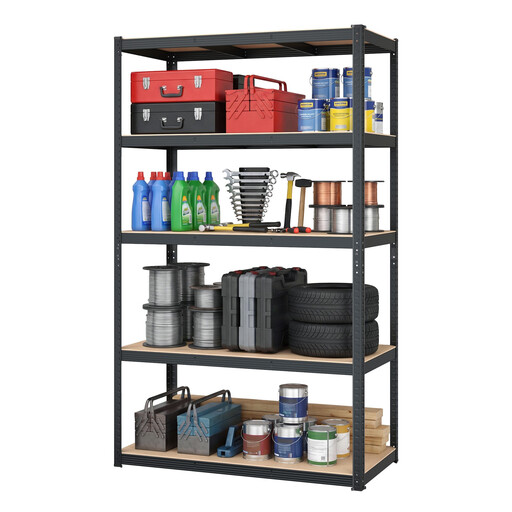
Why this choice suits this profile : With a floor footprint of 120 × 60 cm and a height of 200 cm, this model is designed for workshops, cellars, sheds and storage areas with plenty of available space.
The reinforced crossbars, adjustable tiers and anti-tip kit are suited to storage that is accessed regularly, provided the load is evenly distributed.
Stated total capacity of 750 kg, or 150 kg per tier, dimensions of 200 × 120 × 60 cm and the option to separate the structure into two units.
We have put together a comprehensive, real-time updated selection of products that meet these demanding selection criteria and European safety standards.
For a workshop shelving unit or warehouse racking, place the heaviest items on the lower tiers first. Keep the top shelves for lightweight items that are used less often. This arrangement reduces the risk of imbalance and makes handling safer.
Also check the following:
A 750 kg or 875 kg storage shelving unit does not consume electricity : its running costs therefore depend mainly on the space it occupies, maintenance and the service life of its components. Avoid corrosive products and persistent damp, particularly in a cellar, to help protect the steel and MDF panels.
Use the supplied kit if the model includes one, then choose wall plugs suitable for the surface : concrete, brick, breeze block or partition wall. Secure the unit after checking that the structure is vertical and before loading it.
Follow the maximum load specified by the manufacturer and distribute items across the entire surface. For the models featured here, the stated figures are 150 kg or 175 kg per tier, based on an evenly distributed static load. They do not allow the entire weight to be concentrated in a small area.
It can be used in a cellar, shed or garage, but damp accelerates material deterioration. Allow air to circulate, avoid direct contact with a wet floor and regularly inspect the metal surfaces and MDF panels.