
Livraison le jour même ou le lendemain

Qualité garantie
Téléchargez l'application
Catégories
Choosing a new 55-inch 4K Smart TV can quickly become overwhelming. Between technical acronyms, marketing promises, and the sheer number of models, it's easy to feel lost. The 55-inch size (approximately 140 cm) has become a standard for many living rooms, offering a great balance between immersion and footprint. Our goal is to provide clear guidance to help you make an informed decision that aligns with your actual needs and budget.
Before diving into our selection, here are a few key points to consider to guide your decision.
The panel type is the biggest factor influencing image quality.
If you're a gamer with a new-generation console (PlayStation 5 or Xbox Series X), the presence of HDMI 2.1 TV ports is an important factor. This standard allows you to display games in 4K at 120 frames per second (120Hz), offering superior fluidity and responsiveness. For use primarily focused on streaming and television, HDMI 2.0 ports are sufficient.
Since 2021, the EU has implemented a new, more stringent energy label. It ranges from A (very efficient) to G (inefficient) and indicates consumption in standard (SDR) and HDR modes. A TV rated F or G isn't necessarily a bad product, but its power consumption will be higher. This is an objective piece of information to consider in the total cost of ownership of your smart TV.
Here are three models that cater to different needs and budgets, selected for their technical specifications and market positioning.
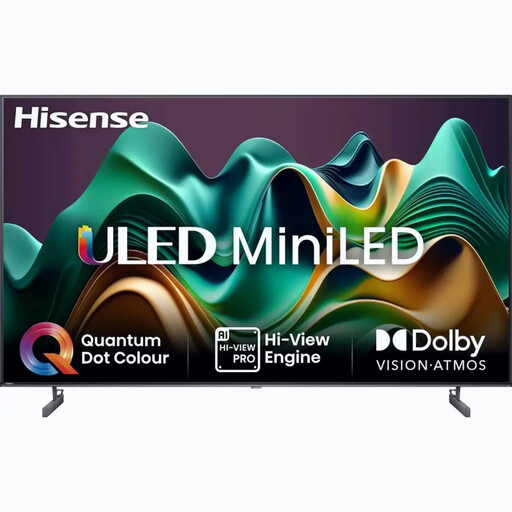
Why We Recommend It The Hisense 55U6NQ makes Mini LED technology more accessible. With over 200 backlighting zones, it delivers a peak brightness and contrast level that traditional LED TVs struggle to match. Support for Dolby Vision TV and Dolby Atmos makes it a strong contender for film and series enthusiasts looking for an immersive audiovisual experience without breaking the bank.
Pros
Who is this product for? For families and cinephiles who want to upgrade to superior picture quality over standard LED, enjoying the benefits of Mini LED at a reasonable price point.
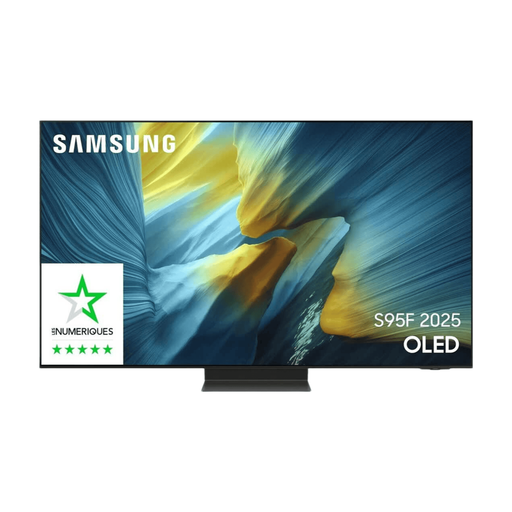
Why We Recommend It This Samsung model combines QD-OLED technology, which blends the perfect blacks of OLED with the color richness of Quantum Dots, with cutting-edge gaming features. Its Neural Quantum Processor 4K uses artificial intelligence to optimize picture and sound scene by scene. For gamers, the high native refresh rate and 4K 120Hz gaming TV compatibility (and higher) make it a top-tier choice.
Pros
Who is this product for? For demanding gamers and cinema enthusiasts who seek top-tier image performance and refuse to compromise on fluidity and visual quality.
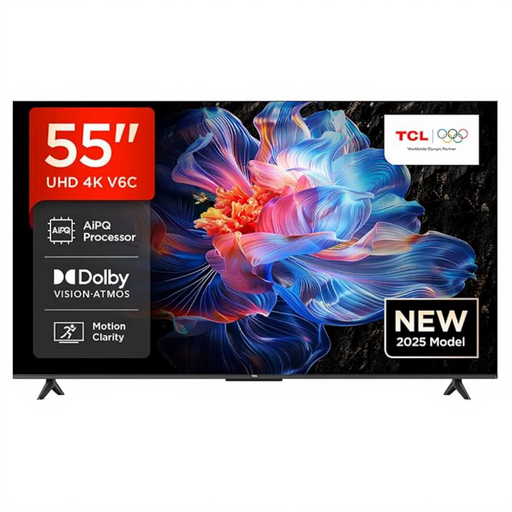
Why We Recommend It The TCL 55V6C is a well-equipped smart TV that focuses on the essentials. It features the Google TV operating system, known for its intuitive interface and vast app library. Compatibility with HDR10+ and Dolby Vision formats ensures an optimized picture with compatible content. It's a complete and accessible solution for enjoying all modern streaming services.
Pros
Who is this product for? For users seeking a reliable, easy-to-use, and versatile 55-inch 4K Smart TV for daily use centered on streaming (Netflix, YouTube, Disney+), without neglecting essential features for movies and casual gaming.
This selection represents three distinct user profiles. The TV market is vast, and your needs may be different: another screen size, a specific technology, or a different price range.
To explore a wider range of models selected for their features and feature-to-price ratio, check out our Ultra Smart Television category.
The main difference lies in light management. An OLED TV has self-emissive pixels that turn on and off individually, allowing for perfect blacks and infinite contrast. A Mini LED TV is an LCD TV that uses a backlight made of thousands of mini-diodes. These are grouped into zones that can be managed independently, offering much better contrast than traditional LED TVs, but without achieving the absolute black of OLED. On the other hand, Mini LED TVs can often reach higher peak brightness levels.
It depends on your use case. If you are a gamer on a PS5, Xbox Series X, or a powerful PC and want to play in 4K at 120 frames per second (120Hz), then yes, HDMI 2.1 is essential. For watching movies, streaming series, or broadcast TV, HDMI 2.0 ports are more than sufficient for delivering a 4K signal at 60Hz.
For an immersive experience with a 55-inch 4K TV, the ideal viewing distance is typically between 1.7 and 2.5 meters (5.5 to 8.2 feet). At this distance, you can fully appreciate the 4K resolution without perceiving individual pixels, while also having a well-filled field of view.