
Livraison le jour même ou le lendemain

Qualité garantie

Débloquez vos offres de bienvenue: Livraison GRATUITE | Jusqu'à -80 % | 30 jours d'essai gratuits à JoyPlus
Téléchargez l'application
A 5-in-1 hot air brush multi-styler can replace several appliances: a hairdryer, a straightening brush, a volumising brush, a curler and a drying nozzle. On paper, the promise is certainly appealing, especially when mornings are tight or the bathroom is short on space. In reality, not all models are created equal, and they don't all suit the same needs.
Before you reach for your card, it's worth sifting through the marketing claims to focus on the features that really matter: airflow power, available settings, included attachments, use on wet or dry hair, and ease of maintenance.
An appliance marketed as "7-in-1" doesn't necessarily offer seven different uses. Some attachments perform a similar function, while others only suit a specific hair length or texture. Look closely at the list: does it include a diffuser for curly hair, a round brush for volume, a straightening brush, or two curling attachments that let you curl sections to the left and right?
A high-speed brushless motor advertised at 110,000 or 130,000 rpm can generate a strong airflow, but this figure alone won't predict performance. The diameter of the air outlet, the wattage, the noise level and the temperature settings all play a decisive role. On thick hair, a powerful flow speeds up pre-drying. On fine hair, a low temperature and moderate airflow are generally easier to control.
Some models sold in Europe come with a British plug or operate under specific voltage conditions. An adaptor doesn't let you skip checking the appliance's electrical compatibility. Also remember to check the cord length, whether it has a 360° swivel joint, how accessible the filter is, and whether there's overheat protection. A blocked filter reduces airflow and puts extra strain on the motor.
For an appliance that combines drying and styling, the power needs to match your intended use. Models between 1,000 and 1,650 W generally suit a variety of routines. By contrast, a 68 W thermal brush, like the Wavytalk Thermal Brush, isn't designed to dry wet hair.
Look for:
Claims of "four times faster drying" or "halving your time" should be taken for what they are: marketing arguments that vary depending on hair length, density and moisture level.
Anti-frizz ionic technology aims to reduce static electricity, following the principle promoted by manufacturers. It can be useful on hair that tends to puff up or frizz, but it doesn't replace the right temperature or good preparation.
Coanda technology, found on some automatic curling attachments, uses the airflow to draw the section of hair around the barrel. It simplifies the technique, especially for beginners, but how well the curls hold still depends on section size, residual moisture and cooling time.
A hot air brush should be used according to the instructions in its manual. Some appliances are designed for towel-dried hair, others only for completely dry hair. A heated brush, like the Wavytalk Thermal Brush, is not a hot air brush: it should not be used to dry wet hair.
A ceramic or tourmaline surface can help distribute heat more evenly. That doesn't make the appliance harmless, though. Use a suitable heat protectant, work in small sections and avoid leaving the hot attachment in one spot.
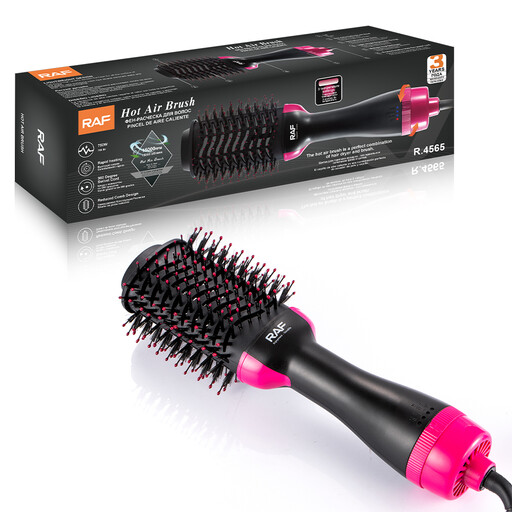
Why this choice suits this profile: This hot air brush combines drying and styling so you can easily achieve a blow-dry look without cluttering your space with multiple appliances.
Its features are clearly designed for blow-drying: a 750 W motor, ceramic coating and a swivel cord. It doesn't claim to replace a full set of curlers.
A compact design, a 360° swivel cord and nylon bristles. The manufacturer offers a three-year warranty.
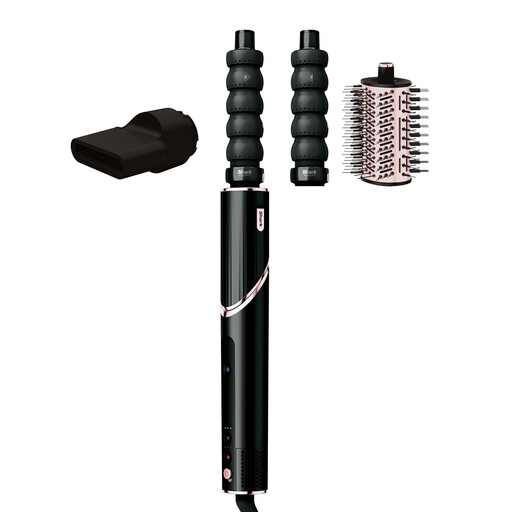
Why this choice suits this profile: Its convertible handle and automatic curling attachments are ideal for those who switch between drying, volume and curls.
The listing presents it as a 3-in-1 appliance and details its attachments: two Auto-Wrap barrels, an oval brush and a concentrator.
A stated power of 1,650 W, a weight of 700 g and heat regulation controlled by the manufacturer.
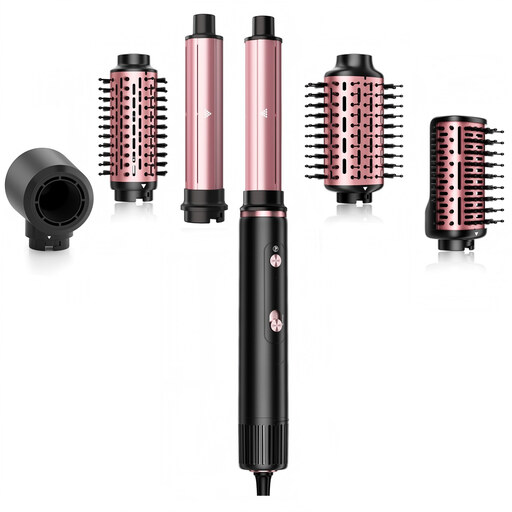
Why this choice suits this profile: People who regularly style thick hair or multiple hair types should appreciate its five functions and independent settings.
The listing mentions three temperatures and three airflow levels, plus overheat protection. This information is more meaningful than a simple promise of speed.
A brushless motor rated at 110,000 rpm, two automatic curling attachments and a swivel cord.
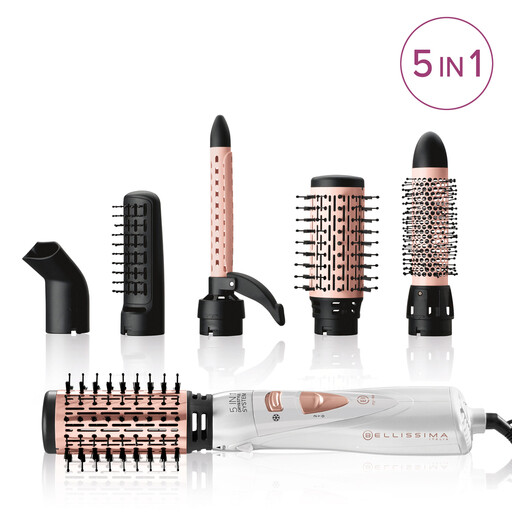
Why this choice suits this profile: Its five attachments cover targeted drying, straightening, volume, waves and defined curls.
The listing states it is designed for towel-dried hair and offers only two temperatures and two speeds: a clear setup with no gimmicky settings.
A power of 1,000 W, a ceramic coating, a cool shot button and a two-year manufacturer's warranty.
We've put together a comprehensive, real-time selection of products that meet these demanding criteria and comply with European safety standards.
For quick styling at home, start by towel-drying your hair, then detangle it and separate it into sections. First set the appliance to the lowest temperature suitable for your hair type. Fine or damaged hair generally needs more care than thick hair.
A few simple habits will help you avoid unpleasant surprises:
It depends on the model. A hot air brush or multi-styler designed for towel-dried hair can be used during pre-drying. A standard heated brush should generally be used on dry hair. If in doubt, the product manual is your best guide.
Start with the lowest setting, work on small sections and avoid repeated passes. Appliances offering three to six temperature levels let you adjust the heat more gradually. A heat protectant can complement your routine, but it won't eliminate the risks associated with heat.
Power consumption depends mainly on the wattage and how long you use the appliance, not just the number of revolutions per minute. Before you choose, compare the stated power, the estimated drying time and how often you plan to use the appliance.