
Livraison le jour même ou le lendemain

Qualité garantie

Débloquez vos offres de bienvenue: Livraison GRATUITE | Jusqu'à -80 % | 30 jours d'essai gratuits à JoyPlus
Téléchargez l'application
Securing your home or business premises shouldn't be a headache. Between wiring constraints, monthly subscriptions, and sometimes disappointing image quality, choosing a surveillance system can quickly become a daunting task. The 4K wireless solar outdoor security camera stands out as the ultimate modern solution, combining high definition, energy independence, and simplified installation.
This guide is designed to help you navigate the multitude of options available. We'll break down the essential criteria to consider before you buy, and then present a selection of models suited for every need, from monitoring a simple garden to securing a completely remote location.
Before you make a decision, let's review the features that will truly make a difference in your day-to-day use.
Image quality is the name of the game. A 4K (3840 x 2160 pixels) image offers four times the detail of Full HD (1080p). In practical terms, this allows you to zoom in on an area of the image without losing clarity—essential for identifying a face or reading a license plate.
Paired with 4K, colour night vision is a game-changer. Gone are the grainy, monochrome infrared images! This technology relies on more sensitive sensors, often assisted by a small spotlight, to capture scenes in full colour even in complete darkness. The increase in visual information is significant in the event of an incident.
Their main advantage is, of course, their wireless operation. Most models connect to your Wi-Fi network, which is perfect for a standard home setup. The top-performing models are dual-band compatible (2.4 GHz and 5 GHz) for a more stable and faster connection.
For locations without a fixed internet connection (second homes, construction sites, warehouses, agricultural land), a 4G solar camera is the perfect solution. It uses a SIM card, much like a smartphone, to transmit footage over the mobile network.
Finally, a motorised 360° outdoor camera vastly expands your surveillance capabilities. Controllable remotely via an app, it can scan a wide area and eliminate blind spots, potentially replacing several fixed cameras.
Video storage is a crucial point that often determines the long-term cost of your setup. Two main options exist:
A good solar surveillance kit will often offer both, giving you the choice based on your budget and security requirements.
Now for our selection of models that stand out from the crowd, each tailored to specific needs.
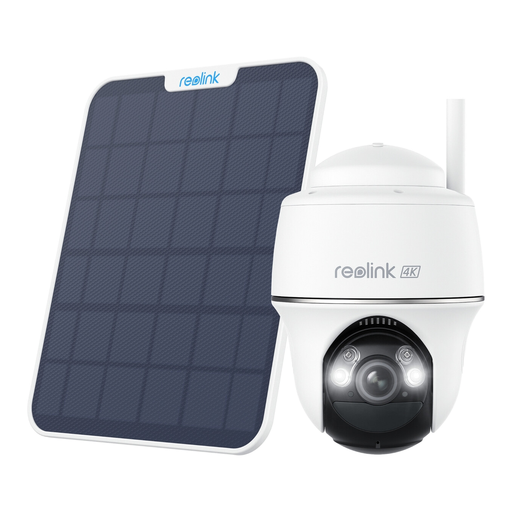
Why we chose it
The REOLINK B440 kit is an excellent all-rounder, combining very high-quality imaging with great flexibility in installation and use. Its 355° motorised camera allows it to cover a wide perimeter, while its dual-band Wi-Fi connectivity ensures a stable connection. It's the sensible choice for anyone looking for comprehensive and smart surveillance.
Key features
Who is this model for?
Ideal for homeowners who want to cover a large area (garden, yard, car park) with a single high-performance, remotely controlled camera.
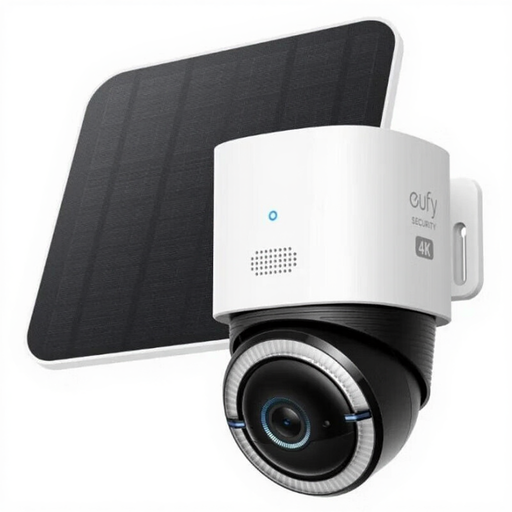
Why we chose it
This eufy camera's standout feature? It meets a very specific need: high-definition surveillance in Wi-Fi dead zones. Its dual 4G and Wi-Fi connectivity gives it impressive versatility. The included SIM card automatically switches to the best available mobile network, ensuring reliable video transmission under all circumstances.
Key features
Who is this model for?
For anyone needing to secure a location without reliable Wi-Fi: a construction site, farm, country house, or even a docked boat.
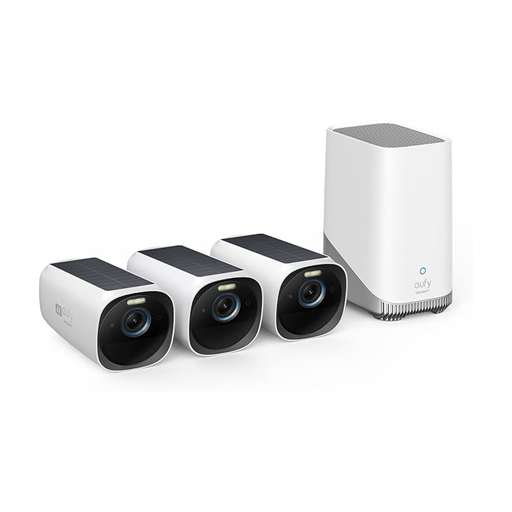
Why we chose it
The eufyCam 3 kit isn't just a camera; it's a complete and expandable security ecosystem. It consists of several 4K cameras with integrated solar panels and a central station, the HomeBase 3. This base is the brain of the system: it houses the facial recognition AI (BionicMind) and, most importantly, allows for local storage expansion up to 16 TB with a simple hard drive. It's the perfect solution for those who want to avoid cloud subscriptions and maintain full control over their data.
Key features
Who is this model for?
For those who want to build a comprehensive security system for their primary residence, featuring cutting-edge AI and total control over their data—all without a subscription.
The security camera market is booming, and many other models might perfectly meet your needs. If our selection doesn't check all your boxes, feel free to explore other possibilities.
? Explore our full range of solar-powered outdoor Wi-Fi cameras to discover other configurations and features.
1. What is the real-world battery life of a solar camera in winter?
Battery life depends on a trio of factors: the battery's capacity, the solar panel's efficiency, and the frequency of motion detection. Naturally, limited sunlight in winter can reduce battery life. However, modern models are equipped with high-capacity batteries and panels designed to scavenge energy even on overcast days. For very heavy usage, a manual USB charge once or twice during the winter might be necessary.
2. Does a 4K camera use more data than an HD camera?
Absolutely. A 4K video stream is much larger than a 1080p stream. It therefore consumes more bandwidth for live viewing and more data for cloud uploads. In the case of a 4G solar camera, choosing a suitable data plan is crucial. Fortunately, most cameras only record and transmit when motion is detected, which significantly limits data consumption. Apps also allow you to switch to a lower-quality stream (a "fluent" or "SD" mode) for live viewing to conserve your data allowance.
3. Is the installation of an outdoor security camera subject to regulations?
Yes, and regulations can be strict. Generally, you are permitted to film within the boundaries of your own property (your house, garden, private driveway), but it is often illegal to film public spaces or your neighbours' property. If your camera could, even accidentally, capture part of a public area, you may be required to inform people with visible signage. Violating privacy laws can carry heavy penalties. As laws vary significantly by country and region, we strongly recommend consulting your local government or data protection authority's website for detailed rules.