
Livraison le jour même ou le lendemain

Qualité garantie

Débloquez vos offres de bienvenue: Livraison GRATUITE | Jusqu'à -80 % | 30 jours d'essai gratuits à JoyPlus
Téléchargez l'application
By the Joybuy editorial team, August 26, 2026
Shooting perfectly smooth and stable video is the ultimate challenge for content creators, vloggers, and travellers alike. If your smartphone or camera produces shaky, amateur-looking footage, you've probably considered investing in a 4K gimbal camera. The only problem? The market is flooded with marketing promises that can easily lead to buyer's remorse. Before taking the plunge, it's crucial to understand the common pitfalls that cost unwary buyers dearly.
To make the right choice, focus on these few non-negotiable technical specifications. They are what will make your 4K pocket camera a creative ally or a source of frustration.
For a vlogging or travel camera, smoothness is king. A mechanical 3-axis stabiliser is the only way to get perfectly fluid camera movements, whether you're walking, running, or filming from a vehicle. It compensates for tilt, pan, and roll in real-time—a performance that no electronic stabilisation can hope to match without degrading the image.
Don't be fooled by resolution alone. A large sensor, like a 1-inch CMOS model, captures significantly more light. In practical terms, this translates to:
This is the number one criterion for any content creator who is serious about image quality.
A good camera is more than just a sensor in a box. Look for features that will make your life easier in the field. A high-performance subject-tracking system, like ActiveTrack 6.0 technology, keeps a person or object perfectly sharp and centred in the frame, even when moving. Also consider the audio side (mic input, integrated wireless module) and standard mounts (like the 1/4-inch thread) to mount the camera on a tripod or other supports.
Rather than an endless list, here is our targeted selection, with a model for every need.
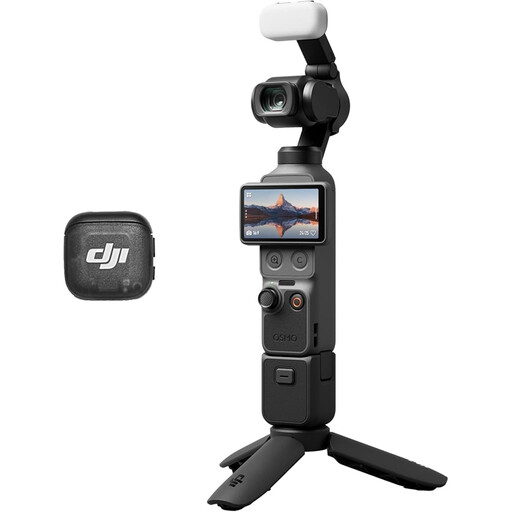
Why we chose it: This is the ultimate all-in-one package for vlogging. It includes not only the camera with its 1-inch sensor and mechanical stabilisation, but also a DJI Mic 2 transmitter for flawless wireless audio, a battery handle, and a mini tripod.
It directly solves the problem of an incomplete ecosystem by including essential audio and mounting accessories. The value for money is much better than buying everything separately.
The combination of a 1-inch sensor, 3-axis stabilisation, and an integrated wireless audio solution in such a compact form factor is a compelling argument for demanding creators.
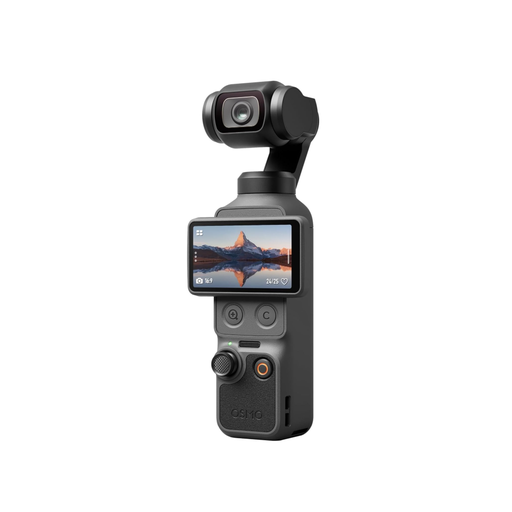
Why we chose it: For those who want to travel light without any compromise on image quality. This standard version offers the same image quality and stabilisation as the Creator Combo, but in an even more minimalist package. It's the perfect tool for capturing travel memories with cinematic quality.
It makes no compromises on the essentials: true mechanical 3-axis stabilisation that leaves the electronic stabilisation of smartphones or compact action cameras in the dust.
Its extreme portability. It slips into a pocket while offering 4K image quality and stabilisation that, until now, required heavy and bulky equipment.
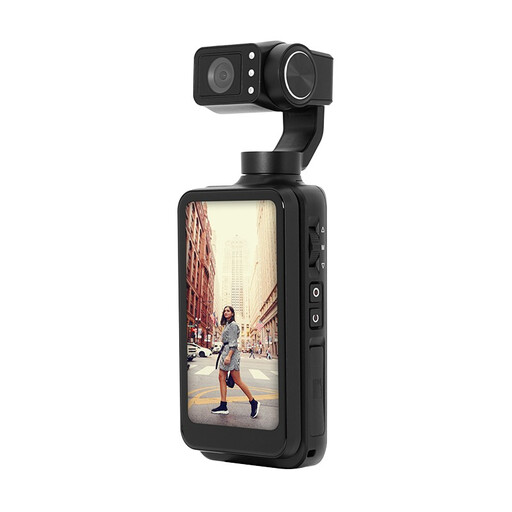
Why we chose it: This camera is aimed at users who prefer a large built-in screen to frame their shots. Its 3.5-inch rotating touchscreen offers superior viewing comfort, a real plus for those who don't like relying on their smartphone.
It includes a true 3-axis mechanical gimbal, thus avoiding the trap of purely electronic stabilisation. It's an all-in-one solution that doesn't depend on an external screen for framing and control.
The large 3.5-inch rotating touchscreen is its main asset. It offers much more intuitive framing comfort and menu navigation.
We have compiled a comprehensive list of products that meet our strict selection criteria.
The main difference lies in their design and primary use. A gimbal camera like the DJI Osmo Pocket is designed to offer maximum smoothness thanks to its mechanical stabiliser, making it ideal for cinematic shots and vlogging. An action camera (like a GoPro or DJI Osmo Action) is optimised for ruggedness, waterproofing, and a very wide field of view, primarily using electronic stabilisation to withstand shocks and extreme conditions.
It all depends on your use case. If you plan to talk to the camera (vlogging, interviews), audio quality is paramount. The wireless microphone included in a "Creator" combo offers significantly better sound quality than built-in mics and often proves to be more economical and practical than buying a separate audio system. The additional handle and tripod are also assets for versatility and battery life. For purely visual and on-the-go use, the standard package may be sufficient.
Most pocket gimbal cameras offer a battery life of about 1.5 to 2.5 hours of continuous recording. For a full day of shooting, it is advisable to plan for charging solutions. Using an external battery (power bank) to recharge the device during breaks is a common practice. Battery handles, like the one provided in some combos, are also an excellent option for significantly extending battery life in the field.