
Livraison le jour même ou le lendemain

Qualité garantie

Débloquez vos offres de bienvenue: Livraison GRATUITE | Jusqu'à -80 % | 30 jours d'essai gratuits à JoyPlus
Téléchargez l'application
A 4K front and rear dashcam can provide invaluable video evidence after an accident, a collision or an act of vandalism. But the advertised resolution alone isn't enough to guarantee a smart purchase. Between the promises of night vision, connected features and parking modes, some specifications are often highlighted without explaining the conditions in which they actually work.
Here are the points to check before choosing a 4K dashcam that suits your journeys in the UK.
The term 4K indicates a high definition for the front image, but on its own it says nothing about the quality of the sensor, the lens or the video processing. A camera can record in 4K while producing images that are barely readable in a tunnel, in the rain or facing headlights.
Also consider checking:
A dashcam with 24-hour parking mode generally requires a constant power supply. Plugging into the 12 V socket often cuts off as soon as the ignition is turned off. To record a bump or movement while parked, you'll need a dedicated hardwire kit, sometimes sold separately.
This kit should also include protection against battery drain. Depending on the model, parking mode can work with collision detection, time-lapse recording or motion detection.
A 4K video quickly takes up a lot of space. A dashcam that comes with a memory card is convenient, but check its capacity, speed and compatibility with the device. For high-definition recordings, a microSD U3, Class 10 card designed for repeated writes will generally be more suitable.
Wi-Fi makes transferring videos to a phone simpler. Models equipped with Wi-Fi 5 GHz or Wi-Fi 6 are, however, more comfortable handling large files. GPS adds, depending on the product's settings, location, route and sometimes speed information to the recordings.
A dual-camera dashcam films the traffic ahead of the vehicle as well as events happening at the rear. For a family car, an SUV or a van, check the length of the rear camera cable and the mounting system. A long vehicle may need a more generous cable and careful routing along the trim, avoiding areas where airbags deploy.
A triple-camera dashcam typically adds a cabin view. It can be useful for professional drivers, vehicles carrying passengers or drivers who want to keep an eye on the rear seats. A wide-angle car camera or a four-channel system extends coverage further, but demands more storage space.
Night vision depends on the sensor, the lens aperture, the image processing and the ambient lighting. Names like Sony STARVIS 2, WDR or HDR refer to specific technologies or components, but don't guarantee perfect readability in every situation.
Above all, compare the night-time performance of the front camera and the rear camera. Some models use a Sony STARVIS 2 IMX678 sensor at the front, but a different component at the rear. For monitoring the cabin, infrared lighting can prove useful in a dark car park.
A dashcam with GPS stores journey data, viewable in the app or on a computer. Wi-Fi lets you quickly retrieve a clip without removing the memory card. Voice control can be used to lock a sequence or take a photo without touching the screen.
The ADAS function provides, depending on the model, alerts for lane departure or insufficient distance from the vehicle ahead. This is a driving aid, not an autonomous system: the driver must remain attentive and check the calibration after installation.
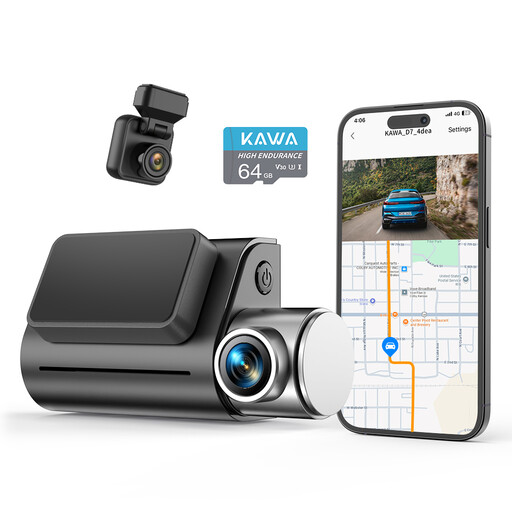
Why this choice suits this profile: this model combines a 4K front camera, a 2K rear camera, GPS, Wi-Fi 6 and a 64 GB card included. Enough to get you set up easily for everyday journeys.
The included card means you don't have to buy accessories straight away, while both cameras aren't limited to just the front view.
Front 4K resolution, rear 2K, built-in GPS, voice control and advertised parking mode.
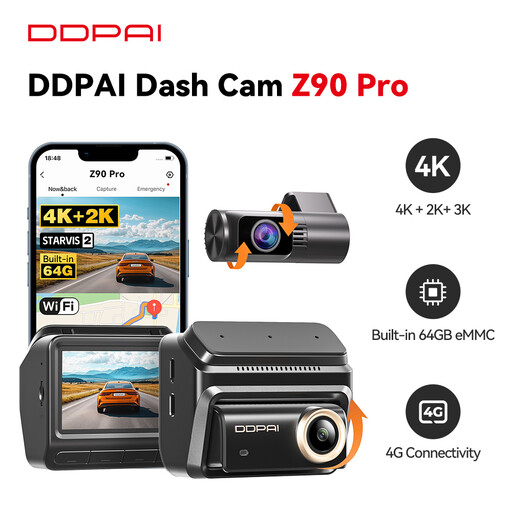
Why this choice suits this profile: its configuration is aimed at drivers who want detailed image quality, fast connectivity and the option to add a cabin camera.
The 64 GB internal memory complements the external card and avoids relying on a single storage medium.
Sony STARVIS 2 IMX678, front 4K and rear 2K recording, HDR, GPS, ADAS, Wi-Fi 5 GHz and voice control.
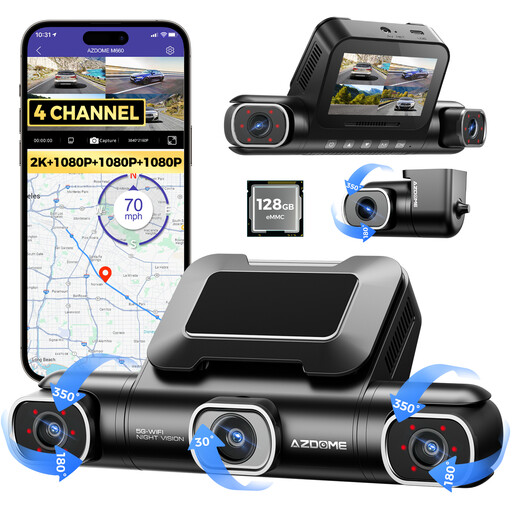
Why this choice suits this profile: its four channels suit commercial vehicles, drivers who want side coverage and those who frequently park in public places.
The 128 GB eMMC memory means you don't immediately rely on a microSD card and supports multi-angle recording.
Four cameras, 128 GB eMMC storage, GPS, Wi-Fi 5 GHz, voice control, infrared night vision and multiple parking modes.
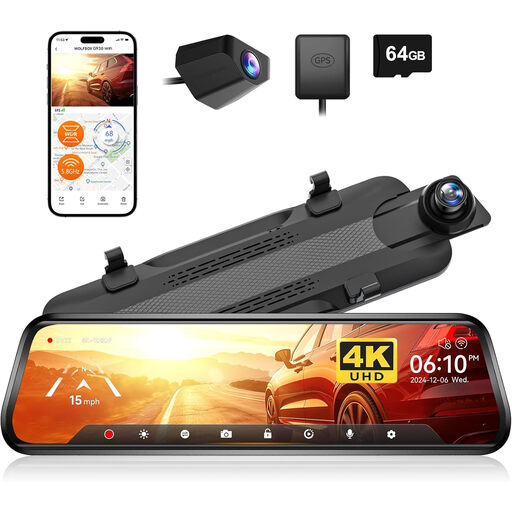
Why this choice suits this profile: this rear-view mirror camera is ideal for SUVs, vans and vehicles with reduced rear visibility. It features a 10-inch touchscreen.
The built-in screen lets you view the rear view directly, without relying solely on a phone or app.
Front 4K camera, rear camera, 10-inch touchscreen, GPS, Wi-Fi 5.8 GHz, 64 GB card and reversing assistance.
We've put together a comprehensive, real-time updated selection of products that fully meet these demanding criteria and European safety regulations.
Install the front camera behind the interior rear-view mirror, without reducing your field of vision. Clean the windscreen before attaching the mount, then check the viewing angle from the app or screen. For the rear camera, route the cable away from areas that could interfere with airbag deployment.
In the UK, recording must serve a legitimate purpose, particularly to preserve evidence in the event of an incident. Avoid publicly sharing images that could identify individuals or number plates without taking the necessary precautions. ADAS alerts should also be checked after every change in the camera's position.
After purchase, the additional expenses mainly involve a durable microSD card, a hardwire kit for parking mode and, depending on the model, a 4G module. Built-in Wi-Fi doesn't necessarily require a mobile data plan.
Yes, if it has a compatible parking mode and a properly installed constant power supply. The hardwire kit must monitor the voltage to limit the risk of battery drain. Always check the required accessories in the model's specification sheet.
It depends on the quality of the power supply, the heat inside the cabin, the frequency of writes and the condition of the memory card. A model equipped with a supercapacitor, paired with a suitable card and a stable installation, will generally withstand temperature variations better than a poorly ventilated device.