
Livraison le jour même ou le lendemain

Qualité garantie

Débloquez vos offres de bienvenue: Livraison GRATUITE | Jusqu'à -80 % | 30 jours d'essai gratuits à JoyPlus
Téléchargez l'application
A 4K front and rear dash cam can capture detailed enough footage to document a journey, a minor collision or an incident in a car park. But high resolution alone doesn’t make a good purchase. The quality of the build, storage management and the features that are actually available matter just as much.
Before choosing a 4K dash cam, here are the main pitfalls to avoid.
Some models advertise 4K at the front, but only offer a rear camera in 720p or 1080p. To read a number plate or understand a manoeuvre precisely, the rear camera also needs sufficient resolution and a suitable viewing angle.
So check the resolution of both lenses separately, along with their frame rate and field of view. A 4K front camera paired with a 1080p rear camera can be perfectly adequate for many uses, as long as you know exactly what you’re buying.
24-hour parking mode usually requires a constant power supply. On the models featured here, a separate hardwire kit is needed to activate certain surveillance functions when the engine is off. Without this accessory, the camera may switch off as soon as the 12 V socket loses power.
The kit must also be compatible with your vehicle and installed correctly to minimise the risk of draining the battery. Impact detection, time-lapse recording or remote alerts can depend directly on this connection.
4K video quickly fills up available space. A MicroSD card that is too slow or has insufficient capacity can cause recording errors. Check the stated compatibility, the maximum supported capacity and the speed class. Several models recommend a U3, class 10 card.
In a cabin exposed to sunlight, a model equipped with a supercapacitor can behave differently from a camera that relies solely on a built-in battery. This doesn’t mean you can ignore the manufacturer’s recommendations regarding temperature and installation.
For a 4K dash cam, look for a clearly stated resolution, for example 3840 × 2160 pixels at the front. A frame rate of 60 frames per second makes motion smoother, while HDR helps to better balance very bright and very dark areas. However, these technologies don’t eliminate the limitations caused by rain, reflections or a dirty windscreen.
For a dash cam with night vision, also consider the lens aperture, the sensor used and any image processing. Marketing terms like “enhanced night vision” should be treated as technical indicators, not as a promise of perfect readability in all conditions.
A wide-angle dash cam covers a broader area, but too wide an angle can distort objects at the edges. For a car or SUV, a front and rear setup meets most needs. Vans, commercial vehicles or drivers who want to monitor the cabin can opt for a 3 or 4-channel car camera.
The AZDOME M350, for example, combines a 2.5K front camera with three 1080p cameras to cover the front, rear, left and right. This type of system requires more cables and more careful positioning.
A dash cam with GPS can record your location, speed and route in the app or compatible player. Wi-Fi, especially 5 GHz, makes it easier to transfer videos to a smartphone without having to remove the memory card.
ADAS can offer lane departure warnings or distance alerts for the vehicle ahead. These alerts are a helpful aid and in no way replace the driver’s attention. Voice control, meanwhile, lets you take a photo or lock a clip without touching the screen while driving.
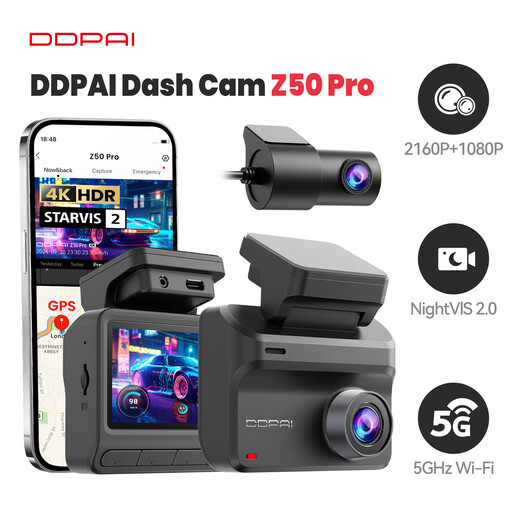
Why this choice suits this profile: It combines a 4K front camera, a 1080p rear camera, a 3-inch screen, GPS and 5 GHz Wi-Fi in an accessible setup for first-time buyers.
The front and rear resolutions are clearly stated. The 48-hour parking mode does require a hardwire kit, sold separately.
Stated field of view of 143° at the front and 124° at the rear, support for MicroSD cards up to 512 GB and a supercapacitor.
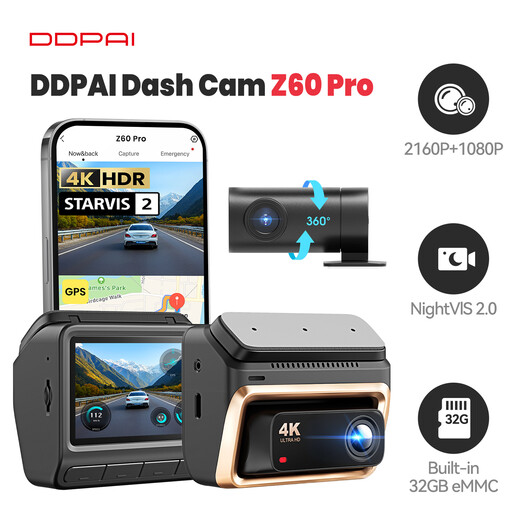
Why this choice suits this profile: Its front Sony STARVIS 2 IMX678 sensor, HDR and 32 GB of internal storage are aimed at drivers who prioritise image quality and recording continuity.
The 1080p rear camera also benefits from HDR. The internal eMMC storage can take over from the MicroSD card in certain situations.
Front 4K recording, 3K mode at 60 frames per second depending on the setting, GPS, 5 GHz Wi-Fi and compatibility with cards up to 512 GB.
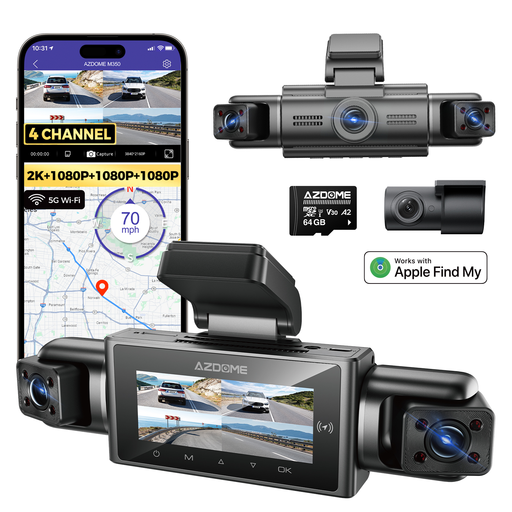
Why this choice suits this profile: Its four channels are ideal for commercial vehicle drivers, families or anyone who wants to monitor the sides and cabin as well as the road.
The coverage doesn’t rely solely on a wide-angle lens at the front. The four views are clearly specified: one 2.5K front camera and three 1080p cameras.
Built-in GPS, 5 GHz Wi-Fi, infrared night vision for the cabin and stated compatibility with the Apple Find My network.
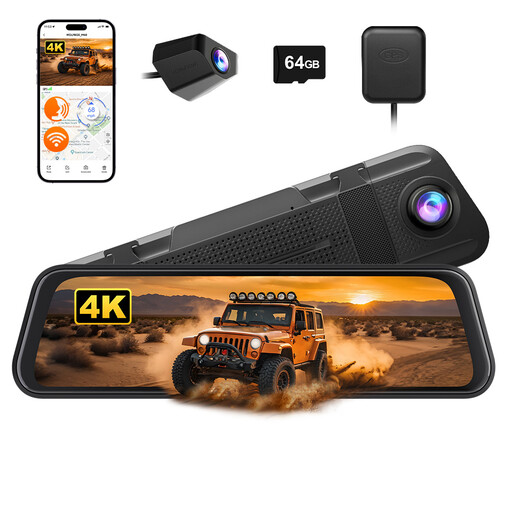
Why this choice suits this profile: This format replaces or covers your original rearview mirror and can suit compatible cars, SUVs, vans and trucks.
Compatibility and the rear cable routing should be checked before purchase. It’s best not to assume a universal fit will work for all vehicles.
10-inch touchscreen, 4K front camera, 1080p rear camera, GPS, Wi-Fi and stated ADAS/BSD alerts.
Install the front camera behind the rearview mirror to minimise visual obstruction. Clean the windscreen before attaching the mount and check that the lens isn’t capturing an excessive portion of the dashboard. The rear camera should be positioned to maintain a clear view, even when the boot is loaded.
Before your first journey, check the following settings:
In the UK, using footage captured on public roads must respect privacy and applicable data protection rules. Avoid publicly sharing videos in which people or number plates are identifiable without taking the necessary precautions.
Yes. 4K files are significantly larger than those recorded in Full HD. A fast, compatible MicroSD card, often U3 type, reduces the risk of errors. When the memory is full, loop recording automatically overwrites older clips that haven’t been locked.
You generally need to buy and install a permanent hardwire kit that is compatible with the model and your vehicle. Depending on the camera, parking mode may rely on impact detection, motion detection or time-lapse recording. Also check that the system protects the battery from excessive drain.
No. GPS is useful for recording your location and speed, while Wi-Fi simplifies transferring videos to a smartphone. ADAS can provide additional alerts, but these features come after the essentials: a proper installation, a usable rear camera and a reliable memory card.