
Livraison le jour même ou le lendemain

Qualité garantie

Débloquez vos offres de bienvenue: Livraison GRATUITE | Jusqu'à -80 % | 30 jours d'essai gratuits à JoyPlus
Téléchargez l'application
A 4K front and rear dash cam can prove invaluable for recording a journey, a minor collision, or damage in a car park. But the resolution printed on the box doesn't, on its own, guarantee footage that's actually usable. Night vision, a mobile app, 24-hour parking mode – some features can quickly push up the price, while others limit everyday usability.
Here are the criteria to check before you order, along with a selection suited to different types of drivers.
On many models, the front camera records in 4K, while the rear camera only manages 1080p or a lower resolution. This setup can be perfectly fine, as long as you know what you're buying. Also check the frame rate: 60 frames per second makes motion smoother, whereas 4K at 30 frames per second focuses more on detail.
24-hour parking mode usually doesn't work with just the cigarette lighter cable. You'll often need to add a hardwire kit, sold separately, to power the camera when the engine is off. Its installation involves connecting to the fuse box and managing the voltage correctly to reduce the risk of draining the battery.
The microSD card isn't always included either. For a 4K dash cam, it's best to choose a U3, Class 10 card designed for continuous recording.
Night-time image quality depends on many factors: sensor, lens aperture, software processing, windscreen cleanliness and ambient lighting. Sony STARVIS 2 sensors, as well as HDR or WDR processing, can improve handling of high-contrast scenes. However, none of these features guarantee a perfect read in an unlit street, in the rain, or facing bright headlights.
For a front and rear car camera, examine the specifications of both modules separately:
The presence of a Sony STARVIS 2 sensor, such as the IMX678 on the front of some models, provides a concrete technical specification. However, it doesn't replace careful adjustment or a properly positioned installation.
Loop recording automatically deletes the oldest files when the memory card is full. Videos locked by the G-Sensor (shock sensor) must be protected from this automatic overwriting.
For long journeys, commercial vehicles and motorhomes, a capacity of up to 512 GB can be useful, if the camera supports it. Internal memory, such as the 32 GB eMMC advertised on some devices, provides a welcome safety net. It doesn't, however, remove the need to check external card compatibility.
Built-in GPS can record the location, route and speed within the video data. 5 GHz Wi-Fi or Wi-Fi 6 speeds up the transfer of large files to a smartphone, without having to remove the memory card.
Before mounting the camera, position it behind the interior rear-view mirror, without obstructing the field of vision. Route the rear cable away from airbag deployment zones. In the UK, footage should only be used appropriately: avoid publicly sharing identifiable faces or number plates without taking the necessary precautions.
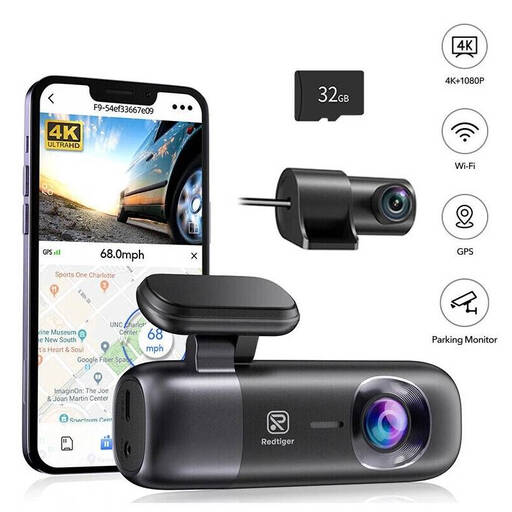
Why this choice suits this profile: This dual dash cam combines a 4K front camera and a 1080p rear camera, with GPS, Wi-Fi and a 64 GB card included in the offer. It's suitable for drivers who want to monitor both front and rear without adding lots of accessories.
The front and rear camera resolutions are listed separately – there's no risk of assuming both record in 4K.
4K front camera, 1080p rear, GPS, Wi-Fi, loop recording and advertised parking mode.
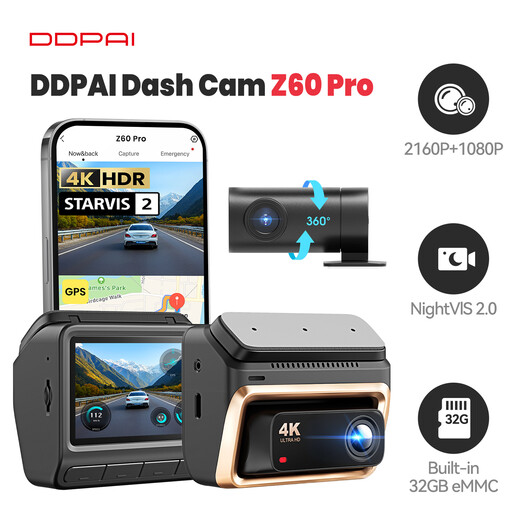
Why this choice suits this profile: The Z60 Pro is aimed at motorists looking for a complete solution, with a 3-inch IPS screen, Sony STARVIS 2 sensors and fast video transfer.
The spec sheet clearly distinguishes the 4K front at 30 frames per second from the 1080p rear camera, and states that the hardwire kit for parking mode is sold separately.
IMX678 sensor on the front, HDR, 5 GHz Wi-Fi, GPS, 32 GB eMMC memory and support for microSD cards up to 512 GB.
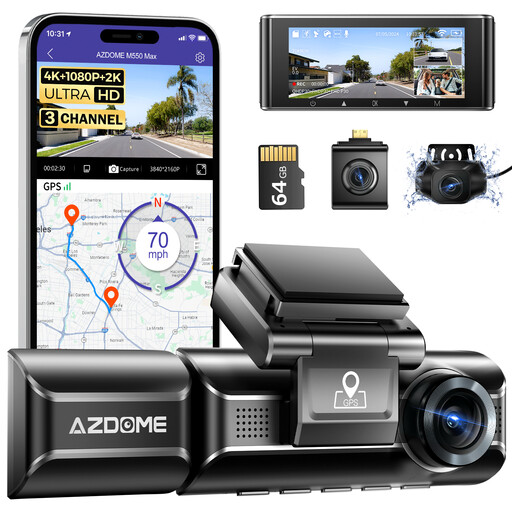
Why this choice suits this profile: Its three-channel setup is aimed at families, drivers and vehicle owners who want to record the road, the rear and the cabin.
The spec sheet details the three video streams and states that the essential kit for 24-hour parking mode is sold separately.
4K + 1080p + 2.5K recording, dual STARVIS sensor, 3.19-inch screen, GPS and included 64 GB card.
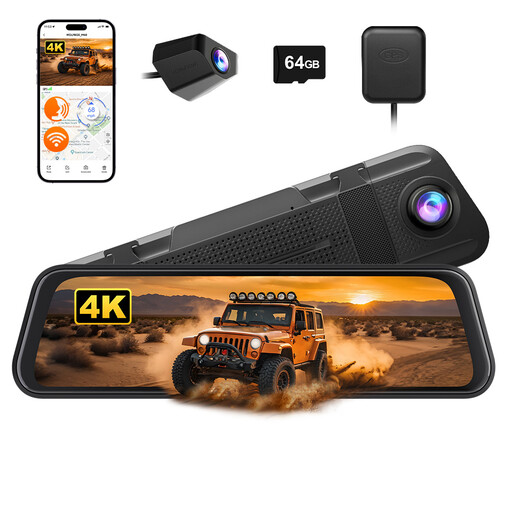
Why this choice suits this profile: Its 10-inch mirror-screen format can be particularly useful when rear visibility is limited, provided you check compatibility with your vehicle and the mounting options.
The spec sheet clearly states a 4K resolution on the front and 1080p on the rear, as well as the 12 V power connection requirements.
10-inch touchscreen, GPS, Wi-Fi, voice control, ADAS/BSD and a 64 GB microSD card included according to the spec sheet.
We've put together a comprehensive, real-time updated selection of products that meet these demanding criteria, while taking European safety regulations into account.
For standard use, connecting to the 12 V socket is generally something most drivers can manage. However, 24-hour parking mode often requires a hardwire kit connected to the fuses. Professional installation can help avoid wiring errors and keep cables away from airbag zones, particularly in the pillars.
Choose a U3, Class 10, high-endurance microSD card, compatible with the maximum capacity stated by the manufacturer. Remember to format it regularly from the camera and replace it as soon as you see recording errors or corrupted files.
On top of the camera's price, you may need to add a memory card, a hardwire kit for parking mode and, depending on the model, a 4G module. Wi-Fi usually lets you retrieve videos nearby without a subscription. However, remote viewing via the mobile network may require separate equipment and a data plan.