
Livraison le jour même ou le lendemain

Qualité garantie

Débloquez vos offres de bienvenue: Livraison GRATUITE | Jusqu'à -80 % | 30 jours d'essai gratuits à JoyPlus
Téléchargez l'application
On the road, in France and everywhere else, the unexpected can happen. An accident, a hit-and-run, or an act of vandalism on your parked vehicle can quickly become a source of stress and administrative headaches. In this context, a 4K front and rear dashcam emerges as the ideal solution for recording clear and objective visual evidence.
Faced with an overwhelming market and often complex technical specifications, it's easy to get lost. This guide is here to help you see things more clearly, decipher the essential features, and choose the model that will equip your vehicle in the most reliable and effective way possible.
Before you take the plunge, let's review the features that truly make a difference in daily use. Here are the three fundamental criteria to scrutinize.
4K resolution (3840 x 2160 pixels) offers an unparalleled level of detail, which is essential for identifying crucial elements like a license plate, even from a distance or while in motion. But be aware, resolution isn't everything. Pay close attention to the quality of the image sensor. Sony STARVIS models, for example, are renowned for their excellent low-light performance. A good night vision dashcam must also incorporate technologies like HDR (High Dynamic Range). This balances dark and brightly lit areas to ensure optimal visibility at night, in a tunnel, or when facing the dazzling headlights of other cars.
A modern front and rear onboard camera goes far beyond simple recording while driving.
Accessing your videos should be simple and immediate. That's why most recent models integrate wireless connectivity.
Here are three models that stand out for their well-balanced specifications and features perfectly suited to the needs of today's drivers.
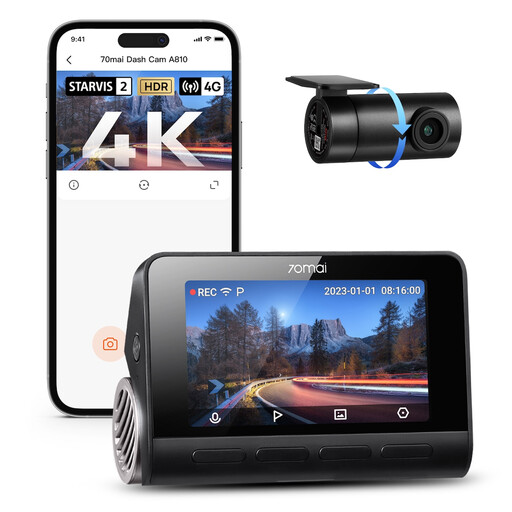
Why it stands out: This model focuses on first-class image quality thanks to its dual Sony STARVIS 2 sensors: one at the front (4K) and one at the rear (1080p). Paired with HDR technology and a wide aperture (f/1.7), it's built to deliver clear and detailed recordings, even when light is scarce. It's no coincidence that leading German media outlets Autobild.de and Computerbild.de awarded it a "Good" rating in 2024.
Pros:
Who is it for? For the demanding driver who prioritizes video quality above all else, day or night, and wants to take advantage of the most advanced features like 4G remote monitoring.
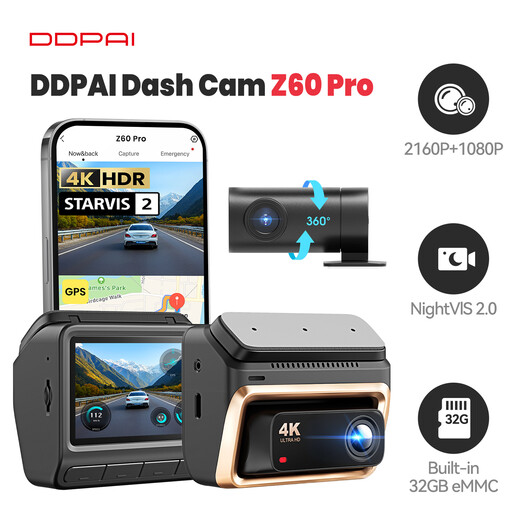
Why it stands out: The DDPAI Z60 Pro stands out for its flexibility and data security. It offers a choice between 4K at 30 fps or 3K at 60 fps. The latter mode is particularly suitable for capturing fast-moving scenes with maximum fluidity. Its secret weapon? A dual storage solution: 32GB of built-in eMMC memory in addition to the microSD port. This ensures your recordings are backed up, even if the memory card fails.
Pros:
Who is it for? Ideal for high-mileage drivers and those who frequent highways, where the smoothness of 60 fps can make a real difference. It's also a smart choice for anyone who doesn't want to compromise on data security.

Why it stands out: The Z50 Pro embodies the perfect balance of performance, features, and price. It includes a complete dual-lens dashcam system (4K front, 1080p rear) and integrates cutting-edge technologies like Wi-Fi 6 for lightning-fast file transfers. It packs all the essential features (GPS, ADAS, parking mode) into a compact and easy-to-install format.
Pros:
Who is it for? For the pragmatic user looking for a complete, reliable, and high-performing 4K front/rear solution, without necessarily wanting to invest in the most advanced options like 4G.
Our selection focuses on high-performing and well-balanced models, but the dashcam market is much broader. To explore other configurations, single-lens models, or options suited to different budgets, feel free to browse our complete category.
4K resolution offers four times the image clarity of Full HD (1080p). This advantage is not a gimmick: it is crucial for distinguishing fine details at a distance, such as the numbers on a license plate or a road sign. To obtain the most usable video evidence possible, 4K is a major asset.
Parking mode allows the camera to monitor your vehicle after the ignition is turned off. To do this, it needs a constant power supply, provided by a hardwire kit connected directly to the car's fuse box. Once activated, the camera enters a standby state and only triggers a recording if it detects an impact (via its accelerometer or G-sensor) or suspicious movement in its field of view.
Installing the front camera is quite simple: it attaches to the windshield (with a suction cup or adhesive) and its power cable plugs into the cigarette lighter socket. The cable can then be easily hidden along the vehicle's trim. Installing the rear camera requires a bit more finesse to run the long connecting cable from the front to the back of the vehicle as discreetly as possible. As for parking mode, installing the hardwire kit in the fuse box requires some basic knowledge of automotive electricity. If in doubt, hiring a professional is the best way to guarantee a clean and secure installation.