
Livraison le jour même ou le lendemain

Qualité garantie

Débloquez vos offres de bienvenue: Livraison GRATUITE | Jusqu'à -80 % | 30 jours d'essai gratuits à JoyPlus
Téléchargez l'application
Crowded roads, unpredictable behaviour... Faced with the hazards of traffic, equipping your vehicle with an onboard camera (or dashcam) has become a go-to safety measure for more and more drivers. A 4K dashcam doesn't just film your journey; it captures video evidence with razor-sharp clarity, which can make all the difference in the event of an incident.
The only problem: the market is flooded with models featuring complex spec sheets. Between resolution, the number of cameras, and connected features, it's easy to get lost. This guide is here to help you see things more clearly, identify the criteria that truly matter, and choose the camera best suited to your needs, with a selection of the most relevant models for 2026.
Before jumping on a specific model, it's essential to understand which features offer real added value. Here are the key points to check during your search.
4K resolution (3840 x 2160 pixels) offers a level of detail four times greater than Full HD (1080p). In practical terms, this guarantees you can clearly read licence plates or road signs, even from a distance or when zooming in on the image.
But protection doesn't stop with what's happening in front of you. Front and rear dashcam systems have become the standard for protecting against rear-end collisions, which are often disputed. For maximum security, a 4-channel dashcam or a 360-degree dashcam simultaneously records the front, rear, and the cabin (or sides), leaving no blind spots.
A vehicle is just as vulnerable when parked. Parking mode is therefore a crucial feature that monitors your car in your absence. It most often comes in three modes:
For this surveillance to be effective day and night, excellent night vision is essential. This performance relies on a winning combination: a high-quality sensor, like a STARVIS-type Sony sensor, and a wide-aperture lens (e.g., f/1.8) to capture maximum light.
Modern dashcams do more than just record; they are becoming true connected co-pilots.
With these criteria in mind, here are three models that caught our attention, each with a distinct approach to automotive security.
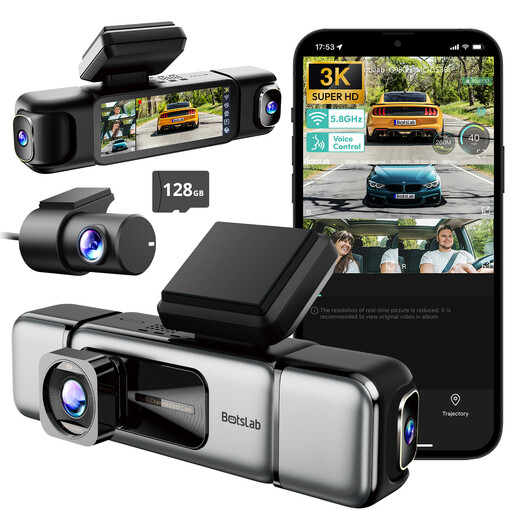
Why it stands out This model offers a near-complete panoramic view thanks to its four-camera system (front, rear, and two sides) for a total advertised coverage of 560°. Its 3.18-inch touchscreen displays a unique four-way split view, allowing you to see all angles simultaneously.
Advantages
Who is it for? Urban drivers, road professionals (ride-hailing drivers, delivery drivers), and anyone looking for comprehensive surveillance of their surroundings, especially in tight underground car parks or high-traffic areas.
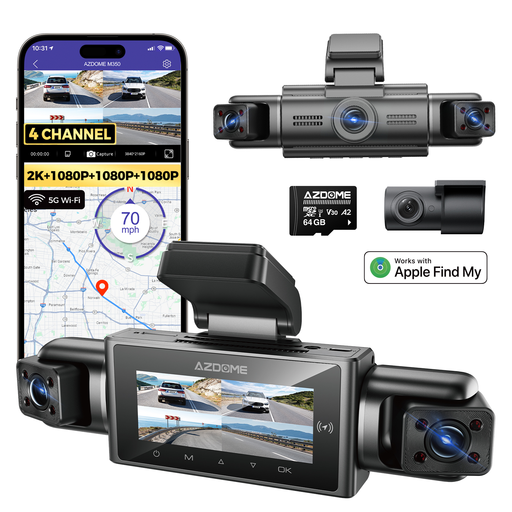
Why it stands out The AZDOME M350 stands out for its native integration with Apple's Find My network. This is a major advantage for Apple enthusiasts, as it allows you to geolocate your vehicle directly from the Find My app, with no third-party app or subscription required.
Advantages
Who is it for? iPhone and other Apple device users who want a security and location solution that is perfectly integrated into their ecosystem.
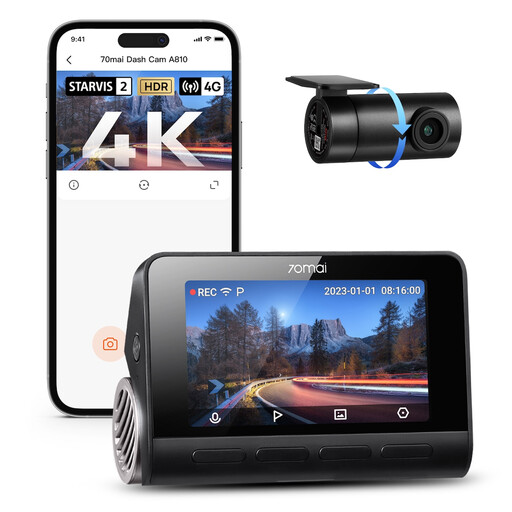
Why it stands out The 70mai A810-2 goes all-in on image quality. It is equipped with two Sony STARVIS 2 sensors, one for the 4K front camera and the other for the 1080p rear camera. The result: it excels where others struggle, whether at night, exiting a tunnel, or facing dazzling headlights, thanks to its dual-channel HDR technology.
Advantages
Who is it for? The most demanding users when it comes to video quality, who want irrefutable evidence day or night and appreciate advanced tech features like 4G monitoring.
Our selection focuses on three flagship models, but the dashcam market is much broader. Whether you're looking for a different resolution, a more discreet design, or a tighter budget, there's a model out there for you.
Discover a wider selection in our Cameras & Photo category to find the perfect fit that matches your expectations and budget.
While 1080p resolution may be sufficient in many situations, 4K offers a decisive advantage for capturing fine details from a distance. Being able to read a licence plate on a fleeing vehicle or identify a face can make all the difference with insurance companies or law enforcement. It's an investment in your peace of mind.
Parking mode allows the camera to monitor your vehicle even when the engine is off. This usually requires installing a 'hardwire kit' connected directly to the vehicle's fuse box. This kit includes a protection feature that cuts power before your car's battery gets too low. Once activated, parking mode can record in the event of an impact, motion, or continuously in time-lapse mode.
The GPS module records and embeds crucial data onto the video: your speed, the date, time, and your geographical coordinates. In the event of an accident, this information provides factual and irrefutable context. It can prove you were respecting the speed limit and pinpoints the incident's location down to the metre, which can greatly simplify your dealings with the insurance company.