
Livraison le jour même ou le lendemain

Qualité garantie

Débloquez vos offres de bienvenue: Livraison GRATUITE | Jusqu'à -80 % | 30 jours d'essai gratuits à JoyPlus
Téléchargez l'application
A 4K car dashcam can record the details of a journey, document a collision or help identify an impact that occurred while your vehicle was parked. However, a long list of technical specifications does not necessarily guarantee a pleasant day-to-day experience. Resolution, power supply, storage and actual coverage all need to be assessed together.
The term 4K primarily refers to image definition. It does not guarantee good night-time visibility or sharp footage during rapid movement. You should also check:
A dashcam should therefore be judged according to the conditions in which it will be used, not just by the number of pixels displayed on the box.
24-hour parking mode, a rear camera or 4G connectivity may require additional accessories. On some models, monitoring while the vehicle is stationary relies on a hardwire kit sold separately. You will also need a microSD card capable of supporting continuous recording.
Before placing your order, check:
A GPS-equipped dashcam can record your speed, route and geographical coordinates. A Wi-Fi dashcam or 4G car camera can also make it easier to transfer footage or view it remotely. These features are convenient, but they make it essential to secure access to the app and check the file retention settings.
In France, avoid filming or sharing people and number plates unnecessarily. Recordings should be restricted to an appropriate purpose, particularly documenting an incident, rather than being used to publish images of third parties without taking suitable precautions.
For everyday use, a front camera may be enough to record the road ahead. A front and rear 4K dashcam adds a view of the rear, which is useful in the event of a rear-end collision or when manoeuvring. A 360-degree dashcam or multi-channel system can also cover the sides and, in some cases, the vehicle interior.
Look at the resolution of each camera: some kits combine a 4K front camera with a 1080p rear camera. This can be a good compromise, but image quality will vary depending on the viewing angle.
A car camera with night vision should preserve detail as light levels fall. HDR, a sensitive sensor and a sufficiently wide aperture are all features worth prioritising. Actual performance may nevertheless vary depending on tinted windows, headlights, rain and urban lighting.
Built-in GPS generally adds the location, speed and route to video files. 5 GHz Wi-Fi or Wi-Fi 6 speeds up transfers to a phone when you are near the vehicle. Depending on the model and subscription you choose, 4G can be used to receive alerts or view the camera remotely.
To monitor your car while it is parked, look for a dashcam with 24-hour parking mode and motion detection. Above all, check the conditions required to activate it: permanent power, impact sensors, recording duration and any mobile connectivity charges.
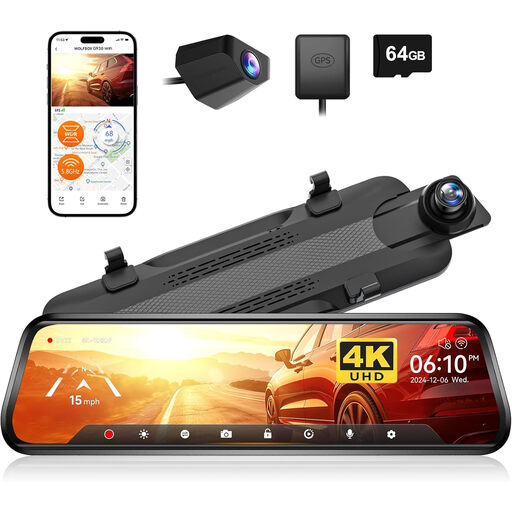
Why it suits this type of user : Its mirror-style design with touchscreen is ideal for drivers who want to gradually replace their traditional rear-view mirror with a front-and-rear solution featuring GPS and a 64 GB card.
The included memory card means you do not have to make multiple purchases at the outset. The front-and-rear configuration also means you are not limited to a single perspective.
10-inch screen, front and rear recording, 5.8 GHz Wi-Fi, GPS and advertised parking surveillance function.
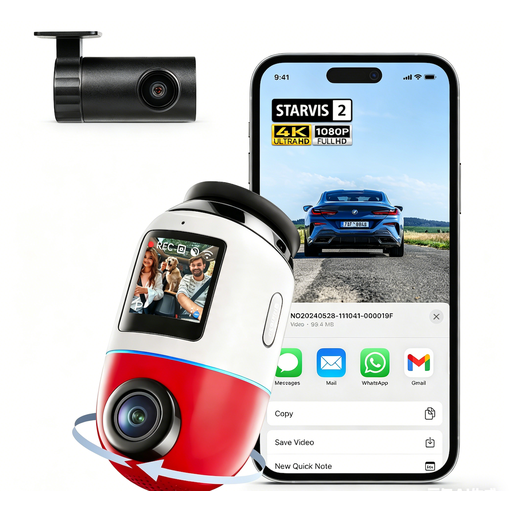
Why it suits this type of user : Drivers looking for extensive coverage and connected features get a 4K front camera and a 1080p rear camera, with an advertised 360-degree horizontal rotation.
The product details specify that the UP03 or UP04 kit is required to activate the parking functions. This is useful information for planning your budget and installation.
4K recording at 60 frames per second, Sony STARVIS 2 sensor at the front, built-in GPS, Wi-Fi 6 and advertised 4G connectivity.
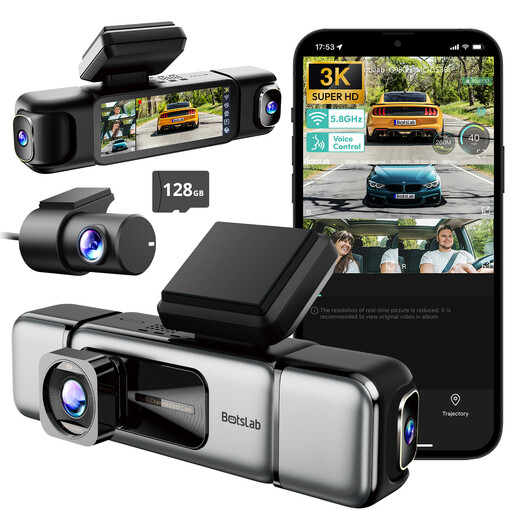
Why it suits this type of user : Motorists who often park on the street or regularly take long journeys can benefit from front, rear, side and interior coverage distributed across four channels.
The three parking modes are clearly explained, including the need for a hardwire kit. The 128 GB card is advertised as included.
Advertised 560-degree field of view, 3K front camera, GPS, 5.8 GHz Wi-Fi, voice control and collision detection in parking mode.
Install the camera behind the rear-view mirror, taking care not to restrict the driver's field of vision. Clean the windscreen regularly and make sure the rear lens remains unobstructed. For permanent parking mode:
Export important files promptly: when the memory is full, loop recording will eventually overwrite the oldest footage.
Yes, a high resolution can help retain more detail, but it is not the only factor. Prioritise a sensitive sensor, HDR, a good aperture and a clean installation behind the windscreen. The result will also depend on lighting and weather conditions.
The price of the camera does not necessarily include mobile connectivity. A 4G dashcam may require a SIM card, a data plan and, in some cases, specific conditions linked to the app. Check for any recurring charges before buying. Wi-Fi generally works when you are near the vehicle, without a mobile subscription.
It depends on where you park and the level of monitoring you want. Above all, check the compatibility of the hardwire kit, motion detection, impact sensor and storage capacity. An incorrect installation could drain the battery or prevent certain functions from working as intended.