
Livraison le jour même ou le lendemain

Qualité garantie

Débloquez vos offres de bienvenue: Livraison GRATUITE | Jusqu'à -80 % | 30 jours d'essai gratuits à JoyPlus
Téléchargez l'application
The arrival of a baby turns daily life upside down, and the list of necessary equipment can quickly become overwhelming. A baby monitor is one of the essentials. Faced with a crowded market, it's hard to know where to start. A 4K baby monitor looks appealing on paper, but be warned: high resolution is far from the only criterion. As a tech editor, my mission is to help you decode the spec sheets to make an informed choice, far from the siren song of marketing.
Before we break down the features, let's review the common pitfalls that can turn an investment into buyer's remorse.
To avoid these disappointments, here are the technical specs that really matter.
This is the starting point, the factor that will dictate how you use your baby monitor.
no-wifi baby monitor): The camera and monitor communicate directly over a dedicated radio frequency (often FHSS). This is the most secure and reliable solution, completely independent of your internet connection.baby monitor with app): Access is via an app on your smartphone, wherever you are. It's convenient, but security depends entirely on the quality of the encryption and the stability of your network.A clear image is crucial, day and night.
Your baby monitor should adapt to your daily life, not the other way around.
Every family has different needs. Here is a selection to help you identify the type of product that's right for you.
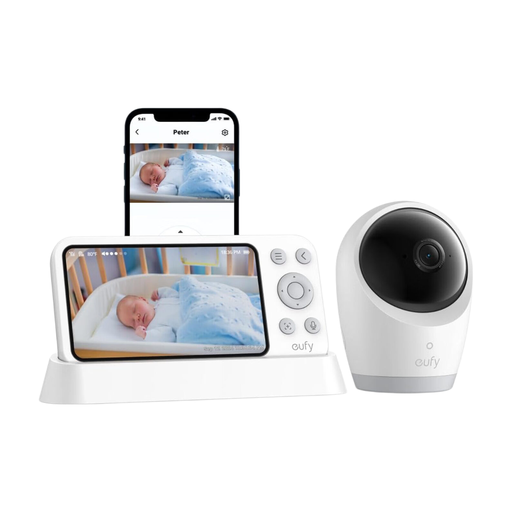
The Editor's Verdict: Perfect for parents seeking flawless image quality, remote smartphone access to keep an eye on the baby from the office, and advanced features like motion tracking.
Its hybrid mode is reassuring: it combines remote Wi-Fi access with a direct, secure local connection at home. The camera's built-in battery offers true freedom, far from the constraints of a power outlet.
Its 4K UHD resolution delivers a stunning level of detail. The motorised camera and the 5,000 mAh battery integrated into the camera unit make it ultra-versatile.
The Editor's Verdict: Monitoring two children at once is a challenge. This system handles it perfectly by displaying two video feeds simultaneously on a single screen, saving you from juggling multiple devices.
Instead of buying two separate baby monitors (an expensive and impractical solution), its Split-Screen feature lets you watch two rooms on a single monitor. It's the ideal solution for twin monitoring.
The Split-Screen mode is its killer feature. The ability to connect multiple cameras to a single monitor radically simplifies monitoring siblings.
Discover our full selection of products that meet our strict selection criteria and current safety standards.
Yes, a 4K stream logically consumes more bandwidth than an HD stream. However, most models with a mobile app allow you to reduce the stream quality to save your mobile data when you're on the go. At home, the local connection mode (if available) uses no internet data at all.
The effectiveness of night vision varies greatly from one model to another. The best models use infrared LEDs that are invisible to the naked eye (no red glow), which preserves total darkness in the baby's room. Quality night vision should provide a sharp black-and-white image, allowing you to see details as fine as the child's breathing movements.
Manufacturers advertise a maximum range (e.g., 300 metres or 1000 feet) measured in an open field, meaning with no obstacles. In practice, in a house or flat with concrete walls and multiple floors, you should expect a real-world range of 50 to 70 metres (160 to 230 feet). The best approach is to test the connection in different rooms of your home before finalising your choice.