
Livraison le jour même ou le lendemain

Qualité garantie

Débloquez vos offres de bienvenue: Livraison GRATUITE | Jusqu'à -80 % | 30 jours d'essai gratuits à JoyPlus
Téléchargez l'application
For a parent, nothing is more important than their child's safety and well-being. The baby monitor market has been transformed by increasingly sophisticated models, with the 4K baby monitor leading the pack. But behind the marketing promises, major disappointments often lurk. How can you tell a real innovation from a misleading sales pitch? Our guide is here to help you see things more clearly and make the right choice.
Before diving into spec sheets, let's review the most common traps that turn a purchase into a regret.
To ensure you don't make a mistake, here are the technical features that truly make a difference in daily use.
High resolution like 4K is only worthwhile if it's paired with a powerful digital zoom, capable of enlarging the image without turning it into a pixelated mess. The idea is to be able to check crucial details, like your baby's breathing, without having to enter the room and risk waking them. The quality of the night vision is just as critical. A good infrared sensor should provide a clear, high-contrast image in complete darkness, whereas entry-level models just display a pixelated fog.
The most reliable solution combines the best of both worlds:
A hybrid model offers you the best of both worlds: it gives you the choice depending on the situation and ensures uninterrupted monitoring, even during an internet outage.
A true battery-powered baby monitor must have both a camera and a parent unit that are battery-operated. A battery-powered camera means the freedom to place it anywhere, without being tethered to the nearest power outlet. Another crucial point: a motorised baby camera (Pan & Tilt) is a significant advantage. It allows you to scan the room remotely to follow your child's movements—a feature that quickly becomes essential as your baby grows and explores their cot from end to end.
Because every family is unique, here is our selection of models that meet specific needs.
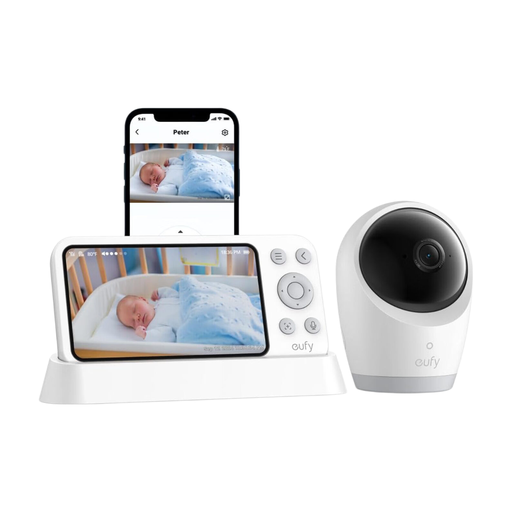
Why it's a match : This eufy baby monitor is for tech-savvy parents who want the best, without compromise. It ticks all the boxes: 4K image, hybrid connectivity, and a motorised, battery-powered camera. The perfect combo for flexible monitoring, both at home and remotely.
Its hybrid mode (Wi-Fi/local) frees you from internet dependency. Most importantly, its camera includes its own 5000 mAh battery, offering true portability where competitors only provide a nomadic parent unit.
4K UHD resolution with 8x zoom, hybrid connectivity (Wi-Fi/local), and a battery-powered motorised camera.
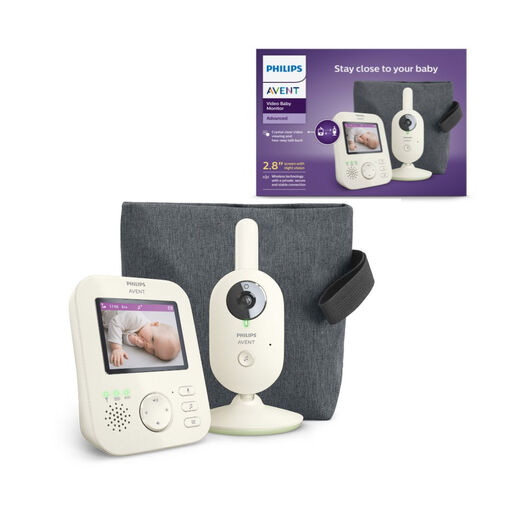
Why it's a match : The ideal choice for parents looking for a reliable, 100% secure, "plug-and-play" solution. It relies on a private, direct connection (FHSS technology) that eliminates the risks and complications of Wi-Fi.
It sidesteps the Wi-Fi dependency trap by relying exclusively on a dedicated, hack-proof local connection. Its simplicity is its greatest strength: no app to manage—just plug it in and it works.
Private and secure Wi-Fi-free connection, long battery life (up to 12 hours), and a range of up to 300 metres outdoors.
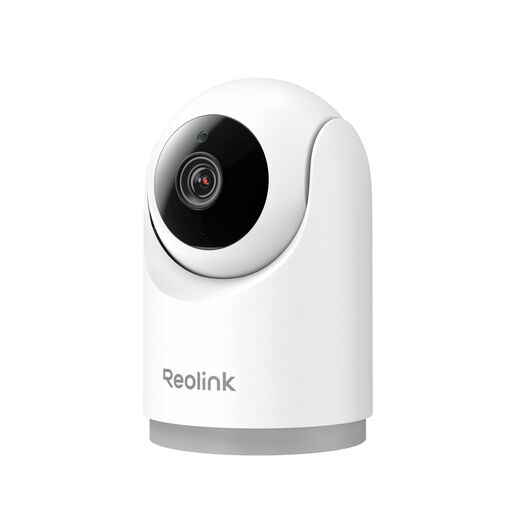
Why it's a match : This indoor security camera is an excellent alternative. While not a baby monitor in the strictest sense, its 3MP Super HD resolution offers remarkable clarity. Its smart features (cry detection) and motorisation make it an impressively comprehensive solution for its price.
It packs advanced features (motorisation, cry detection) worthy of much more expensive models, without compromising on image quality. It gets straight to the point: effective monitoring accessible from an app.
Smart baby cry detection, 355° motorisation for complete coverage, and a very sharp Super HD resolution.
We have compiled a complete and up-to-date selection of products that meet our demanding selection criteria and current safety standards.
Yes, streaming a 4K video feed over Wi-Fi is bandwidth-hungry. That's the main benefit of a hybrid model with a local mode: it doesn't use your internet connection for at-home monitoring, reserving Wi-Fi only for remote access.
Yes, as a general rule. A direct local connection (like FHSS) operates on a closed circuit between the camera and the monitor. It is therefore inherently much more difficult to hack or intercept. For a Wi-Fi connection, it is imperative to choose a model with strong encryption (like AES-128 or higher) and, of course, to protect your home network with a complex password.
Baby monitors are specifically designed for monitoring infants. They typically include a dedicated parent monitor (more reliable than a smartphone), temperature and humidity sensors, lullabies, and specially calibrated cry detection. A standard security camera can do the job, but it will always rely on a smartphone app and will lack all these features designed for a baby's comfort and safety.