
Livraison le jour même ou le lendemain

Qualité garantie

Débloquez vos offres de bienvenue: Livraison GRATUITE | Jusqu'à -80 % | 30 jours d'essai gratuits à JoyPlus
Téléchargez l'application
Whether you're an extreme sports enthusiast, a passionate globetrotter, or a content creator, the desire to capture your exploits in high definition is stronger than ever. The 4K action camera has become the essential tool for recording these moments with stunning clarity and smoothness. The problem: faced with a jungle of models and endless spec sheets, it's hard to know where to start.
This guide is here to help you see things more clearly. As a product expert at Joybuy, my mission is to unearth the gems that combine performance, versatility, and a tight budget. Forget the marketing jargon: we're getting straight to the point by analysing the criteria that truly matter and offering a selection of cameras tailored to real-world uses.
Before diving into our selection, let's review the key points to find the perfect camera for your needs.
For a sports camera, stabilisation isn't an option—it's the number one criterion! Without it, your mountain biking, skiing, or even simple hiking videos will be a nightmare to watch, full of shakes. 6-axis gyroscopic stabilisation (EIS) technology has become the standard. It electronically smooths out jolts in real time for a fluid, professional result, whether you're on your motorcycle or skiing down a slope.
Nothing is more frustrating than a battery that dies on you mid-action. A long-battery-life camera ensures you can film for several hours straight. Be sure to check the advertised battery life in 4K, as this mode is particularly power-hungry. And if your adventures involve water, a camera waterproof up to 30m (usually with an included case) is non-negotiable to protect your investment and bring back breathtaking underwater memories.
A good action camera is a true Swiss Army knife. For a vlogging camera, a front screen is almost essential to perfect your framing. Other modes like slow motion to enhance an action scene, time-lapse to capture a sunset, or even a dashcam function for your car, multiply the possibilities of your device.
Here are three models that shine with their excellent value for money and stand out as great affordable GoPro alternatives, each catering to a different user profile.
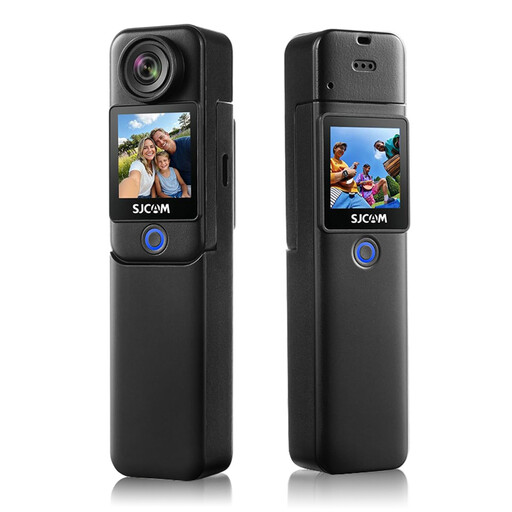
The Promise
The SJCAM C300 tackles the Achilles' heel of action cameras: battery life. Thanks to its grip that houses an extra battery, it shatters records and becomes the perfect ally for long excursions, far from any power outlet.
Key Features
Who is it for?
Long-haul adventurers, hikers, cyclists, and anyone for whom a long-battery-life camera is the main criterion. It's the ideal travel companion to ensure you never run out of power.
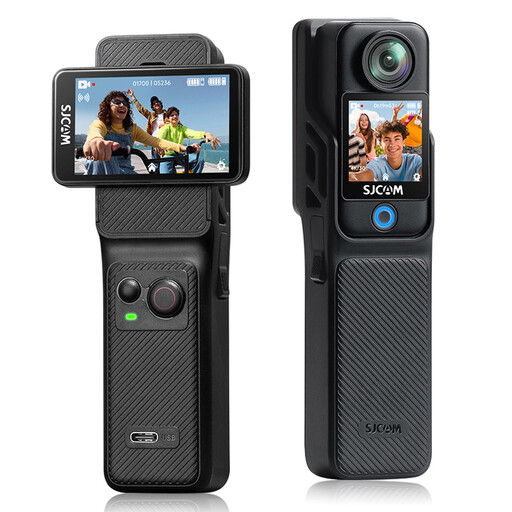
Built for Creation
The SJCAM C400 is clearly designed for content creators. Its large 2.29-inch rear screen and front screen make it the perfect tool for vlogging, while its live streaming function opens up a world of possibilities.
Key Features
Who is it for?
Vloggers, content creators, and athletes who love to share their exploits live. Its combination of practical screens and streaming features makes it a true pocket-sized studio.
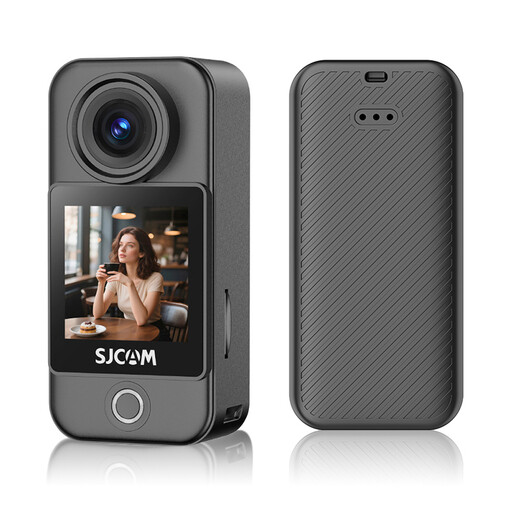
The Featherweight
As its name suggests, the SJCAM C400 Pocket is all about extreme compactness. Weighing only 54 grams, it slips into any pocket and is completely unnoticeable, without sacrificing the fundamentals of a modern 4K action camera.
Key Features
Who is it for?
Minimalist travellers, hikers who count every gram, or anyone looking for a discreet camera to capture the moment on the fly, without being weighed down.
The cameras in our selection are built for action and movement. If your projects are different and require, for example, an all-in-one solution with an integrated control screen for monitoring or specific installations, other options are available to you.
Explore our complete collection of monitors with cameras to discover other configurations suited to a wider variety of uses.
1. Is a cheaper GoPro alternative a good choice?
Yes, without a doubt. Brands like SJCAM have specialised in offering action cameras with solid technical specs (4K, advanced stabilisation, waterproofing) at much gentler price points. For the vast majority of users—amateur athletes, travellers, or vloggers—these models represent the ideal compromise between quality, features, and budget, without having to pay the premium price of legacy brands.
2. What's the difference between 4K at 30 fps and 4K at 60 fps?
"fps" stands for "frames per second". A 4K video at 30 fps is the standard today, offering a smooth, cinematic look suitable for most situations (vlogs, travel, sports). 4K at 60 fps, by capturing twice as many frames, provides even sharper motion and, most importantly, allows for creating stunning slow-motion effects without loss of quality. For most users, 30 fps in 4K is already excellent.
3. Is image stabilisation really necessary for a sports camera?
Yes, and it's non-negotiable. It's actually THE most important feature. Without good stabilisation, your videos shot in motion (mountain biking, running, skiing...) will be an unwatchable, shaky mess. A 6-axis gyroscopic stabilisation system, like the one integrated into our selection, smooths out all these vibrations for a stable, fluid, and professional-looking result.