
Livraison le jour même ou le lendemain

Qualité garantie

Débloquez vos offres de bienvenue: Livraison GRATUITE | Jusqu'à -80 % | 30 jours d'essai gratuits à JoyPlus
Téléchargez l'application
A flat battery, an under-inflated tyre or a nearly empty phone battery can turn a simple journey into a real ordeal. A 4-in-1 car battery booster generally combines a portable jump starter, compressor, power bank and emergency light. It is a practical all-in-one solution, provided you do not rely solely on the stated capacity or a few marketing claims.
For French motorists, your choice should take into account the type of vehicle, the temperatures the device may be exposed to, how easy it is to use and its safety features. Here are the key points to check before ordering a portable car jump starter.
A high capacity, expressed in mAh, does not by itself guarantee an effective start. You should also check the starting current, peak current and compatibility with your vehicle’s engine.
A model designed for a small petrol city car will not necessarily be suitable for an SUV, van or diesel engine. Product descriptions sometimes state a maximum engine size, so you must compare this information with your car’s specifications before buying.
A portable tyre inflator can be a lifesaver, but performance varies considerably from one model to another. A maximum pressure of 150 PSI is a technical specification, not a guarantee of fast inflation for every tyre. Also check:
For regular use, a 150 PSI car compressor with several modes will be more versatile than a device intended only for minor pressure adjustments.
Equipment left in a boot must withstand cold, heat and changes in humidity. The stated operating temperature range therefore deserves your full attention. Figures provided by the manufacturer for standby time, number of cycles or thermal stability are declared specifications, not an independently verified guarantee.
The GOKKCL GK01 17 500 mAh sodium-ion battery booster features a sodium-ion battery, with a starting current of 600 A, a peak current of 1 500 A and a system voltage of 12 V. Its product description states that it is compatible with petrol and diesel cars up to 8 litres, as well as SUVs, vans, motorbikes, motorhomes and lorries. Always check the precise limits before connecting the device.
The product description also mentions an approximately 1% loss of charge per month and recovery after complete discharge once recharged. This information relates to the specifications provided for this model. As a precaution, check the charge level regularly, especially before a long journey.
A 60 W USB-C PD fast charger can reduce the time needed to recharge the booster and power certain compatible devices. The GK01 states that it has a 60 W PD input and output, as well as an 18 W QC3.0 output. It can therefore be used as a car power bank for a phone, tablet or other compatible devices.
However, the actual power delivered depends on the cable used, the connected device and the compatible protocols. The “60 W” rating does not mean that every device will charge at this power.
Before attempting a start, position the clamps correctly: the red clamp on the positive terminal and the black clamp on the negative terminal, as instructed in the manual. The GK01 product description recommends a charge level of at least 50% and a delay of 15 to 30 seconds between attempts.
Choose a device equipped with smart clamps, reverse-polarity protection and an emergency light. The GK01 states that it has a 200-lumen light with three modes, including a flashing mode. Never use a booster if its casing is swollen, cracked or damaged.
The three cards below feature the same model for three different uses. Your choice will mainly depend on your vehicle, how often you travel and how much you value versatility.
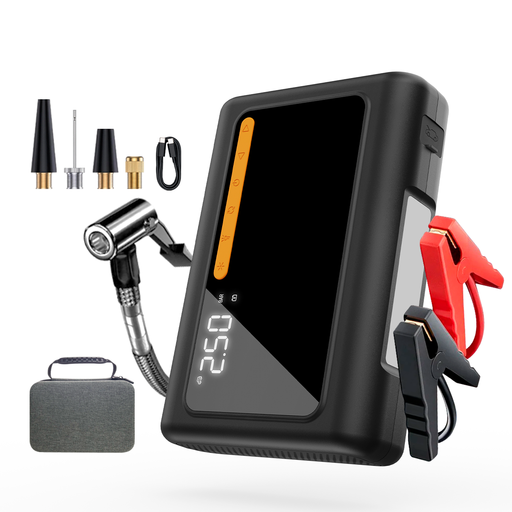
Why this choice suits this profile : One device combines 12 V starting, tyre inflation, USB-C charging and lighting. A practical solution that saves you from buying several separate products.
The product description states a starting current of 600 A and a peak current of 1 500 A, rather than focusing solely on capacity in mAh.
Compressor rated at 150 PSI, 60 W PD output and a 200-lumen light with three modes.
Why this choice suits this profile : Its sodium-ion battery and stated operating range may suit drivers who want to keep a backup solution in their vehicle.
The manufacturer’s product description states an operating range of -40 °C to 80 °C and up to 6 000 cycles. However, these figures should be considered alongside your actual storage conditions.
Dimensions of 213 × 147 × 57 mm, stated 60 W PD charging and petrol/diesel compatibility indicated up to 8 litres.
Why this choice suits this profile : Its multifunctional design is ideal for drivers who switch between several vehicles and want to carry just one emergency device.
Starting, inflation and charging functions are combined in one casing, with smart clamps listed in the product description.
Four functions in one device, four stated pump modes and a 60 W USB-C PD output for compatible devices.
We have put together a complete, real-time updated list of products that meet these strict selection criteria, as well as European safety requirements.
An all-season jump starter can stay in the boot, but it does not replace routine battery maintenance, checking tyre pressure or calling a professional if a fault persists.
Park the vehicle, switch off all electrical equipment and check that the booster has sufficient charge. Connect the red clamp to the positive terminal, then the black clamp to the negative terminal, following the instructions in the manual. Wait for the stated interval before attempting to start the engine. Once the engine has started, disconnect the clamps in the recommended order, then recharge the device.
It depends on the battery technology, its self-discharge rate and the temperature inside the boot. For the GK01, the product description states approximately 1% self-discharge per month and standby time of up to five years after a full charge. Nevertheless, it is best to check its condition regularly, particularly before winter or a long journey.
The stated maximum pressure is not enough to determine compatibility. Compare the vehicle manufacturer’s recommended pressure, valve type, airflow and operating time. For a lorry or motorhome, pay particular attention to tyre volume and the inflator’s usage limits.