
Livraison le jour même ou le lendemain

Qualité garantie

Débloquez vos offres de bienvenue: Livraison GRATUITE | Jusqu'à -80 % | 30 jours d'essai gratuits à JoyPlus
Téléchargez l'application
A second home, remote property, stable, or a construction site with no Wi-Fi or electricity? Securing these locations can be a major challenge. This is precisely where the 4G solar security camera comes in: a completely autonomous solution to keep an eye on your property, wherever you are.
This guide breaks down the essential criteria for making an informed decision and introduces you to the best models currently available. Our mission: to give you the keys to finding the camera that truly meets your needs, based on objective technical specifications.
Before diving into our selection, let's review the three pillars that define a good standalone camera with a SIM card.
Their strength? Complete independence.
Seeing isn't enough; you need to see clearly.
An effective camera only bothers you when necessary. Recent models integrate algorithms capable of distinguishing between people, vehicles, and sometimes animals, ignoring irrelevant motion (moving branches, rain, etc.). This is an essential feature for drastically reducing false alarms.
Two options exist for storing recordings:
Here is our selection of models that stand out for monitoring remote sites.
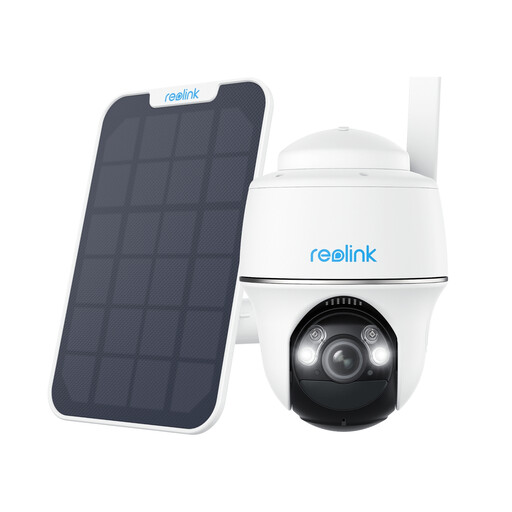
The Reolink G430 is an outdoor 4G camera built for off-grid locations. It combines mobile connectivity, solar power, and a motorised head for 360° surveillance.
Why it stands out: Its motorised head (355° rotation and 140° tilt) allows it to cover a huge area, all while being completely autonomous thanks to 4G and its solar panel. It's the ultimate all-in-one solution for monitoring a second home or an isolated warehouse.
Key features:
Who is it for? Ideal for owners of large properties, farms, or construction site managers who want to cover a wide area without installing multiple fixed cameras.
See details for the REOLINK G430
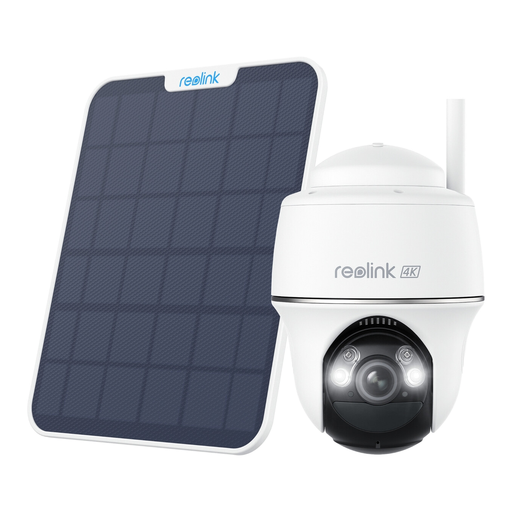
If your site, even if remote, has a Wi-Fi signal (for example, from a 4G router inside a building), a solar-powered Wi-Fi camera like the Reolink B440 will give you access to superior image quality. Please note: This model is Wi-Fi only and does not accept a SIM card.
Why it stands out: Its 4K Ultra HD (8MP) resolution offers an exceptional level of detail, perfect for identifying a specific element from a distance. Its colour night vision is also a major advantage for effective 24/7 surveillance.
Key features:
Who is it for? For those who demand the best possible image quality to monitor the surroundings of a home or business premises and who already have a Wi-Fi connection on-site.
See details for the REOLINK B440 Solar Kit
Surveillance needs vary from one person to another. If you want to explore other options with different features or for various budgets, our full catalogue is here for you.
To discover a wider range of motorised and autonomous cameras, take a look at our dedicated category.
Discover our selection of Smart Outdoor Solar Battery PTZ Cameras
A 4G solar security camera needs a nano-SIM card with a mobile plan that includes data. "Data-only" plans are often the most suitable. Consumption depends on your usage: a few gigabytes (GB) per month may be enough if you rely on alerts, but frequent viewing of the live feed will require a more generous plan (10 GB or more). Carriers like AT&T, Verizon, and T-Mobile all offer suitable plans.
This is a common concern. Winter battery life depends on two things: the amount of sunlight and the frequency of alerts. A well-sized and south-facing solar panel will continue to charge the battery, even on grey days, but more slowly. The integrated battery then takes over during days without sun. Pro tip: finely tune the detection zones and sensitivity to avoid wasting energy on unnecessary recordings.
Absolutely. The vast majority of these cameras are designed to be installed in minutes, even by those who aren't tech-savvy. The process is simple:
No special technical skills are required.
From the Joybuy Product Team