
Livraison le jour même ou le lendemain

Qualité garantie

Débloquez vos offres de bienvenue: Livraison GRATUITE | Jusqu'à -80 % | 30 jours d'essai gratuits à JoyPlus
Téléchargez l'application
Is your drawer overflowing with all kinds of chargers? Tired of endless charging times and a bag weighed down by separate adapters for your phone, tablet, and laptop? The widespread adoption of USB-C promised to end this chaos. The good news: a 45W USB-C charger is often the one-stop solution to unify everything.
Whether you have the latest iPhone 16, a Samsung Galaxy S25, or a MacBook Air, a single power brick can now do it all. This guide breaks down the essential features and presents our selection of the best models to help you make the right choice, without getting lost in marketing jargon.
Before you jump on the first model you see, let's review the key criteria that will make all the difference in your daily use.
A power output of 45W is the ideal sweet spot. It's enough for fast charging most recent smartphones, whether you need a fast charger for iPhone 16 or a charger for Samsung S25. This wattage is also sufficient to power more demanding devices like a tablet or a MacBook Air, making it a true universal USB-C charger. Always remember to double-check compatibility, although most modern devices can intelligently negotiate the power they draw.
Behind these acronyms lies the secret to charging that is both fast and safe.
For those on the go, size and weight are non-negotiable. Thanks to GaN (Gallium Nitride) technology, modern chargers are much more compact and lightweight than their silicon-based predecessors at the same wattage. A compact travel charger, ideally with retractable prongs or multiple ports, will quickly become an indispensable ally for lightening your bag.
Here is our selection of models that caught our eye, designed for today's needs.
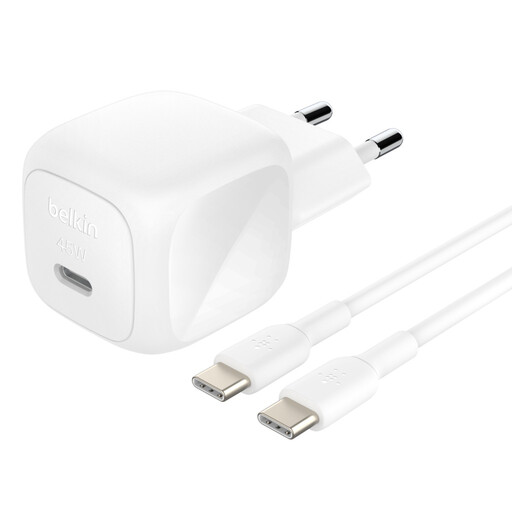
Why It Stands Out
The Belkin BoostCharge gets straight to the point: it's a simple and effective solution. It delivers the expected power in a feather-light package (just 58g) that you'll forget is in your bag. Supplied with its USB-C cable, it's ready to use right out of the box. We also appreciate its eco-friendly commitment, featuring a design made from recycled materials.
Highlights
Who is it for? For those who want a reliable and high-performance plug-and-play solution from a brand known for its quality accessories.
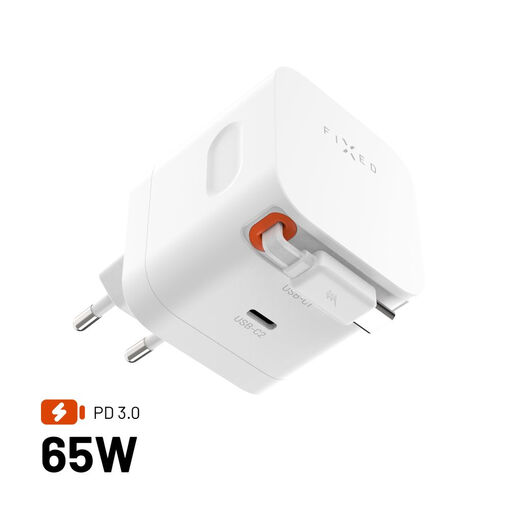
Why It Stands Out
The FIXED charger is all about clever design. Its key feature? A built-in, retractable 64 cm USB-C cable. No more forgotten or tangled cables at the bottom of your bag. With its 65W total output and GaN technology, it combines power and portability, making it the perfect compact travel charger.
Highlights
Who is it for? The ideal companion for travellers and mobile professionals looking for an ultra-practical, all-in-one solution to charge their laptop and smartphone at the same time.
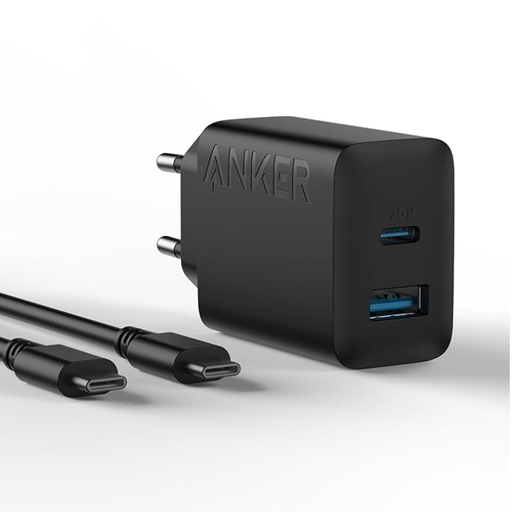
Why It Stands Out
At 20W, this Anker charger plays in a different league, but it remains a highly relevant option for those whose priority is charging their smartphone. Its strengths are its extreme compactness and welcome versatility, thanks to its dual ports (USB-C and USB-A). It can charge an iPhone 15/16 at full speed while also powering up an accessory like earbuds or a smartwatch.
Highlights
Who is it for? For those primarily looking for an ultra-compact charger for their smartphone and a small accessory, who will appreciate the versatility of the USB-A port.
None of these models quite right for you? If you're looking for a different wattage, more ports, or specific cable lengths, many other solutions are available.
Explore our full range of fast charging cables and adapters.
1. Is a 45W charger too powerful for my smartphone? No. Thanks to protocols like Power Delivery (PD), the charger and your device "negotiate" the required power. The charger will only deliver the maximum power your smartphone can safely accept, even if the charger itself is capable of providing 45W.
2. Can I use a 45W USB-C charger for my MacBook Air? Yes, absolutely. A 45W output is perfectly sufficient to charge a MacBook Air. Charging might be slightly slower than with the original 67W power brick if you are using the computer heavily at the same time, but for standard use or when the machine is asleep, it's perfect.
3. What is the difference between Power Delivery (PD) and PPS? Power Delivery (PD) is the base protocol that enables fast charging via several fixed voltage and current levels (e.g., 5V, 9V, 15V, 20V). PPS (Programmable Power Supply) is an extension of this standard. It allows the charger to adjust the voltage and current much more finely and dynamically. In practical terms, this optimises efficiency, reduces heat, and can even speed up charging on compatible devices, particularly many Samsung Galaxy smartphones.