Start by considering the space you actually have and how much washing-up builds up between cycles. A 45 cm model may suit a small family, while a countertop appliance can work for smaller loads if you have room on your worktop. In an open-plan kitchen, also compare the noise rating on the energy label and check the door clearance, water supply, drainage and electrical requirements for the model you choose.
Who are these sizes for?
Small family with limited floor space
If you can fit a floor-standing appliance but not a wider model, a 45 cm dishwasher can take more washing-up per load than a small countertop model. Que Choisir says 45 cm models with a capacity of 9 place settings may suit a small family, although you may need to run them every day.
Studio-dweller or owner of a very small kitchen
If floor space is scarce and you don’t have much washing-up, consider a worktop model. The Candy CP 6E51LS, for example, is listed as taking 6 place settings. You’ll still need to set aside a suitable surface and check its connections.
Open-plan kitchen-diner
If cycles might run during meals, while you’re working from home or in the evening, compare the noise level and noise class rather than choosing by size alone. These details can help you compare appliances, but they can’t guarantee the same level of comfort in every home.
Which criteria should you compare first?
First rule out any sizes that won’t fit, then compare capacity with the washing-up you usually have. Noise and energy and water use can help you compare the remaining models that suit your space.
| What matters |
What to check |
Who is this for? |
| Space |
Measure the height, width and depth, as well as door clearance. Check the intended space or worktop area. |
When every centimetre counts, I need to be able to open the door and load the racks without blocking the kitchen. Around 31% of consumers would put ease of installation first. |
| Capacity and loading |
Compare the stated number of place settings with the space available for the items you usually wash. |
If a small family’s washing-up builds up between cycles, an appliance that’s too small may need to be run more often. For around 25% of consumers, being able to load everyday dishes would be the priority. |
| Noise |
Check the noise level in dB(A) and the noise class, and consider when you’ll run the cycles. |
In an open-plan living space, I want to be able to talk or work while a cycle is running. Around 25% of consumers would be most concerned about reducing this disturbance. |
| Water and electricity |
Compare the kWh per 100 cycles and litres per cycle shown on the label, taking capacity into account. |
If I’m going to use the appliance often, I want to compare the water and electricity needed to wash my usual load. Around 19% of consumers would put this comparison first. |
For open-plan kitchens, Que Choisir includes noise among the factors to consider. The ADEME also points out that the energy label shows capacity and consumption, so you can compare these features without judging noise comfort by one figure alone.
Mistakes to avoid before you buy
-
Assuming a slim model will handle all your household’s washing-up
A narrower appliance doesn’t tell you how many plates, pans and utensils you’ll be able to load at once. If capacity is too limited, you may need to run more cycles.
Think about your usual load and check the rack layout, not just the stated number of place settings.
-
Measuring only the width
An appliance may fit in the space but stick out too far or prevent the door from opening fully. A countertop model will also take up some of your worktop.
Check all three dimensions and the clearance needed for loading. For an integrated model, also check the housing and compatible door panel.
-
Taking the dB(A) rating as a promise of silence
In an open-plan kitchen, where the appliance is placed and when it runs can also affect how disruptive it feels. Que Choisir highlights the importance of noise in this type of space.
Compare the noise level and class on the label, then think about when you’ll use the appliance.
-
Assuming a countertop appliance needs no connections
Candy says the CP 6E51LS connects directly to the water supply. However it’s supplied with water, you’ll still need to check how it drains and how it will be powered.
Check the instructions for the exact model and compare its installation diagram with the connections already in your kitchen.
Brands to consider
These examples show different installation options; their features don’t apply to every appliance from each brand.
Bosch
Worth considering if you’re looking for a 45 cm integrated model and already have a compatible housing and, where needed, door panel.
- Bosch lists dimensions of 815 × 448 × 550 mm and a noise level of 44 dB for the fully integrated SPV4EMX17E.
- Installation requires you to check the housing, door panel and connections. Bosch recommends using a professional installer.
Candy
An option to consider when floor space is limited and a countertop appliance with a smaller capacity will do.
- Candy lists 6 place settings and dimensions of 550 × 501 × 443 mm for the CP 6E51LS.
- The upper rack on this model isn’t adjustable, according to its product details. Also check the instructions for drainage and installation requirements.
Electrolux
Worth looking at if you have floor space for a freestanding 45 cm model and don’t need a fully integrated appliance.
- The ESA63200SX product details list 10 place settings, an adjustable upper rack and a noise level of 46 dB(A).
- The same details state that this model can’t be installed at a raised height. Check that it will fit in your chosen spot and that the door can open fully.
Miele
Another 45 cm freestanding dishwasher to compare if this type of installation suits your kitchen.
- Miele lists a noise level of 45 dB, a cutlery tray and a delay-start function for the G 5540 SC SL Active.
- These features and the noise level apply to this specific model. Check its dimensions and loading capacity against the space you have.
Countertop dishwashers on Joybuy
These four appliances are countertop options for compact kitchens. If you have floor space instead, compare the installation requirements of 45 cm models separately.
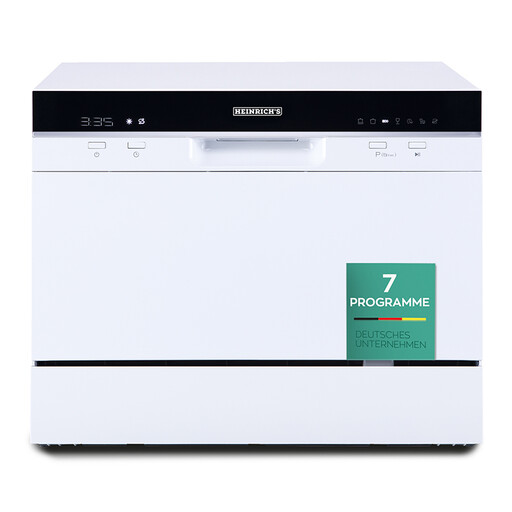 Image unavailable
Heinrich's HTG 8840 Weiss, 6 place settings
Worth considering if you’re looking for a countertop appliance with a stated capacity of 6 place settings. The product title lists 7 programmes, a 24-hour delay-start function, 47 dB and energy class D. Check these details against the energy label, and make sure the dimensions and connections suit your space.
View on Joybuy
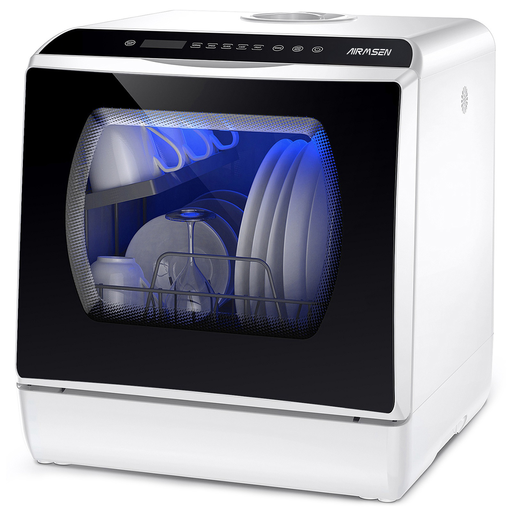 Image unavailable
AIRMSEN countertop model, 5 l water tank
Worth a look if you’d like to compare a countertop model with a built-in water tank. The product title lists a 5 l tank and 5+1 wash cycles. Before deciding where to put it, check its capacity, noise level, dimensions and drainage route.
View on Joybuy
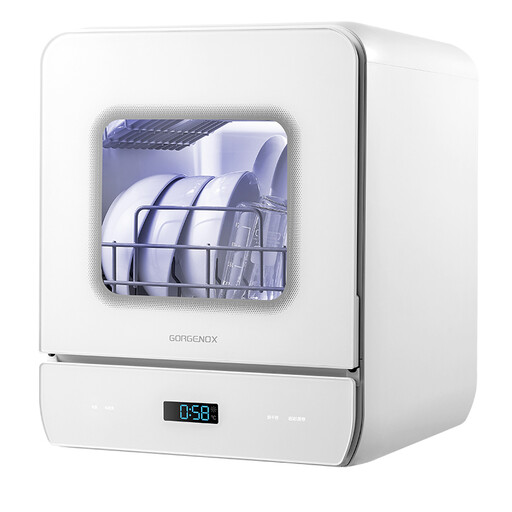 Image unavailable
GORGENOX DW5-D40A, 3 place settings
This countertop model is designed for smaller loads, provided its stated capacity of 3 place settings suits your needs. Check its dimensions and noise level, and read the instructions for its water supply and drainage requirements before setting aside space for it.
View on Joybuy
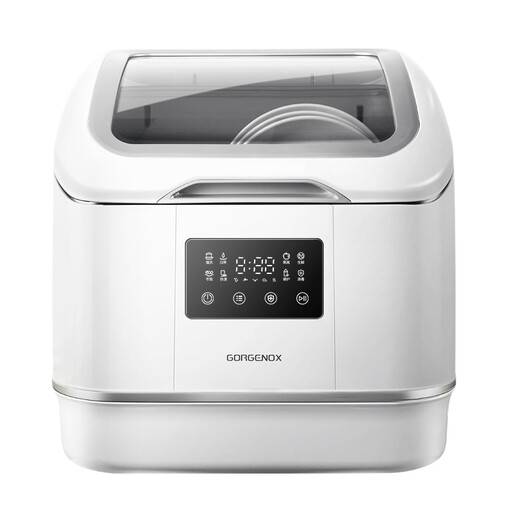 Image unavailable
GORGENOX DW4-D30A, 3 place settings
Another countertop appliance listed for 3 place settings. Consider it only if this capacity is enough for your everyday needs. Before choosing it, check how much space it needs, its noise level and the exact water supply and drainage requirements.
View on Joybuy
Frequently asked questions
Is a 45 cm dishwasher suitable for a small family?
It can be, if its capacity matches the amount of washing-up you produce between cycles. Que Choisir highlights 45 cm models with 9 place settings as an option for small families, while noting that you may need to run the appliance every day.
How should you compare noise levels in an open-plan kitchen?
Look at both the dB(A) level and the noise class on the energy label, then consider where the appliance will go and when you’ll be at home. The ADEME says a difference of three decibels corresponds to almost twice the noise. No single figure can guarantee how comfortable it will be in your living space.
Does a countertop dishwasher mean you won’t need any connections?
Don’t assume so. Candy, for example, says the CP 6E51LS connects directly to the water supply. Check the instructions for your chosen model to confirm its electrical supply, water inlet and drainage requirements against your existing setup.
Can you install an integrated model in place of a freestanding one?
Only if the housing, required door panel and connections are suitable for the integrated model you’ve chosen. Bosch recommends using a professional installer, so measure the space and check the installation instructions before you buy.


