Households with a narrow niche
If there’s a space under the worktop, measure its width, height and depth, then compare them with the installation diagram for the model. The door panel and clearance for opening the door must also suit the cabinet.


For a fitted small kitchen, start by checking the space available and the cabinet door. An integrated dishwasher is only suitable if the niche, connections and door panel all match the specific model. A 45 cm slimline appliance can work where width is limited, while a freestanding or worktop model needs its own space. If you’re unlikely to have enough washing up to fill a machine regularly, it’s also worth considering whether to stick with washing by hand.
If there’s a space under the worktop, measure its width, height and depth, then compare them with the installation diagram for the model. The door panel and clearance for opening the door must also suit the cabinet.
Que Choisir says a 45 cm dishwasher with capacity for 9 place settings can suit a small family, even if it needs to run every day. Check that the racks can accommodate the dishes you use regularly, though.
A freestanding appliance may be an option if you have the space and the necessary connections. It means you don’t need to provide a furniture door panel, unlike some fully integrated models.
Start with the space available, then make sure the capacity and installation requirements suit the amount of washing up you actually produce.
| Factor | What to check | What suits my needs |
|---|---|---|
| Space | Measure the usable width, height and depth. For an integrated model, compare these measurements with the model’s installation diagram, including the space needed for the hoses and door to open. | I want the appliance to fit the niche and its door to open without getting in the way of the surrounding cabinets. |
| Installation type | Check whether a door panel is needed and how it attaches. According to Que Choisir, the control panel remains visible on a semi-integrated model, unlike on a fully integrated one. | Without a suitable door panel, I’d rather look at a freestanding or worktop appliance than assume an integrated model will fit. |
| Capacity | Compare the number of place settings, the rack layout and the space for larger dishes. Consider how often you’ll be able to fill the machine. | I’m interested in a slimline model if its capacity suits my household’s washing up, even if it needs to run frequently. |
| Connections | Check the model’s instructions for the water supply, drainage and electricity requirements. For a worktop appliance, also check the surface it will stand on and where the drain hose will run. | I only want to automate the washing up if the appliance can be installed where I plan to put it. |
| Eco programme | The European Commission says that dishwasher energy labels show information including energy use per 100 cycles, water use per cycle, Eco programme duration, capacity and noise. Compare figures for the same programme. | Noise matters to me in an open-plan kitchen. I also need to know whether the Eco programme’s duration fits my routine. |
A suitable width doesn’t guarantee that the height and depth will fit, or that there’ll be enough room for the hoses and the door to open.
Measure the niche in all three dimensions and compare it with the installation diagram for the exact model before choosing a door panel.
A semi-integrated model has a visible control panel. A fully integrated model may be supplied without a furniture door panel and may need a specific fitting system, such as the SlideFit sliding hinges Beko specifies for the KDIS28122.
Check whether you have a suitable door panel, then look at the fitting instructions for the model you’re considering.
This figure doesn’t tell you whether larger dishes and utensils will fit. Que Choisir notes that a 45 cm model with capacity for 9 place settings may need to run daily in a small family.
Look at the rack layout and consider how much washing up your household produces each day.
The figures on the energy label relate to the Eco programme; they don’t necessarily describe a quick or intensive cycle.
Compare Eco figures across appliances, then check the duration and other programmes you’ll need separately.
The details below apply to specific models; they don’t describe every dishwasher from each brand.
The SPV4EMX17E is a slimline fully integrated model. Its installation diagram is worth comparing with the dimensions of your existing niche.
The EEA22100L is a 45 cm fully integrated model to consider if your kitchen has a suitable furniture door panel.
The KDIS28122 is a 45 cm fully integrated model to consider if capacity and the door-fitting system are key factors.
These four worktop dishwashers are for kitchens where space on a worktop is an option. They’re not a substitute for checking that a 45 cm integrated appliance will fit in your niche.
 Image unavailable
Consider this model if you can set aside space on your worktop and would prefer the option of filling it by hand. The title lists a built-in 5 L water tank, 6+3 programmes and an energy rating of D. Check its dimensions, clearance requirements and drainage arrangements for your chosen spot.
 Image unavailable
Its listed capacity for 6 place settings makes it easy to compare with the amount of washing up you usually have. The title mentions 7 programmes, 47 dB and an energy rating of D. Check the dimensions and water supply and drainage options before choosing a spot for it.
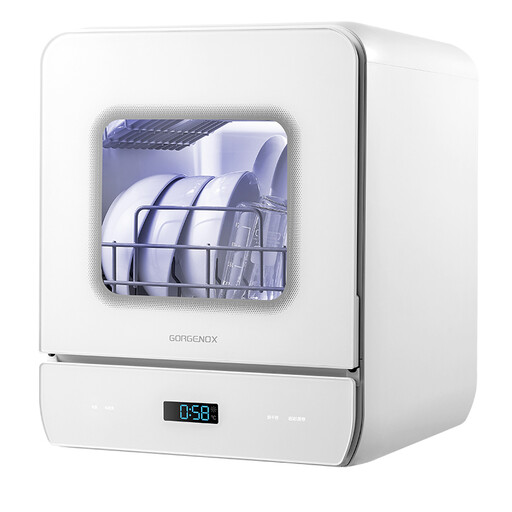 Image unavailable
Compare its listed capacity of 3 place settings with your household’s washing up before choosing a worktop appliance. Check the dimensions, clearance requirements and instructions for the water supply and drainage at your chosen spot.
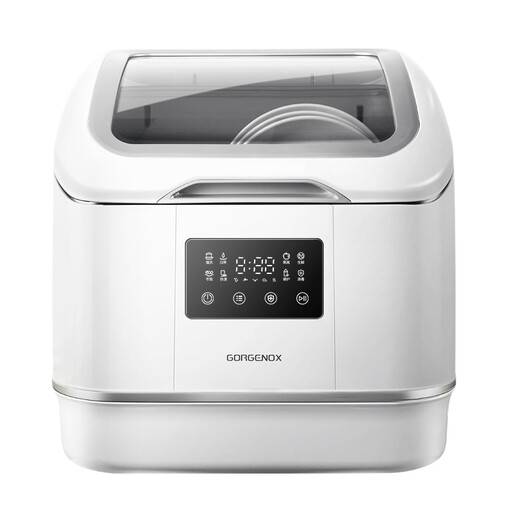 Image unavailable
This worktop model lists capacity for 3 place settings, so check that it suits the amount of washing up you produce. It’s listed as connecting to a tap; check that this is compatible with your plumbing, that the drain can be positioned appropriately and that you have enough space for the appliance.
Measure the usable width, height and depth of the niche, allowing for space behind the appliance and room for the door to open. Then compare your measurements with the installation diagram for the exact model, as Bosch recommends in its size guidance.
It can be, if its capacity and racks suit the dishes you use regularly. Que Choisir says a 45 cm model with capacity for 9 place settings can work for a small family, although it may need to run every day. In particular, check that there’s room for larger dishes.
According to Que Choisir, the control panel on a semi-integrated model remains visible on the front. For a fully integrated model, check whether a furniture door panel is included and whether its dimensions and hinges are compatible with the appliance you’ve chosen.
No. The European energy label also shows energy use per 100 Eco cycles, water use per cycle, Eco programme duration, capacity and noise. Compare these figures on a like-for-like basis, then check whether the programme duration suits the way you’ll use it.
First compare water use for the same programme, then choose a capacity you’ll use regularly. ADEME recommends waiting until the dishwasher is full before running a cycle and not pre-rinsing the dishes.