Small household without a dedicated water supply
A mini dishwasher with a water tank can save you from needing a fixed water connection. You’ll still need to direct its drain hose to a suitable outlet, as Daan Tech specifies for its Bob model.


Start by checking what installation is possible. A model with a water tank avoids the need for a fixed water supply, but it still needs a drain; a plumbed-in tabletop appliance or a slimline model needs the appropriate connections. For smaller loads, compare how much worktop space the tabletop models take up. If you often cook with dishes and pans, check whether a 45 cm model can fit your crockery and whether you have room for it on the floor. If no appliance can be installed safely, washing up by hand remains an alternative.
A mini dishwasher with a water tank can save you from needing a fixed water connection. You’ll still need to direct its drain hose to a suitable outlet, as Daan Tech specifies for its Bob model.
A plumbed-in tabletop appliance can handle smaller loads without taking up floor space. Candy France offers 6-place-setting models for small kitchens. Check that your crockery, particularly dishes and utensils, will fit in the basket.
If pans and dishes quickly fill a mini appliance, a slimline 45 cm model may offer more capacity. Beko France lists its DVS05024X as holding 10 place settings, but it needs floor space and the necessary connections.
First rule out any appliances your kitchen can’t accommodate or drain properly. Then compare the stated capacity with the crockery you actually use.
| Consideration | What to check | Who might prioritise it? |
|---|---|---|
| Installation | Check the socket, any water supply and the permitted route for the drain hose, as set out in the instructions. A tank doesn’t remove the need for drainage. | Without a dedicated water supply, I want to avoid altering the plumbing while still being able to drain the appliance without it overflowing. Around 36% of consumers would put this installation option first. |
| Space and everyday load | Measure the available space, including with the door open, then check the basket against the plates, glasses and utensils you usually use. | In a kitchen where the worktop is already used for meals, I need to save space without having to run another cycle for everyday crockery. Around 29% of consumers would prioritise this balance. |
| Meal size | Look at the basket layout and the space for pans and dishes, not just the number of place settings. | If I cook regularly, I’d rather be able to load my utensils alongside the plates than wash some items by hand. Around 21% of consumers would prioritise this capacity per cycle. |
| Energy use and maintenance | Compare kWh per 100 cycles, litres per cycle and the Eco programme duration. Also check the drying performance and which parts are available for the exact model. | For an appliance I’ll use regularly, I want to understand its energy use, drying performance and maintenance requirements before choosing. Around 14% of consumers would consider these factors decisive. |
ADEME says that the energy label’s electricity consumption figure is given in kWh per 100 standard cycles. This information helps you compare specific models, but it doesn’t, on its own, tell you how well each programme dries your crockery.
Daan Tech’s Bob can be filled from its tank without a fixed water supply, but waste water still leaves through a hose. It won’t be suitable if there’s nowhere to manage the drainage.
Before choosing a tank model, check the instructions to see where to position the hose and how to prevent it from being trapped or overflowing.
The stated capacity doesn’t guarantee that your frying pans, bowls and large plates will all fit at once. Basket layout matters especially in a compact appliance.
Measure your bulkiest crockery and compare it with the dimensions and loading limits of the model you’re considering.
A plumbed-in appliance needs accessible water and drainage connections. A tank model needs to be filled and drained in a way that suits its location.
Check what’s involved and make sure the connections are suitable before settling on a size, rather than judging by dimensions alone.
You’ll also need to keep detergent in stock and, depending on the model, dishwasher salt and rinse aid.
Manufacturers offer different programmes and drying systems across their models. A cycle’s duration or energy class alone can’t tell you how dry your crockery will be.
If drying performance is important to you, check the instructions and look for a comparable test of the exact model.
Daan Tech’s Bob is an ultra-compact freestanding appliance, listed at 34 × 49 × 49 cm. It can be used with its built-in tank or connected to a water supply.
Candy France offers plumbed-in tabletop dishwashers for small kitchens. Its CP 6E51LS is listed for 6 place settings and measures 550 × 501 × 443 mm.
Beko France offers the DVS05024X, among other models: a 45 cm slimline freestanding dishwasher listed for 10 place settings.
These countertop or tabletop appliances are designed with small kitchens in mind. Before choosing a model, compare how it takes in water, how it drains and how much space it needs.
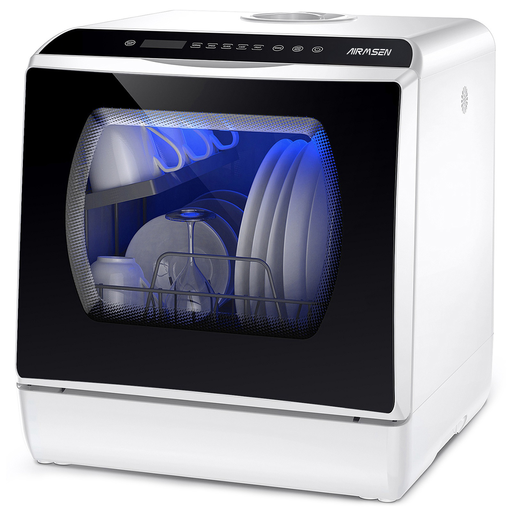 Image unavailable
Worth considering if you have worktop space but no dedicated water supply. The title lists a built-in 5 L tank and 5 + 1 wash cycles. Check the drainage route, whether your crockery will fit and whether the power supply is compatible with your home’s electrical system.
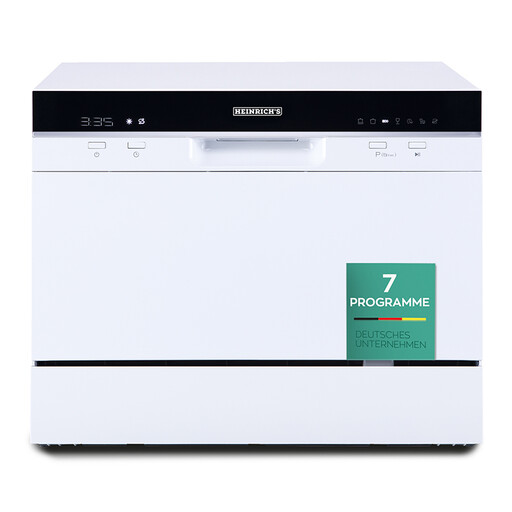 Image unavailable
Consider this for smaller loads if you have access to a water supply and drainage. The title lists 6 place settings and 7 programmes. Measure the space available and check that you can reach the connections.
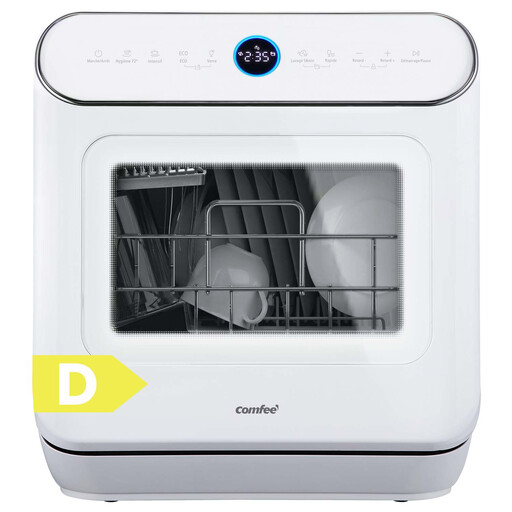 Image unavailable
This tabletop model is worth considering if you’re looking for an appliance you can fill by hand. Its title lists 7 programmes, but the phrase “3 Cutlery” doesn’t make the place-setting capacity clear. Ask for clarification on capacity and drainage. The associated safety information includes references to a refrigeration appliance; obtain the instructions for the CDWMT305WD before use.
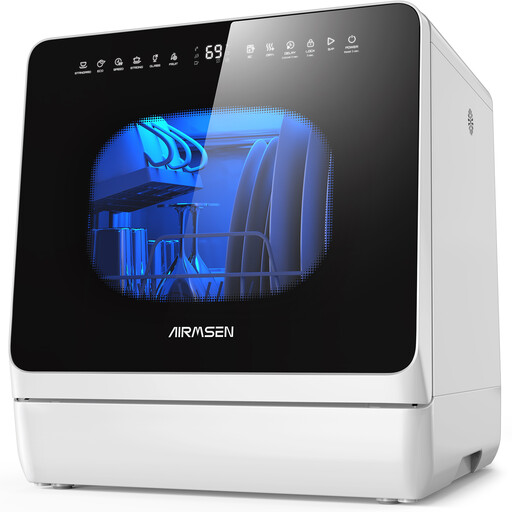 Image unavailable
Compare this model for smaller loads if you’d like a choice of programmes. The title lists 8 programmes and a built-in water softener. Check the instructions to see how the appliance takes in water, where it drains and how much space you’ll need.
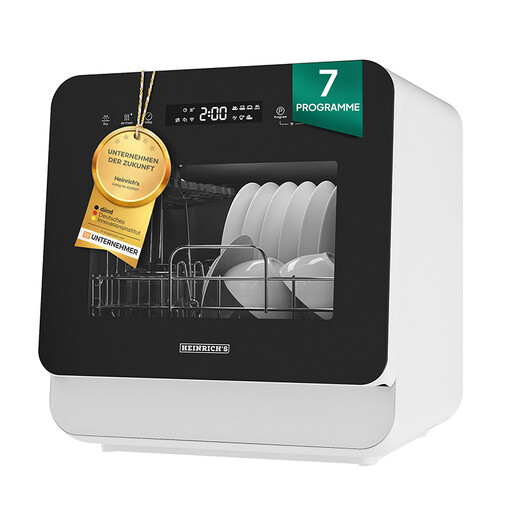 Image unavailable
Worth considering for a small load if you’re choosing between manual filling and connecting to the water supply. The title lists 3 place settings, 7 programmes and use with or without a water-supply connection. Check the dimensions, whether your utensils will fit and what drainage is needed for each setup.
No. A tank can remove the need for a fixed water-supply connection, but not for drainage. Daan Tech says Bob’s hose should be directed into a sink or another suitable drain. Check where the hose can run before choosing a spot for the appliance.
It depends on the model. Candy France’s CP 6E51LS connects directly to a water supply, while some mini appliances have a tank. Check the instructions for the model you’re considering to find out about its water supply, drainage and electrical requirements.
For the specific models you’re interested in, compare kWh per 100 cycles, litres of water per cycle, the Eco programme duration and noise level. ADEME explains that the consumption figures relate to the standard cycle; they don’t, on their own, predict how well a quick cycle will dry your crockery.
Check the repairability information for the model and ask which parts are available. The DGCCRF distinguishes between availability periods for different types of household dishwasher parts. Check the information for the appliance you’re considering rather than assuming all parts will be available for the same length of time.