
Same-day & Next-day Delivery

Quality Guaranteed

Unlock Your Welcome Offers: FREE Delivery | Up to 80% OFF | Free 30-day JoyPlus trial
Download the APP
Swapping out duvets with every changing season is a chore we could all do without. The promise of a 4-season duvet is an appealing one: perfect warmth all year round, from the lightest summer duvet to the most frigid winter nights. The problem? The market is flooded with models that don't live up to the hype, leading to restless nights and buyer's remorse. To invest in quality sleep, it's crucial to avoid the most common pitfalls.
As a product expert for Joybuy, I'm here to decode the market with you. Let's cut through the marketing jargon and focus on what really matters.
The "4-season" concept is often misused by manufacturers, and disappointment is common. Here are the two mistakes you absolutely must not make.
The most common trap? The so-called "temperate" or "all-season" duvet, sold as a miracle solution. In reality, it's often an awkward middle ground: a medium weight that's too hot during a heatwave and far too light when the frost sets in. A true4-season duvet is a modular system, composed of two separate duvets (a lightweight duvet for summer and a mid-season one) that can be joined together to create a warm, cosy duvet for winter.
We often focus on the filling, overlooking two game-changing details: the casing (the outer fabric) and the labels. A low-quality synthetic casing will lack breathability, ruining the benefits of a good filling and guaranteeing night sweats. Likewise, the absence of certifications like the STANDARD 100 by OEKO-TEX label can indicate the presence of harmful substances. For a natural duvet, the RDS (Responsible Down Standard) label certifies that animal welfare has been respected. These details, far from being minor, are guarantees of quality and safety for your health.
To make an informed choice, three technical parameters must be scrutinised. They determine the comfort, warmth, and ease of care of your future duvet.
The fill weight, expressed in grams per square metre (g/m?), measures the density of the filling and therefore the level of warmth it provides.
A high-performance 4-season solution combines a duvet of around 200?g/m? with another of around 300?g/m?. Once clipped together, they offer a combined warmth of 500?g/m?, ideal for the coldest weather.
This is the heart of the duvet, and each type has its own advantages.
Choosing the right size is essential to avoid finding your feet uncovered or fighting over the duvet. The golden rule: allow for an overhang of at least 20 to 40?cm on each side of the bed.
Rather than a simple list, we've matched standout models to specific user profiles. The goal: to help you find the duvet that's right for you.
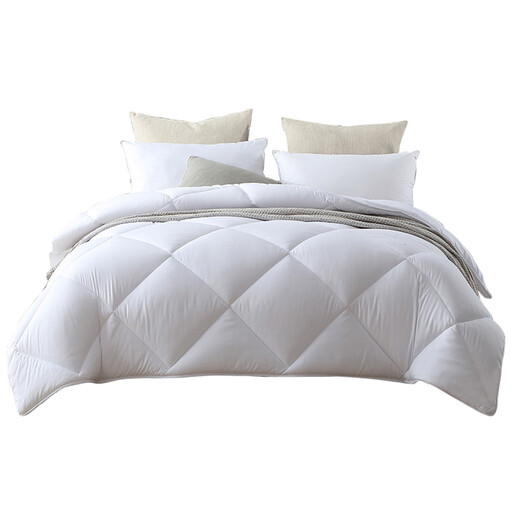
Why this choice? For those who prioritise simplicity, hygiene, and a controlled budget. Its synthetic filling is the ideal answer for people prone to allergies, and its machine-washable design simplifies daily care.
By focusing on a non-allergenic filling, it addresses an often-overlooked health criterion. Its "all-season" design is engineered for balanced comfort in moderately heated rooms.
Hypoallergenic and machine washable, for a healthy sleep environment and incredibly simple care.
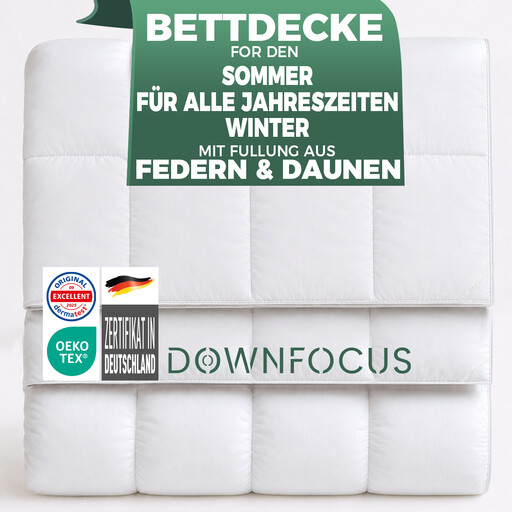
Why this choice? This is the very definition of a smart 4-season duvet. Ideal for couples or those who demand precise control over their comfort, it adapts to every temperature change with remarkable efficiency.
It sidesteps the "temperate" duvet trap by offering two distinct elements: a summer duvet (200 g/m?) and a mid-season duvet (450 g/m?). Combining them creates a true fortress against the cold in winter.
3-in-1 modularity for tailor-made comfort all year round. The Oeko-Tex and RDS certifications guarantee a healthy and ethical product.
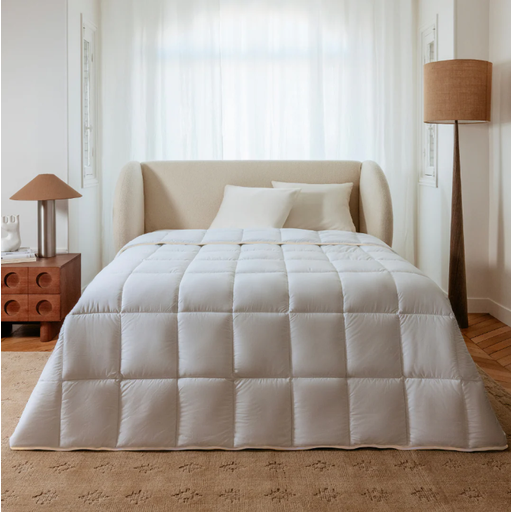
Why this choice? For those who swear by the loft and breathability of a natural filling. This model offers remarkable thermoregulation—warm in winter and breathable in summer—thanks to the inherent qualities of down and feathers.
Its baffle-box stitching prevents the filling from shifting and creating cold spots—a critical flaw in low-end natural duvets. Certifications (Oeko-Tex, etc.) guarantee a flawless product.
Natural temperature regulation and enveloping comfort. The organic cotton sateen casing perfectly complements it with exceptional softness.
We have selected other models for you that meet our demanding specifications for quality and safety.
It all depends on the filling. A synthetic duvet can usually be machine washed at 40?°C. Make sure to use a large-capacity machine (12?kg minimum) to avoid compressing it. For a natural duvet, dry cleaning is often recommended to preserve the loft of the down. If you attempt to wash it at home, choose a delicate cycle and tumble dry on low heat with dryer balls.
For a 160?x?200?cm (Queen Size) bed, two sizes stand out. A 220?x?240?cm duvet provides a comfortable overhang of 30 to 40?cm on each side. For even more room, especially if you move around a lot or have a thick mattress, don't hesitate to choose a 240?x?260?cm duvet.
Contrary to a common misconception, the allergy is rarely to the feathers or down themselves, but rather to the dust mites that can thrive in them. Many modern natural duvets have an anti-dust mite treatment, and their tightly woven casing acts as a protective barrier. However, if you are very sensitive, a synthetic hypoallergenic duvet remains the simplest and safest solution.