
Livraison le jour même ou le lendemain

Qualité garantie

Débloquez vos offres de bienvenue: Livraison GRATUITE | Jusqu'à -80 % | 30 jours d'essai gratuits à JoyPlus
Téléchargez l'application
One duvet for the entire year: the promise of a 4-season duvet is tempting. Say goodbye to the hassle of storage and changing your bedding with every season! However, this apparent simplicity often hides marketing traps that can turn your purchase into a real disappointment. To avoid being misled, it's crucial to know how to decipher labels and see through deceptive claims. Here is our guide to identifying the 3 mistakes to avoid and choosing the model that will truly adapt to your nights, from freezing winters to mild summers.
The "Universal" Duvet Myth: Be wary! Many models labelled "4-season" are actually just mid-weight duvets—too warm for summer and often not warm enough for deep winter. A TRUE 4-season duvet is modular. It must consist of two separate parts: a lightweight summer duvet and a mid-season duvet, which attach to each other to form a warm and cosy winter duvet. Without this modular system, comfort is likely to be subpar for much of the year.
Confusion Over Fill Weight (GSM): It's easy to assume that a high fill weight (measured in g/m? or GSM) automatically means more warmth. This is a misleading shortcut. A duvet's thermal performance depends primarily on the quality of its filling. For example, a natural down duvet at 250 GSM can be far more insulating and breathable than a low-end synthetic model at 400 GSM. Therefore, fill weight is just one indicator among many and must be considered in relation to the filling material.
Uncertified "Hypoallergenic" Claims: The word "hypoallergenic" is often thrown around without any proof. For sensitive or allergic individuals, effective protection relies on credible certifications. The Oeko-Tex Standard 100 label, for instance, is essential: it guarantees the textile is free from harmful substances. Furthermore, a good hypoallergenic synthetic duvet can be identified by its tightly woven casing, which acts as a physical barrier against dust mites.
You don't need to be a bedding expert to make the right choice. Focus on these three key points: they determine the comfort, durability, and effectiveness of your future duvet.
This is the number one criterion. The choice of filling affects everything: warmth, weight, breathability, and ease of care.
As we've seen, fill weight alone means little. For a 4-season duvet, the secret is modularity. Ensure the model consists of two duvets that can be joined together (with press studs, ties, or a zip):
When combined, they form a very warm winter duvet with a total fill weight that can exceed 500 GSM, perfect for facing the coldest nights.
For maximum comfort (and to avoid fighting over the duvet at night), it should overhang by at least 20 to 40 cm on each side of the bed. For a standard double bed (140x190 cm), aim for a 220x240 cm duvet. For a Queen or King Size bed (160x200 cm or 180x200 cm), a 2-person duvet of 240x220 cm or even 260x240 cm will be ideal.
Don't overlook the casing (the outer fabric)! A casing made of cotton, percale, or cotton sateen with a tight weave (over 90 threads/cm?) will not only be softer and more durable, but it will also create a better barrier against filling leakage and dust mites.
To help you visualise, here are a few options that meet specific needs, taking into account the criteria we've just discussed.
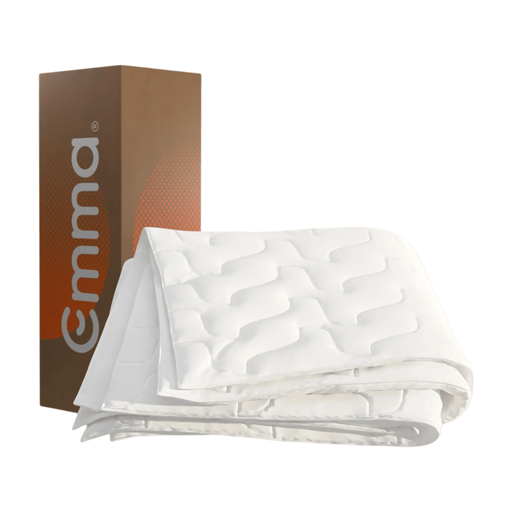
Editor's Take: Perfect for a couple, this model adapts to different heat sensitivities and seasonal changes. Its large 240x220 cm size ensures optimal comfort for two, with no need to fight over the covers at night.
This isn't a fake "universal" duvet, but a true 3-in-1 system. Its two layers of different thicknesses provide three distinct levels of warmth for perfect year-round adaptation.
Simple and effective modularity. The duvet is also breathable and machine-washable, two features that greatly simplify daily maintenance.
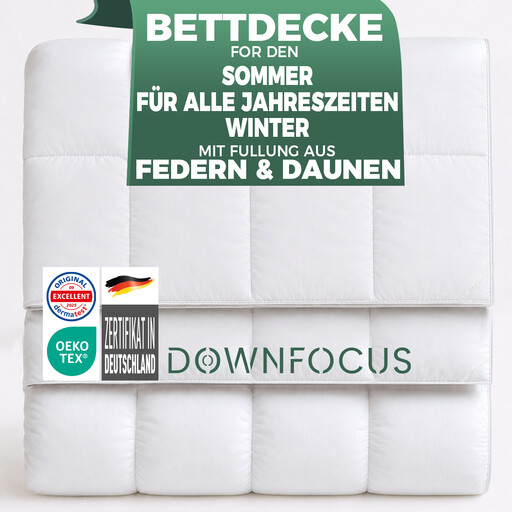
Editor's Take: For those who swear by the luxurious feel and thermal performance of down. This model combines the best of both worlds: a premium natural filling and an ultra-practical 4-season system.
This is a true 2-in-1 system with well-defined fill weights (200 g/m? + 450 g/m?), far from the "one-size-fits-all" duvet trap. The Oeko-Tex and RDS certifications guarantee impeccable quality and ethical sourcing.
Its filling (90% feathers, 10% down) offers an excellent balance of loft and warmth. The tightly woven cotton casing provides an effective natural barrier against dust mites.
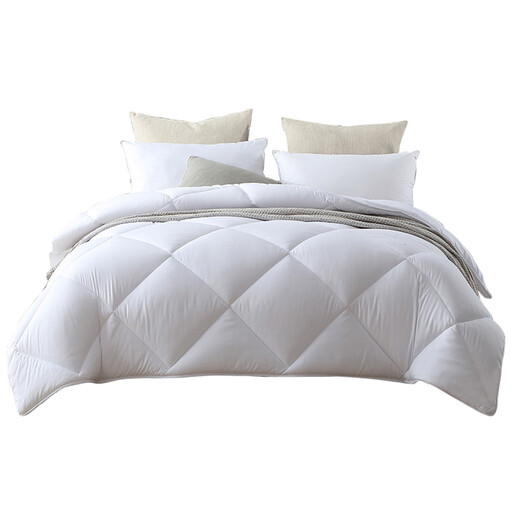
Editor's Take: This model is presented as hypoallergenic and washable, two essential criteria for those sensitive to dust mites and dust. The synthetic filling is a precautionary choice to minimise risks.
This model gets straight to the point by focusing on two concrete benefits: a synthetic filling (naturally less prone to allergens) and easy washability for perfect hygiene.
Practicality is its strong suit. Machine washing makes it simple to eliminate dust mites and ensure a healthy, hassle-free sleep environment.
Browse our complete selection of products that meet strict selection criteria and current safety standards.
A good 4-season duvet has a lifespan of 5 to 10 years. It all depends on the quality of its filling and how it's cared for. A well-maintained natural down model will often last longer than a synthetic one. Our tip: shake it out every morning to air out the filling and restore its loft.
Always refer to the manufacturer's label. Most synthetic duvets can be machine washed at 30°C or 40°C, provided you use a large-capacity washing machine (10 kg or more) to avoid compressing it. For natural duvets, dry cleaning is often recommended to preserve the qualities of the down. In any case, drying is a crucial step: use a tumble dryer on low heat with dryer balls to prevent mildew and restore the filling's full volume.
No, that's a common misconception. Warmth depends on the filling's ability to trap air (its "loft" or "fill power"). A high-quality goose down, for example, will be extremely insulating with a low fill weight because it is very light and airy. Conversely, a synthetic duvet will need a higher fill weight to achieve the same level of warmth, often making it heavier and less breathable.