
Livraison le jour même ou le lendemain

Qualité garantie

Débloquez vos offres de bienvenue: Livraison GRATUITE | Jusqu'à -80 % | 30 jours d'essai gratuits à JoyPlus
Téléchargez l'application
By the Joybuy Team, your product experts – Published August 26, 2026
On paper, the promise of a 4-in-1 convertible tricycle is incredibly appealing: a single purchase to support your child from their first wobbly steps to their first independent rides. However, this brilliant idea often clashes with a harsh reality. A cumbersome conversion mechanism, precarious stability, or materials that age poorly can quickly turn what should have been a smart purchase into an unused gadget gathering dust.
As product experts at Joybuy, our mission is to help you see things more clearly. Let's break down the common pitfalls to avoid and the essential criteria to check to make an informed choice, ensuring your child's long-term safety and enjoyment.
Before you even start comparing models, it's crucial to know the design flaws that frustrate parents the most:
To avoid these disappointments, it's best to focus on objective technical features. These are the true guarantees of a tricycle's quality and durability.
A true convertible tricycle should allow you to switch effortlessly between push-trike mode (steered with the parent handle), an independent tricycle, and finally a balance bike with pedals. Make sure the pedals and small wheels can be removed easily. Tool-free conversion systems are a real plus: they allow you to adapt the tricycle to your child's progress in seconds, even during an outing at the park.
Your child's safety is non-negotiable. Here are the points to inspect closely:
For a tricycle to truly grow with your child between the ages of 2 and 4, it must be fully adjustable. A height-adjustable seat (for example, from 33 to 37 cm) and a handlebar or parent handle that can be adjusted to several levels are therefore essential. This not only guarantees the child's comfort but also promotes good posture, which is vital for learning to balance with confidence.
Keeping these criteria in mind, here is a selection of models that tick the right boxes, each meeting a specific need.

Why it stands out: Ideal for toddlers from 18 months, this model has one goal: to offer rock-solid stability for learning to push off with their legs. Its low frame and four wheels allow the child to get on and off independently and with complete confidence.
This model counters "deceptive modularity" by specialising. By focusing on four wide wheels, it immediately eliminates the risk of instability and provides a solid base that classic tricycles cannot match.
Its 4-wheel structure offers ultra-reassuring stability for the youngest riders, which encourages balance development without the fear of falling.
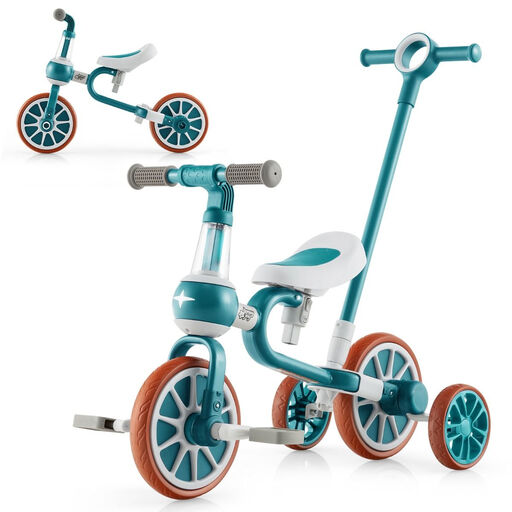
Why it stands out: This is the archetype of a well-designed 4-in-1 tricycle. Built to last with its sturdy frame and numerous adjustments, it adapts perfectly to a child's growth from 2 to 4 years old. A sensible choice for parents who want a single product for several years.
Its carbon steel frame and high-quality EVA wheels directly tackle the problem of low-grade materials. Its removable pedals and training wheels ensure modularity that actually works.
Its parent handle, adjustable to 4 heights (from 71 to 101 cm), and its adjustable seat offer optimal comfort for both the adult and the child, guaranteeing its longevity.
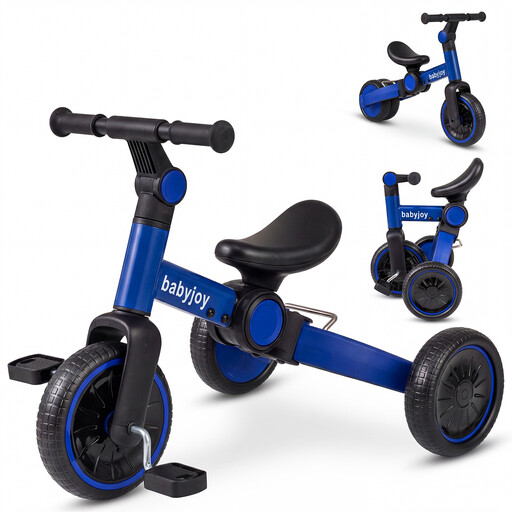
Why it stands out: For families looking for the ultimate all-in-one solution, this 5-in-1 model covers absolutely every stage of learning. It transforms to adapt to each new skill the child develops, maximising its lifespan.
Its design is entirely focused on transformation. By offering 5 distinct modes, it thumbs its nose at "deceptive modularity" and provides a logical progression curve, from an assisted balance bike to a small independent bike.
Its 5 configurations make it one of the most versatile models on the market. It adapts perfectly to every stage of a child's motor skill development.
We've curated a complete selection of products that meet our selection criteria and safety standards. Discover other options to support your child's play and development.
Most models target the 2-4 year age range. However, some, like four-wheeled balance bikes, are suitable from 18 months. The most important thing: always check the manufacturer's recommended age and ensure your child's feet can touch the ground when the seat is at its lowest setting.
A quality model with a good range of adjustment can be used for 2 to 3 years. It will follow your child's development from push-trike mode (around 18-24 months) to independence on a balance bike or small bicycle (around 3-4 years), making it a very cost-effective investment.
Generally, the initial assembly is quite simple and takes only 15 to 30 minutes. Good models come with clear instructions and the few necessary tools. The real factor to watch for is the ease of converting between modes (with or without tools), as this is what you will be doing regularly.