
Livraison le jour même ou le lendemain

Qualité garantie

Débloquez vos offres de bienvenue: Livraison GRATUITE | Jusqu'à -80 % | 30 jours d'essai gratuits à JoyPlus
Téléchargez l'application
Choosing your child's first bike is a major milestone. On paper, the 4-in-1 convertible tricycle seems to have it all: a single product that grows with your little one from 18 months up to 4 or 5 years old. It's an appealing promise, but one that can quickly turn into a headache. Behind the marketing, there are often pitfalls that transform a great deal into a source of frustration.
Too many parents end up with unstable models, clunky conversion mechanisms, or materials that don't survive the boundless energy of a young child. To avoid buyer's remorse, here are the three mistakes to steer clear of:
To ensure the tricycle will go the distance and truly accompany your child for several years, here are the technical points to check. These are the real guarantees of quality and durability for a child's first bike.
A good convertible tricycle must perform well in every configuration. Transitioning from one mode to another should be simple and quick. Ideally, the product covers four key learning stages:
Your child's safety is non-negotiable. Look closely at the tricycle's overall design. A sturdy frame, often made of carbon steel, offers far better longevity and stability than all-plastic frames.
Another critical safety feature is the steering angle limiter. A stop that prevents the handlebar from turning more than 135° significantly reduces the risk of a sudden fall caused by turning the handlebar too sharply. Finally, for a bike for a 2-year-old, wide wheels and a low centre of gravity are an essential guarantee of stability.
The wheels are a determining factor for comfort and versatility. EVA foam wheels are the most common on these models. They have the advantage of being lightweight, quiet, and puncture-proof, which is perfect for mixed indoor/outdoor use. They are ideal for smooth surfaces like pavements or hardwood floors. For rougher terrain, inflatable rubber wheels would offer better cushioning, but they are rarer and heavier on this type of product.
Rather than an exhaustive list, we've identified options that meet specific user needs, based on our criteria for versatility and safety.
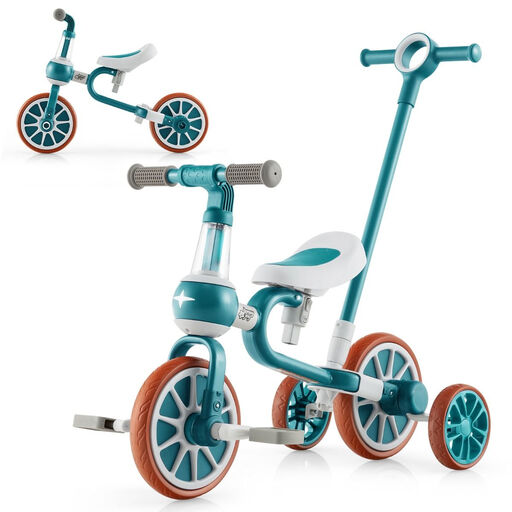
Why we recommend it: This model is for parents who want a single product for every learning stage, from ages 2 to 4. Its smart design allows for an easy switch from push trike to balance bike, making it a clever and cost-effective long-term choice.
It sidesteps the "fake modularity" trap with truly removable pedals and training wheels. As a result, each mode (push trike, tricycle, balance bike) is well-designed, functional, and stable.
Its robust carbon steel frame supports up to 30 kg, and its parent handle is adjustable to 4 positions, ensuring both comfort and durability.
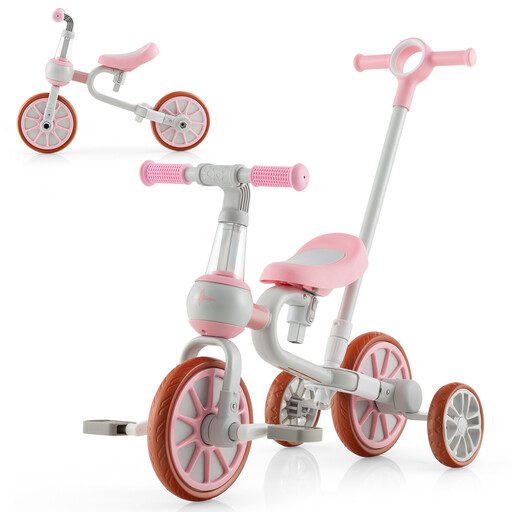
Why we recommend it: Perfect for little ones just starting out. This model focuses on safety and comfort for those first rides when parental control is essential. Its design is meant to reassure both parent and child.
It tackles the problem of instability head-on. Its frame is designed for a low centre of gravity, and the adjustable push handle provides precise parental control, minimizing swerving and the risk of tipping.
The design prioritizes safety for the youngest riders (ages 2-4), with a comfortable parent grip and a stable structure for those first outings.
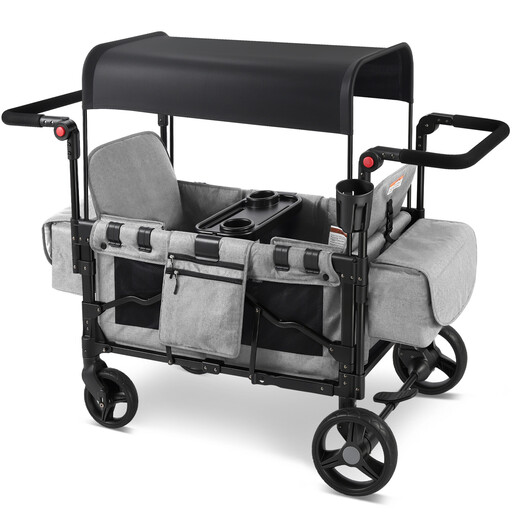
Why we recommend it: For parents of twins or children close in age, the logistics of outings can quickly become a nightmare. This wagon is a fantastic solution for transporting two children comfortably and safely, without having to juggle two separate tricycles.
It solves a logistical problem that a single tricycle can't: managing two young children at the same time. No more juggling a stroller and a tricycle.
It's equipped with two seats with 5-point harnesses, a suspension system, and excellent manoeuvrability, ensuring safety and comfort for both passengers.
We've put together a complete selection of products that meet our quality criteria and current European safety standards.
Most models can be used from 18 months or 2 years old, in push-trike mode with the parent handle. At this age, the child is just a passenger. You just need to make sure they can sit up straight and their feet rest comfortably on the footrests.
The transition to the convertible balance bike is an important moment. To ensure everything goes safely, completely remove the pedals (don't just fold them away). Next, adjust the seat to the correct height: the child should be able to sit down and place both feet flat on the ground with their knees slightly bent. This is the key to giving them the confidence to get going and find their balance.
Yes, absolutely. For the typical use of a convertible tricycle, EVA foam wheels are the ideal solution. Their advantages? They are lightweight (easier for a child to handle), quiet, and, most importantly, puncture-proof, which saves you from any maintenance. They are perfect for smooth surfaces like pavements, driveways, or even hardwood floors at home. Their grip is slightly less effective than rubber on wet ground, but they remain a very safe and practical option for a first bike.