
Livraison le jour même ou le lendemain

Qualité garantie

Débloquez vos offres de bienvenue: Livraison GRATUITE | Jusqu'à -80 % | 30 jours d'essai gratuits à JoyPlus
Téléchargez l'application
By Joybuy, Your Product AdvisorPublished July 15, 2026
Finding your car damaged in a parking lot or being caught in an accident with no witnesses... these are situations every driver dreads. In the face of these risks, equipping your car with a surveillance system is no longer a luxury, but a true peace-of-mind investment. A 4-channel dashcam goes a step further by offering a panoramic view, simultaneously recording the front, rear, and sides of your vehicle.
In this guide, we'll break down the key features of these cameras and introduce you to the models that stand out from the crowd. Our goal: to help you make an informed choice, without the marketing fluff.
The dashcam market is evolving at lightning speed. To navigate it, it's best to focus on a few criteria that truly make a difference.
The main advantage of a 4-channel system is its 360-degree coverage. Unlike a 3-channel dashcam (front, rear, interior), the fourth lens covers a crucial blind spot, typically on the sides of the vehicle. For a video to be admissible as evidence, image quality is paramount. A 4K car camera for the front lens is now the standard for clearly reading a license plate, day or night. Night vision is therefore a decisive factor, depending on the quality of the sensors and image processing technologies.
Recent models come packed with features that make your life easier and enhance your security. A dashcam with GPS and Wi-Fi is standard on high-end models.
It's when your vehicle is parked that a car surveillance camera becomes truly essential. The 24-hour parking mode is the key feature for protecting against hit-and-runs and vandalism. It typically works in one of three ways:
To take advantage of this round-the-clock surveillance, a specific hardwire kit, sold separately or included, is essential. It connects to the vehicle's battery to provide continuous power to the camera.
Here is our selection of models that stand out for their performance and their approach to 360° surveillance.
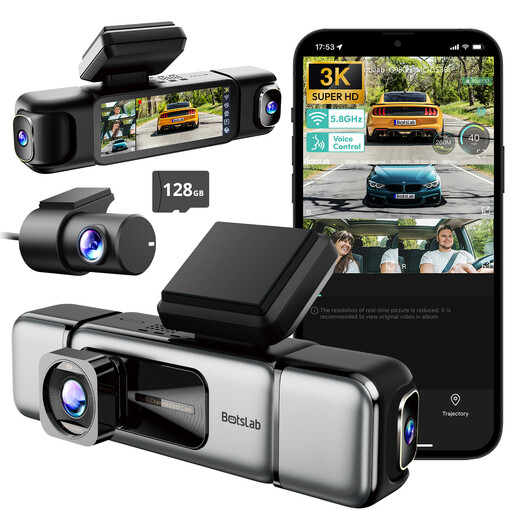
What sets it apart: This model offers an all-in-one solution with four distinct cameras (front, rear, and two side cameras) for an advertised 560° coverage. Its 3.18-inch touchscreen allows you to view all four feeds simultaneously, a real plus for immediate monitoring.
Pros:
Who is it for? Drivers looking for a "pure" 4-channel solution with a control screen and a complete starter pack.
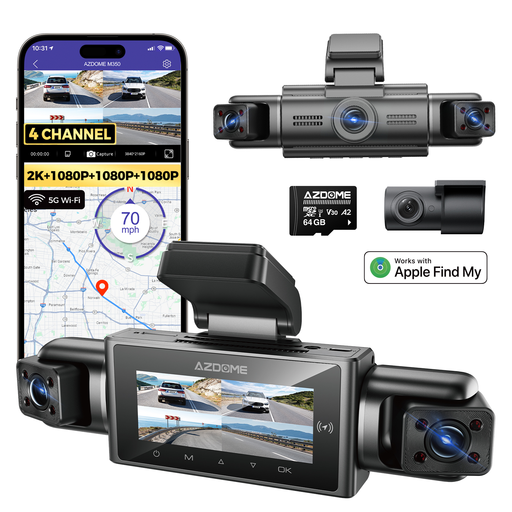
What sets it apart: Billed as the world's first 4-channel dashcam with native integration of the Apple Find My network. This feature allows you to geolocate your vehicle through the Apple ecosystem, without a third-party app or subscription. A major innovation for iPhone owners.
Pros:
Who is it for? Apple ecosystem users who want to add a layer of security and peace of mind with the location tracking feature.
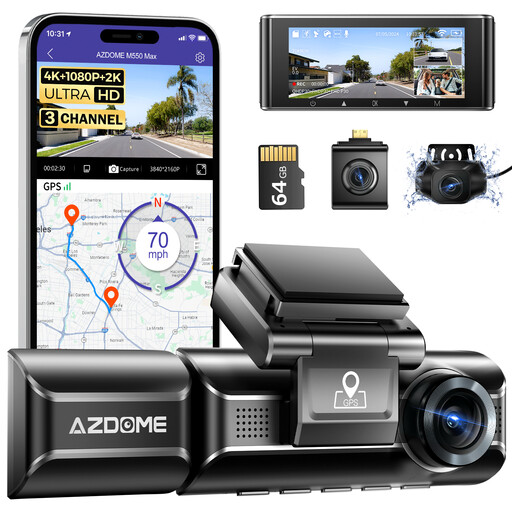
What sets it apart: Although it's a 3-channel model (front, interior, rear), the AZDOME M550 MAX plays in the big leagues thanks to its resolution. It can simultaneously record in 4K at the front, 2.5K at the rear, and 1080p inside—a configuration as rare as it is powerful.
Pros:
Who is it for? Drivers (rideshare, taxis, families) for whom interior surveillance is as crucial as the exterior, and who refuse to compromise on front/rear image quality.
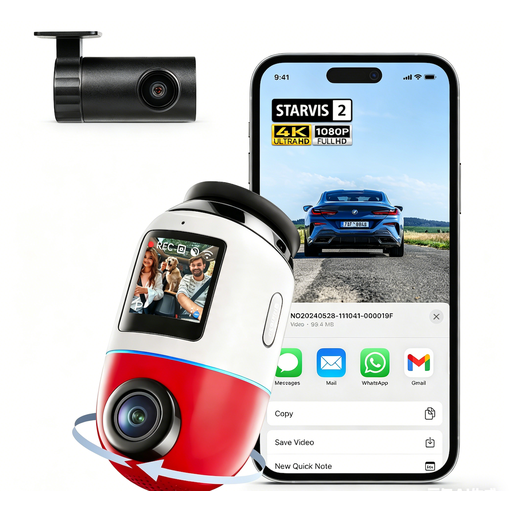
What sets it apart: This dashcam reinvents 360-degree surveillance with a single motorized front camera that swivels on its axis. Paired with a 1080p rear camera, it offers flexible coverage and AI-enhanced motion detection that tracks suspicious subjects around the vehicle.
Pros:
Who is it for? Tech enthusiasts who want a state-of-the-art surveillance solution with ultra-smooth 4K image quality, intelligent detection, and the option for remote access via 4G.
Every driver has different needs. If the models presented don't check all your boxes, or if you're looking for a simpler solution, feel free to explore our full category. There you'll find a wide range of navigation systems and dashcams for all budgets and uses.
? Explore our full selection of Automotive GPS and dashcams.
Yes, using a dashcam is legal in most countries for private use. You are generally allowed to film public roads from your vehicle. However, be cautious: sharing this footage on the internet or social media is strictly regulated by privacy laws (like GDPR in Europe) and right-to-privacy principles. In the event of a legal dispute, recordings can be submitted as a form of evidence, but their admissibility is ultimately at the discretion of the court.
Parking mode allows the camera to monitor your car even when the engine is off. To work, the dashcam requires a constant power supply. This necessitates installing a "hardwire kit" that connects directly to the vehicle's fuse box. This kit includes a voltage cutoff feature to prevent draining your car's battery. Once installed, parking mode automatically activates as soon as you turn off the ignition.
The basic installation (front and rear cameras) is fairly straightforward and can be done by most people. The cables can be easily tucked away along the windshield and interior trim. However, installing the hardwire kit for parking mode is more complex, as it involves the car's electrical system. If you're not comfortable with automotive wiring, it is highly recommended to have a professional handle the installation to ensure it is safe and reliable.