
Livraison le jour même ou le lendemain

Qualité garantie

Débloquez vos offres de bienvenue: Livraison GRATUITE | Jusqu'à -80 % | 30 jours d'essai gratuits à JoyPlus
Téléchargez l'application
A 4-channel dash cam compatible with Apple Find My meets several needs: recording the road, monitoring the area around your vehicle, and making it easier to locate your car from an iPhone. However, be aware: not all dash cams marketed as “360-degree” offer the same coverage or the same connected features.
Before placing an order, check the actual number of cameras, the resolution of each lens, the conditions required for parking mode, and genuine compatibility with the Apple Find My network. These few checks will save you from a disappointing installation and extra costs.
A front camera fitted with a wide-angle lens does not necessarily film the sides or the rear of the vehicle. A true front, rear, left and right car camera relies on several distinct lenses, positioned to reduce blind spots.
So make sure the specification sheet clearly mentions four independent channels: front, rear, left and right. A simple front-and-rear dash cam does not offer the same coverage as a model with four cameras.
The mention “4K” may apply to just one camera, with the other sensors filming at a lower resolution. To compare models on a solid basis, examine the resolution of each channel. A 2K 1080p dash cam setup, with a 2K front camera and three 1080p cameras, can prove more consistent than a model that only boasts a high resolution on paper.
Image quality also depends on the lens aperture, video compression, lighting and the stability of the installation. H.265 format can reduce file sizes at comparable quality, but check that your smartphone or computer can actually play it.
24-hour parking mode generally requires a permanent power supply or a suitable hardwire kit. Plugged into the cigarette lighter socket, the camera may stop recording as soon as the ignition is switched off. You also need a system to protect against excessive battery drain.
Before ordering, check whether the hardwire kit is included, sold separately, or intended for professional installation. In any case, monitoring a parked vehicle must comply with UK regulations regarding privacy and image capture.
For perimeter protection, look for four independent video streams, with a display that lets you view the feeds separately or simultaneously. Side cameras must be installed without obstructing the mirrors, airbags or the driver’s visibility.
Infrared night vision can improve image clarity inside the cabin or around the car. However, it does not replace adequate lighting or careful camera positioning. Ambient brightness, reflections on the windscreen and the cleanliness of the lenses all play a decisive role.
A dash cam with built-in GPS can record position, speed and route in the video metadata. This information makes it easier to organise footage and reconstruct a journey. A word of caution: accuracy varies depending on satellite reception and the urban environment.
In town, in an underground car park or between buildings, the GPS signal may temporarily drop out. This does not necessarily mean the camera is faulty.
A 5 GHz Wi-Fi dash cam can speed up video transfers to a compatible smartphone, particularly for reviewing an incident without removing the memory card. The range is limited to the vicinity of the vehicle, and the phone usually needs to connect to the wireless network created by the camera.
Plan for a memory card designed for continuous recording. Four channels generate far more data than a single camera. Loop recording normally overwrites the oldest files, while the impact sensor can lock certain clips. Check regularly that the card remains readable and back up important videos.
Voice control also helps reduce distractions while driving. For a voice control dash cam, check the language actually supported: some specifications only list English, which can quickly become inconvenient for everyday use in the UK.
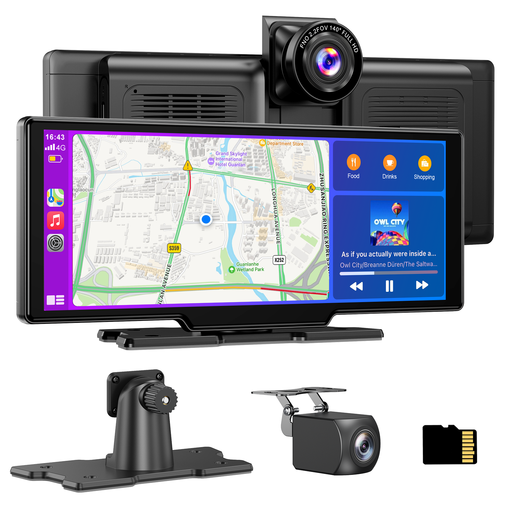
Why this choice suits this profile: This solution is ideal for a first installation, without major modifications to the vehicle. It includes a 26.1 cm screen, wireless CarPlay and a front-and-rear camera.
The specification clearly states a 4K front camera, a 1080p rear camera, a 64 GB TF card and a 12–24 V plug connection. However, coverage is limited to two cameras.
Wireless CarPlay and Android Auto, loop recording, 140-degree wide-angle lens and multiple audio outputs.
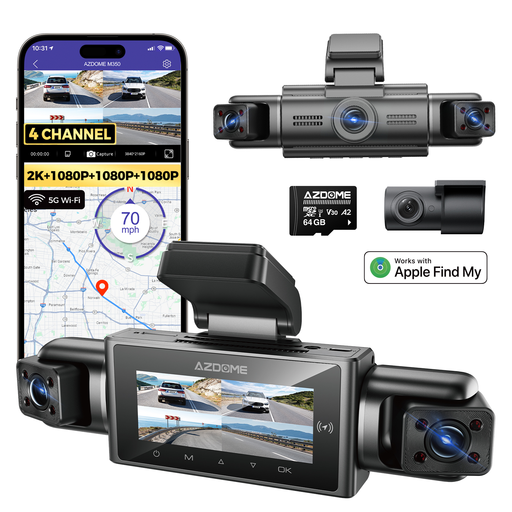
Why this choice suits this profile: It is aimed at iPhone users who want to combine location tracking via Apple Find My, front, rear and side views, GPS and wireless transfer.
The product specification lists four distinct channels, with a 2K front camera and three 1080p cameras. It also mentions native compatibility with the Apple Find My network: check the operating conditions and feature availability in your region.
Built-in GPS, 5 GHz Wi-Fi, supercapacitor, infrared night vision, English voice control and advertised continuous recording.
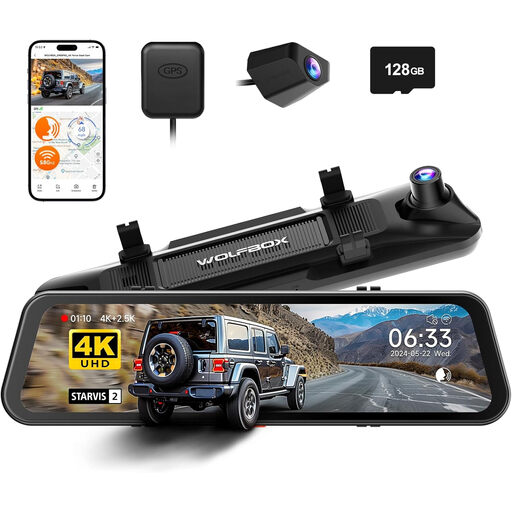
Why this choice suits this profile: Its rearview mirror format targets drivers looking for an integrated installation with a rear screen, GPS, voice control and fast Wi-Fi connectivity.
The specification indicates a 4K front camera, a 2.5K rear camera, a 128 GB card, loop recording and a G-sensor. This is not a four-channel setup: a distinction to keep in mind when comparing with dash cams advertised as “360-degree”.
Advertised STARVIS IMX678 sensor, 30.5 cm screen, 5.8 GHz Wi-Fi, GPS and 128 GB memory card included.
We have put together a comprehensive, real-time updated selection of products that meet these demanding criteria and comply with European safety regulations.
The front camera is usually mounted behind the rearview mirror, without reducing the field of vision. The rear and side modules should be positioned according to the bodywork and cable routing. Before starting, check compatibility with airbags, door seals and interior trim. For parking mode, a hardwire kit with undervoltage protection may be necessary.
No. Apple Find My can help locate a device or vehicle associated with the network, subject to the conditions set out by the product and service. The feature does not prevent the engine from starting, does not trigger an alarm and does not guarantee vehicle recovery. It is a complementary location tool, to be used with the usual precautions.
The cost mainly depends on the memory card, the power supply needed for parking mode and, potentially, professional installation. Wi-Fi does not necessarily require a mobile subscription: it is typically used to transfer files near the vehicle. However, check the model’s documentation for the terms of use of Apple Find My and access to the service.