
Livraison le jour même ou le lendemain

Qualité garantie

Débloquez vos offres de bienvenue: Livraison GRATUITE | Jusqu'à -80 % | 30 jours d'essai gratuits à JoyPlus
Téléchargez l'application
A 4-channel 360° dashcam records the front, rear and both sides of your vehicle simultaneously. This setup is particularly well suited to urban drivers exposed to side-swipe incidents, motorists who spend long hours on the road and owners who want a record of an incident that occurred while their car was parked.
However, technical specifications are not always easy to interpret. The term “360°” may refer to a rotating camera, a wide-angle lens or four separate sensors. Before buying, check exactly what the system includes, the installation requirements and the essential accessories.
A front-facing camera mounted on a rotating bracket may cover a large part of the car’s interior, but it does not record the rear and sides simultaneously like a 4-camera dashcam. For genuinely multi-directional coverage, look specifically for 4-channel and check the listed positions: front, rear, left and right.
A 4K dashcam may record in ultra-high definition at the front, while the rear and side modules are limited to Full HD. This is not necessarily a drawback: the front camera benefits from a higher level of detail, while the other angles are mainly used to document what is happening around the vehicle. Simply compare the resolution of each channel.
Parked-vehicle monitoring often requires a hardwire kit connected to the fuse box. The 12 V socket does not guarantee continuous recording once the ignition is switched off. Also check for impact detection, motion detection or time-lapse recording, as well as the kit’s compatibility with your car.
When choosing a front, rear and side car dashcam, examine the following points:
Four video feeds fill storage space quickly. Choose a high-endurance Class 10 or U3 microSD card, while staying within the maximum capacity specified by the manufacturer. The H.265 format can reduce file sizes compared with some older encoding formats, but make sure it is supported by your phone and computer.
Automatic locking via the G-sensor is just as important: when an impact is detected, the footage is protected from being overwritten by the loop recording system. Some models also record a few seconds before and after the event.
Built-in GPS adds the location, speed and route to the video data. 5 GHz or 5.8 GHz Wi-Fi generally speeds up transfers to the app, provided your phone is compatible. Voice control reduces the need for manual interaction, but check which languages are available: some models only understand English.
For installation, position the front camera behind the rear-view mirror without obstructing your view. Route the cables away from the airbag deployment areas. In France, a dashcam intended for personal use must be used responsibly: avoid publishing images that could identify people or number plates without taking appropriate precautions, and never operate the device while driving.
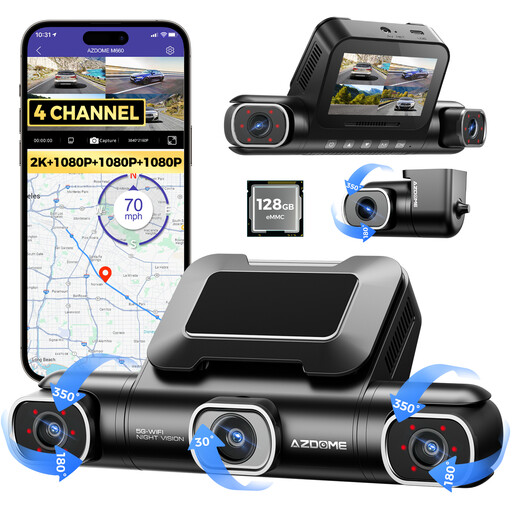
Why this choice suits this profile: Its configuration, with a 2.5K front camera and three 1080p channels, is a great introduction to four-sided coverage. The 128 GB eMMC storage is built in, so you do not need to buy a microSD card straight away.
The four-channel specification makes it clear that this is not simply a rotating lens with simultaneous coverage. GPS, the G-sensor and parking modes are built in.
Four channels, a 3-inch IPS screen, 5 GHz Wi-Fi, voice control and advertised 10-second pre-incident recording.
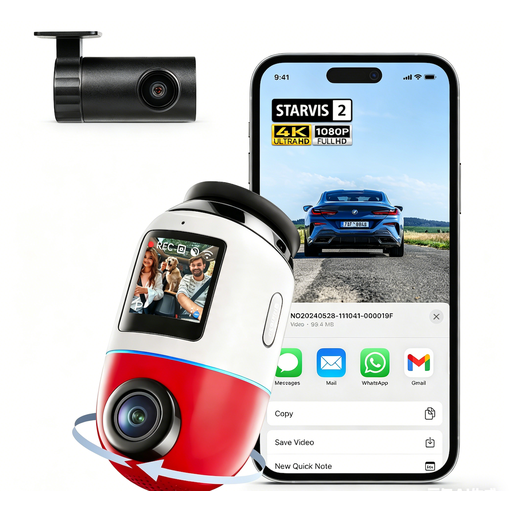
Why this choice suits this profile: This alternative combines a rotating 4K front camera with a 1080p rear camera, plus 4G and Wi-Fi 6 connectivity. It is aimed at drivers looking for connected monitoring and excellent image quality at the front, without needing four independent video feeds.
The product details clearly distinguish the front-and-rear system from a 4-channel dashcam. A hardwire kit is still essential to use the parked-vehicle monitoring features.
4K front video at 60 frames per second, built-in GPS, advertised motion detection and support for a card of up to 512 GB.
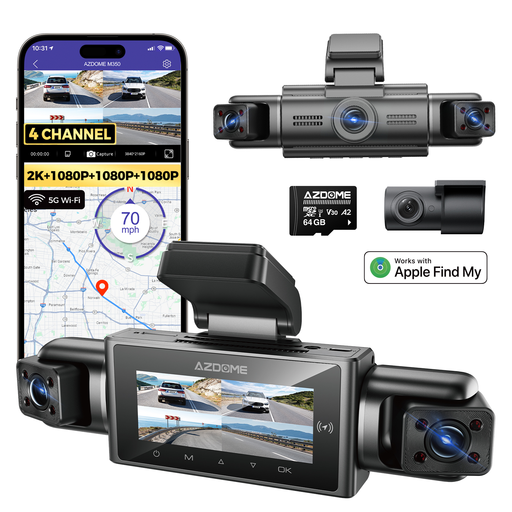
Why this choice suits this profile: iPhone users may be tempted by the native Apple Find My support advertised in the product details, along with four channels, GPS and 5 GHz Wi-Fi.
The resolutions are listed separately: 2.5K at the front and 1080p for the other three cameras. 24-hour parking mode and a supercapacitor are also mentioned.
Four views, built-in GPS, infrared night vision, voice control in English and advertised access to the Apple Find My network without an additional app.
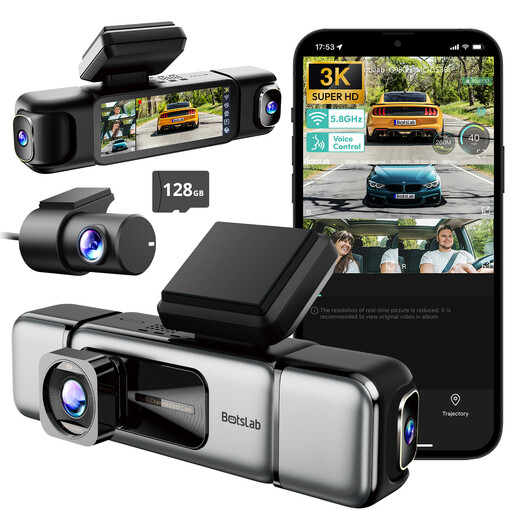
Why this choice suits this profile: Its 3.18-inch touchscreen makes it easy to check the different viewing angles quickly. All four cameras record the front, rear and sides, which is a real advantage for manoeuvring in town and frequent parking.
The three parking modes are explained in detail, and the hardwire connection required for certain features is clearly indicated.
3K front camera, 120° side modules, 150° rear camera, GPS, 5.8 GHz Wi-Fi, voice control and an advertised included 128 GB SD card.
We have put together a complete, real-time updated selection of products that fully meet these demanding criteria, while taking European safety regulations into account.
Installation takes longer than with a front-and-rear model: you need to position two side cameras and conceal several cables. Clean the windscreen before attaching the mount, keep the cables away from airbag deployment areas and check each angle using the screen or app. For connection to the fuse box, it may be best to call in a professional.
Choose a high-endurance Class 10 or U3 microSD card with a capacity compatible with your dashcam. Four video feeds use up available space much faster; regularly formatting the card from the camera can help maintain stable operation. Some models, such as the AZDOME M660, include eMMC storage.
Yes. Continuous monitoring can place a demand on the battery. Parking mode should normally use a hardwire kit with battery-discharge protection, where a compatible model is available. Before buying, check the available modes, recording duration and the manufacturer’s recommendations for your car.