
Livraison le jour même ou le lendemain

Qualité garantie

Débloquez vos offres de bienvenue: Livraison GRATUITE | Jusqu'à -80 % | 30 jours d'essai gratuits à JoyPlus
Téléchargez l'application
Installing a trampoline in the garden is the promise of children's laughter and wonderful afternoons of outdoor play. But be careful, that initial enthusiasm can quickly turn into a nightmare if you choose your equipment poorly. A frame that rusts after the first winter, a safety net that tears, a jump mat that sags... these classic disappointments can quickly turn a great investment into a bulky and dangerous pile of scrap metal.
This guide is here to arm you against bad decisions. We'll break down the essential criteria for a durable and safe purchase, focusing on the market's most popular size: the 3-metre trampoline, often sold under the reference 305 cm trampoline.
The trampoline market is a jungle where not all offers are created equal. To avoid regretting your purchase, here are three key points to watch out for.
An outdoor trampoline spends its life outside, exposed to rain, humidity, and temperature changes. A simple steel frame, even if painted, will inevitably rust. Corrosion then attacks its structural integrity and, most importantly, the safety of the jumpers. Rust weakens welds and connection points, turning the trampoline into unstable and dangerous equipment.
Buying a trampoline with a safety net seems like a no-brainer, especially if it's for children. However, not all nets provide the same level of protection. The main flaw in entry-level models? A gaping space between the net and the jump mat, right above the springs. This is an extremely high-risk area where a foot or hand can get trapped in a fraction of a second. Add to that a low-quality mesh, not treated against UV rays, and you get a net that will visibly degrade under the sun.
All the fun of a trampoline comes down to the quality of its bounce. A jump mat made with low-grade materials and unresponsive springs will give you a weak bounce and will sag miserably after just a few months. To maintain its properties and colour over the seasons, the mat's material must be resistant to wear and UV rays.
To make the right choice, forget the marketing and focus on the technical specifications that guarantee the longevity and safety of your trampoline.
This is the number one criterion for a sturdy trampoline. Hot-dip galvanised steel is steel that has been dipped in a bath of molten zinc. This process protects it from corrosion from the inside out, making it virtually rustproof, even if the surface paint were to chip. Insist on this treatment for the frame, legs, and net poles. For stability, opt for a structure with W-shaped legs, which provides a better footing on the ground.
The best configuration is one where the safety net is sewn directly onto the jump mat. This design, sometimes called "no-gap," eliminates any risk of access to the spring area. As for the protective padding covering the springs, it must be thick and wide to properly cushion falls. Check that it is made of PVC, which is much more weather-resistant than simple polyethylene (PE).
A good jump mat is made of polypropylene (PP), a material known for its excellent resistance to tearing and UV rays. The quality of the bounce, meanwhile, depends directly on the number and length of the springs. For a 3m trampoline, aim for a model equipped with 54 to 64 springs: this is an excellent performance indicator. Make sure the springs are also galvanised to prevent them from rusting.
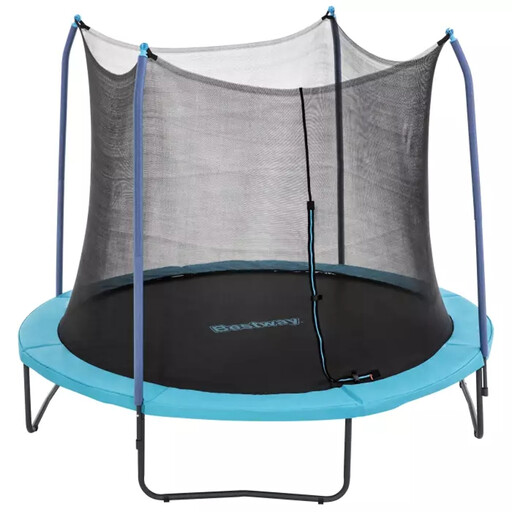
Why it's a great choice: With its 3.05 m diameter, it fits into most gardens. It's the ideal compromise between a generous jumping surface and a manageable footprint, perfect for children aged 6 and up.
Its galvanised steel frame, complemented by a powder coating, offers a double barrier against rust. The safety net, attached to the jump mat, eliminates any dangerous gaps near the springs.
The pack includes ground anchors for rock-solid stability, as well as a patented assembly tool (QuickSpring) that radically simplifies spring installation.
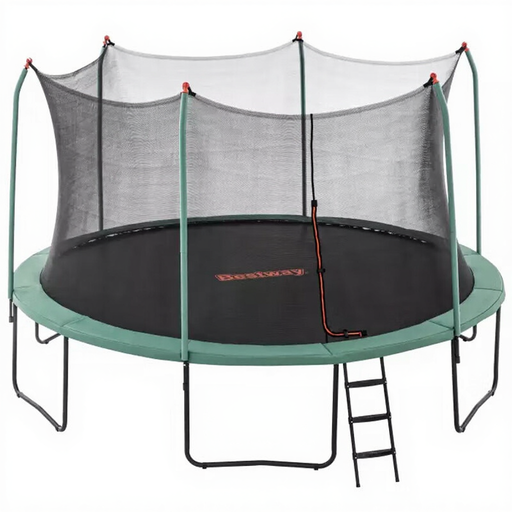
Why it's a great choice: For large families or those lucky enough to have a big garden, this 4.27 m model offers an XXL jumping surface. Its 120 kg capacity is suitable for teens and adults alike.
It incorporates the fundamentals of the 3m model: galvanised steel frame, no-gap safety net, and anti-UV materials. Its structure is, of course, reinforced to handle a higher load.
A very large jumping surface for maximum freedom of movement. The kit is ultra-complete: it includes the ladder, anchors, and leg pads. A true all-in-one package.
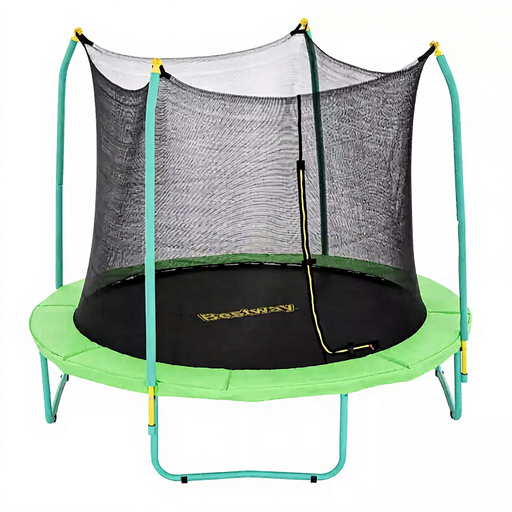
Why it's a great choice: Is your garden a bit tight for a 3m model? This 2.44 m version is the perfect alternative. It's ideal for younger children (3-10 years) and fits well in smaller spaces.
Smaller, but just as safe! It features a hot-dip galvanised steel frame, a full safety net, and thick protective padding that neutralises the spring area.
Its smaller footprint makes it easy to integrate into the garden. Its W-shaped legs ensure excellent stability, even with a smaller base.
Discover our complete selection of trampolines and outdoor play equipment, all chosen for their compliance with safety standards and their durability.
A trampoline's longevity is directly linked to the quality of its materials. A good model with a galvanised steel frame and UV-treated components (mat, net, padding) can easily last between 5 and 10 years. Be aware that wear-and-tear parts like the net or protective padding will likely need to be replaced every 2 to 4 years, depending on sun exposure and usage intensity.
It's highly recommended! To preserve your equipment, winter storage is a key step. Ideally, you should dismantle the net, padding, and jump mat and store them in a dry place, away from frost. This simple action will significantly extend their lifespan. If a full disassembly is not possible, at the very least cover it with a protective tarp and securely anchor the frame to the ground to protect it from strong winds.
The golden rule for safety: leave a clearance zone of at least 2 metres all around the trampoline. This area must be completely free of any obstacles: walls, fences, tree branches, garden sheds, etc. Also, remember to check the height: a clear space of about 7 metres above the mat is necessary for safe jumping.