
Livraison le jour même ou le lendemain

Qualité garantie

Débloquez vos offres de bienvenue: Livraison GRATUITE | Jusqu'à -80 % | 30 jours d'essai gratuits à JoyPlus
Téléchargez l'application
Choosing the right resin for your 3D printer can often be a daunting task given the saturated market. Between marketing promises and confusing technical datasheets, it's easy to end up with an unsuitable product, leading to failed prints and unnecessary expenses. This guide aims to demystify the topic and give you the keys to selecting the perfect resin for your projects, whether you're a figurine enthusiast, an engineer, or a creator.
But before we dive into the heart of the matter, let's debunk two common pitfalls together:
To make an informed decision, you need to understand a few key parameters that determine the compatibility and performance of your resin 3D printer consumable.
Almost all consumer 3D printers (LCD, DLP, or SLA) operate on the same principle: they polymerise a liquid photopolymer resin using a UV light source. The wavelength of this light is therefore a crucial parameter.
Today, the industry standard has settled at 405?nm. Ensuring that the resin you're considering is compatible with this wavelength is the first thing you should check. This is the basic guarantee that it will work with your machine, especially if you are looking for a resin for an LCD printer like those in the Anycubic Photon series.
Not all resins are created equal when it comes to strength. The choice will depend entirely on the final application of your object.
The work doesn't stop once the print is finished. Post-processing is an essential step in resin printing.
To illustrate these criteria in practice, here is a selection of resins suitable for different profiles.
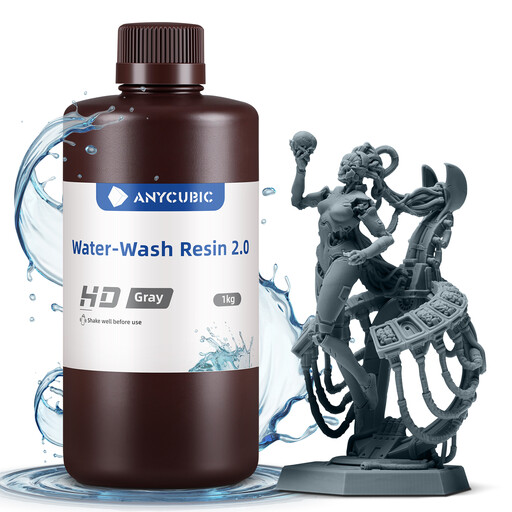
Why we chose it: It radically simplifies post-processing by eliminating the need for isopropyl alcohol (IPA) and reduces odours, making the experience much more pleasant in an apartment or small workshop.
It offers the convenience of water-based cleaning without false promises. The manufacturer clearly states that the rinse water must be treated before disposal, thus encouraging responsible use.
Water-washable cleaning and low odour for a cleaner, more pleasant working environment.
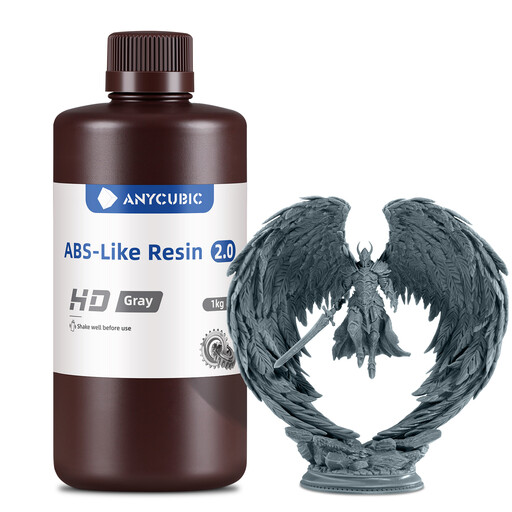
Why we chose it: It's formulated for parts that need to withstand mechanical stress, impacts, and torsion, with properties similar to ABS plastic. It's the go-to resin for functional prototypes.
It sidesteps the trap of standard resins, which are too brittle for functional use. No more prototypes that break during the first test or with the slightest handling.
Its high toughness and impact resistance allow for the creation of durable parts that can be drilled or tapped without cracking.
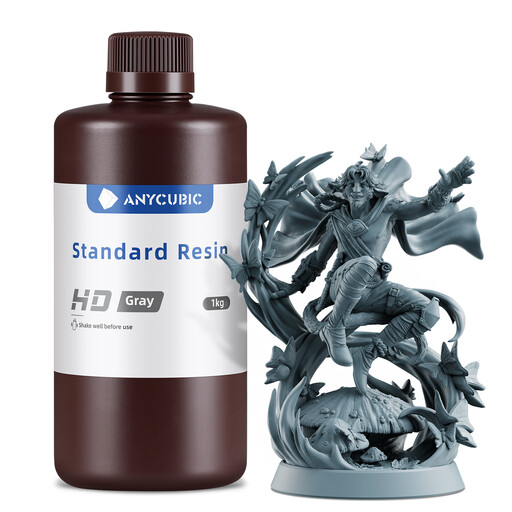
Why we chose it: It offers the best balance between printing speed and fine detail, a critical factor for miniatures and complex figurines where every last detail matters.
It ensures consistent and reliable performance, preventing the failed prints and poor finishes that are common with low-end resins with inconsistent properties.
High precision and a perfectly smooth surface, ideal for capturing the finest details and simplifying the painting process.
Explore our full, up-to-date selection of products that meet these quality criteria and current regulations.
Finally, let's answer some common questions about handling and using grey 3D resin and other colours.
Most resins can be stored for one to two years. Always check the expiration date provided by the manufacturer on the bottle. An expired resin may lose its properties, which can lead to incomplete polymerisation and print failures.
Proper storage is crucial for preserving your resin's performance. It is imperative to keep it in its original, opaque, and tightly sealed bottle. Store it in a cool, dry place, away from direct sunlight or any other UV source. A stable ambient temperature, ideally between 20°C and 30°C (68°F and 86°F), is recommended.
No, absolutely not! Each type of resin, and even each colour within the same range, may require specific print settings (layer exposure time, base layer exposure time, lift speed, etc.). To achieve optimal results, it is highly recommended to start with the profiles provided by the resin manufacturer. This is what Anycubic offers for its range of Anycubic resin and its printers, providing an excellent starting point that you can then fine-tune based on your observations.