
Livraison le jour même ou le lendemain

Qualité garantie

Débloquez vos offres de bienvenue: Livraison GRATUITE | Jusqu'à -80 % | 30 jours d'essai gratuits à JoyPlus
Téléchargez l'application
Choosing the right 3D printer filament can quickly become a daunting task given the jungle of materials, colours, and brands. From the user-friendly PLA to the more robust PETG, finding the perfect spool is the key to successful prints.
This guide is here to shed some light on the subject. We'll break down the essential criteria and present our recommendations to help you buy the 3D filament that's perfectly suited to your needs, whether you're a seasoned maker or a curious beginner ready to start your journey.
Before you buy, here are the key points to check to ensure you make the right choice.
It all starts with choosing your material. For FDM (Fused Deposition Modeling) printers, two materials reign supreme: PLA and PETG.
PLA (Polylactic Acid): This is THE go-to material for beginners. It's easy to print, doesn't always require a heated bed, has very little warping, and is available in a nearly infinite palette of colours. It's the ideal choice for decorative objects, rapid prototypes, and parts that won't be subjected to high stress. If you're looking for the best filament for beginners, look no further: PLA is it.
PETG (Polyethylene Terephthalate Glycol): If your project demands greater robustness, PETG filament is the perfect alternative. Tougher and more durable than PLA, it offers better resistance to heat, impacts, and moisture. It's a durable filament, perfect for creating functional parts, electronics enclosures, or objects intended for outdoor use. However, printing with it requires slightly higher temperatures and more precise settings.
The look of your object is just as crucial. The filament's finish plays a major role in the final visual appearance.
Always check for compatibility with your machine. The vast majority of consumer 3D printers use 1.75 mm diameter filament. It's the de facto industry standard. As for weight, the 1 kg filament spool is the most common format, offering an excellent price-to-quantity ratio.
To help you bring your ideas to life, here are three filaments that stand out from the pack, each with its own strengths.
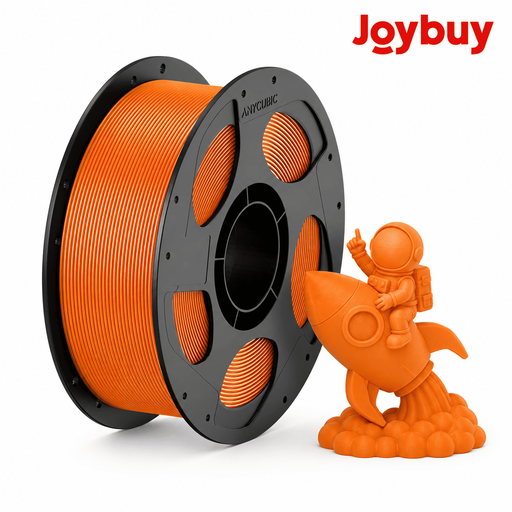
Why it stands out: This PETG filament from ANYCUBIC is engineered for performance. It combines durability and strength, making it suitable for the most demanding applications. The manufacturer highlights its excellent resistance to moisture, weather, and various chemicals, all with a vibrant and consistent orange colour.
Advantages:
Who is it for? For makers creating functional parts, prototypes under stress, or outdoor objects, who need a durable filament.
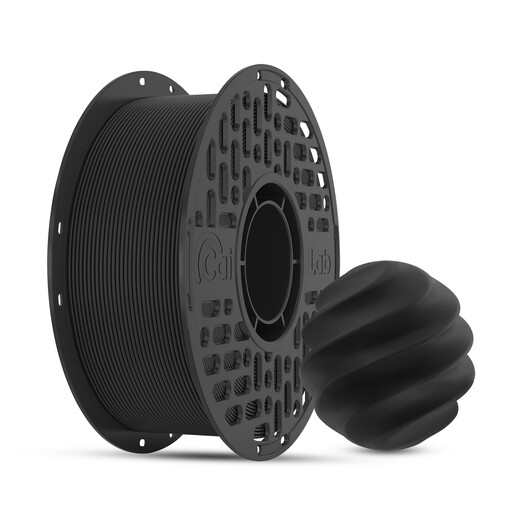
Why it stands out: CaiLab's matte PLA filament is specially formulated for a sophisticated surface finish. Its non-glossy look reduces the "plastic" appearance and is incredibly effective at hiding layer lines. The result: prints with a professional look and a velvety feel.
Advantages:
Who is it for? For artists, designers, and enthusiasts seeking an impeccable visual finish for their creations, whether they are figurines, decorative objects, or models.
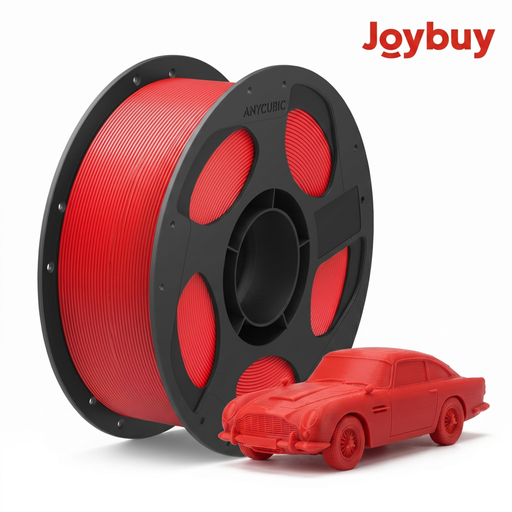
Why it stands out: This Basic PLA filament, a collaboration between ANYCUBIC and Joybuy, is a reliable and versatile choice. It embodies the very simplicity of PLA: good layer-to-layer adhesion, minimal warping, and a consistent flow thanks to a rigorously controlled 1.75 mm diameter. A trustworthy option for a wide range of projects.
Advantages:
Who is it for? For beginners, schools, or fab labs that prioritise simplicity and reliability for rapid prototyping, without needing extreme mechanical properties.
Your creativity shouldn't be limited to standard colours and materials. To give your projects a new dimension, filaments with unique properties are available. For example, for creations that come alive in the dark, why not try a material that stores light?
? Discover our range of glow-in-the-dark filaments for projects that shine in the dark.
1. What is the easiest filament for a beginner? Hands down, PLA. It is widely recommended for beginners. It's more forgiving of setting errors, prints at low temperatures, and has virtually no odour. The ANYCUBIC x Joybuy Basic PLA filament is an excellent starting point.
2. How should I properly store my 3D printer filament? Filaments, especially PLA and PETG, are hygroscopic: they absorb moisture from the air. This can degrade print quality (causing bubbles, brittle filament, and a poor surface finish). It is therefore crucial to store your spools in an airtight container with desiccant packets (silica gel) to protect them from humidity.
3. Can I use any brand of filament with my printer? Yes, in the vast majority of cases. As long as the filament diameter (1.75 mm or 2.85 mm) matches what your printer accepts, you are free to use filaments from any brand. You will simply need to adjust the settings (especially the extrusion temperature) to optimise the results for the specific material and brand.