
Livraison le jour même ou le lendemain

Qualité garantie

Débloquez vos offres de bienvenue: Livraison GRATUITE | Jusqu'à -80 % | 30 jours d'essai gratuits à JoyPlus
Téléchargez l'application
Choosing a new 3D printer filament? A minor detail, you think? Think again: the quality of your prints depends directly on it. Faced with a jungle of options, it's easy to fall into the classic traps that lead to failed prints, clogged nozzles, and a significant waste of time and money. As the head of product selection at Joybuy, my mission is to help you see clearly and cut through the marketing noise to focus on what really matters.
Before you fill your cart, let's review the three most common mistakes when buying 3D printer refills:
To avoid these disappointments, focus on a few objective technical specifications. These are the true arbiters of a filament's quality and reliability.
The choice of material depends entirely on your project.
The vast majority of consumer 3D printers use 1.75?mm filament. This is the standard to look for. But the most important criterion remains the dimensional tolerance.
A quality spool must arrive perfectly dry. Insist on vacuum-sealed packaging containing a silica gel (desiccant) packet. A clean, tangle-free winding on the spool is just as essential to avoid the nightmare of a print stopping halfway through due to a snagged filament.
Rather than drowning you in dozens of options, we have selected reliable choices for three distinct user profiles.
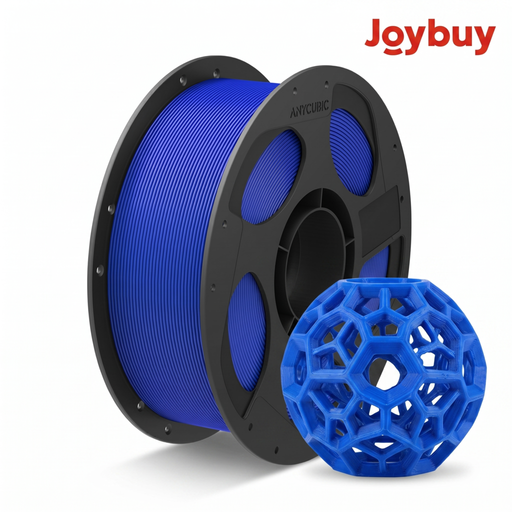
Why this choice? For beginners, reliability is key. This PLA filament from Anycubic is a sure bet: it's easy to print with and forgives minor setting errors. Ideal for focusing on learning 3D printing without fighting with your equipment.
Its ±0.02 mm tolerance drastically limits the risk of clogging from an inconsistent diameter. Its vacuum-sealed packaging protects it from moisture.
Great consistency from one spool to the next, which guarantees predictable results and successful first prints every time.
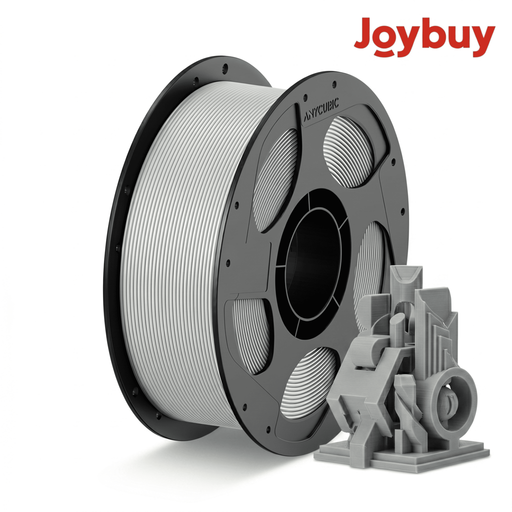
Why this choice? For parts that need to withstand mechanical or thermal stress, PETG is the material of choice. This option from Anycubic offers an excellent balance of performance and printability for a PETG.
By choosing a material suited for the application (in this case, PETG for strength), you avoid the disappointment of a PLA part breaking or deforming under stress or heat.
Far superior durability, chemical, and thermal resistance compared to PLA, for functional parts that stand the test of time.
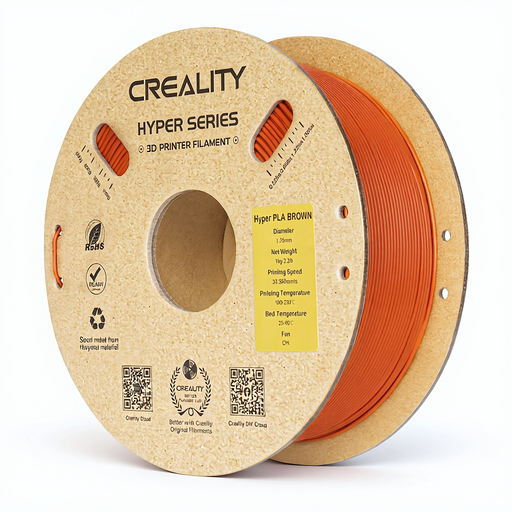
Why this choice? Modern printers are getting faster and faster. This "Hyper PLA" filament from Creality is specifically formulated to keep up the pace, with increased fluidity that maintains quality extrusion even at full throttle.
It prevents under-extrusion, a typical problem when pushing a standard PLA at high speeds because the filament doesn't have enough time to melt properly.
Optimised for high-speed printing. The manufacturer claims compatibility with speeds up to 600 mm/s, enough to drastically reduce print times.
We have put together a complete selection of filaments that meet our criteria for quality and reliability.
An unopened and properly sealed 1?kg filament spool can be stored for over a year. Once opened, it all depends on the storage conditions. Left in the open air, a PLA or PETG filament can absorb enough moisture in a few weeks or months to become brittle and unusable. The best practice: store it in an airtight container with desiccant packets between uses.
For standard PLA filament and PETG filament, a classic brass nozzle is perfectly fine. Most coloured 3D filaments, like those in the Anycubic range, do not require any special hardware. A special nozzle (e.g., hardened steel) is only necessary for so-called "abrasive" filaments, such as those filled with carbon fibre, wood, or metal.
The first criterion is the diameter: almost all consumer printers (Creality, Anycubic, Elegoo, etc.) use 1.75?mm filament. Check this information on your machine's technical sheet. Next, make sure your printer can reach the recommended extrusion temperatures. PLA generally prints between 190 and 220°C, while PETG requires a higher nozzle temperature, around 230 to 250°C, as well as a heated bed.