
Livraison le jour même ou le lendemain

Qualité garantie

Débloquez vos offres de bienvenue: Livraison GRATUITE | Jusqu'à -80 % | 30 jours d'essai gratuits à JoyPlus
Téléchargez l'application
Choosing a 3D printer filament can quickly become a headache. Between warped prints (warping), disappointing finishes, and clogged nozzles, the quality of the consumable is just as crucial as the printer itself. This guide is here to help you see things more clearly and select the filaments and accessories that will finally guarantee successful results, whether you're making functional prototypes or decorative objects.
As the Head of Product Recommendations at Joybuy, my mission is to guide you through the jungle of available options with practical advice and a selection of products that have truly caught our attention.
Before diving into our selection, let's review the essential criteria that will guide your choice.
PLA filament (Polylactic Acid) is the go-to classic for beginners. Made from renewable resources like corn starch, it's popular for its ease of use, low tendency to warp, and nearly non-existent odour. It's the ideal material for decorative objects, rapid prototypes, or any part that won't be subjected to high mechanical or thermal stress.
To go further, other materials like PETG (stronger and more durable) or ABS (reserved for technical parts) open up new possibilities but require a more advanced mastery of your machine.
The vast majority of consumer 3D printers today are standardised on a 1.75 mm filament diameter. A quick look at your machine's spec sheet to verify this is a simple but essential step to avoid any unpleasant surprises. An incorrect diameter is a guaranteed recipe for extrusion problems and even damage to your equipment.
Humidity is public enemy number one for your filaments and a common cause of failed prints. The symptoms are easy to spot: brittle filament, small crackling or popping sounds from the nozzle, a "hairy" appearance (stringing), or poor layer adhesion.
To preserve the quality of your spools, the basic step is to store them in an airtight container with silica gel packets. For active protection, investing in a filament dryer (or filament drying box) makes perfect sense. This 3D printer accessory heats the spool at a controlled temperature to drive out moisture just before starting a print.
Let's get practical with a few products that stand out, whether you're aiming for the perfect aesthetic finish or raw performance.
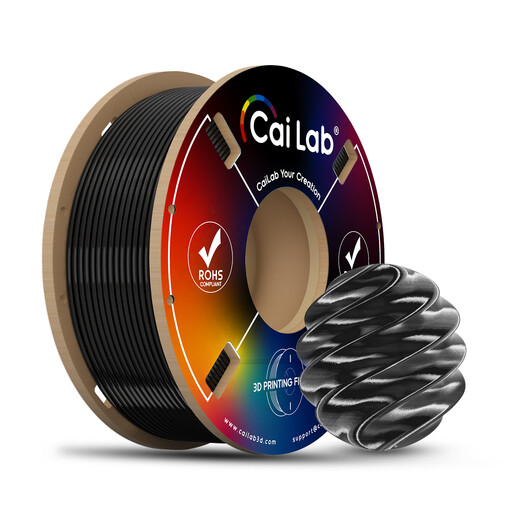
Why It Stands Out
This Silk PLA filament is for those who want a flawless, effortless finish right off the print bed. Its special formula gives it a shiny, smooth appearance that catches the light, making post-processing unnecessary for most aesthetic projects. The "Midnight Black" shade provides a rare depth and elegance, perfect for objects with a sophisticated design.
Advantages
Who is it for? Makers, designers, and enthusiasts creating decorative objects, figurines, vases, or prototypes where aesthetics are the top priority.
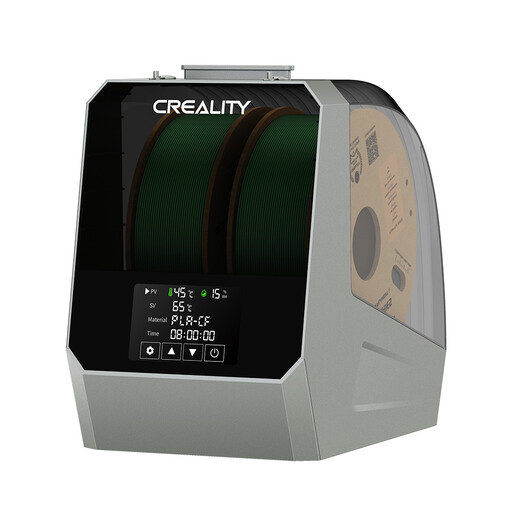
Why It Stands Out
The Space Pi Plus from Creality is a filament drying box that gets straight to the point: efficiency. Capable of holding two spools at once, it uses 360° heating for fast and uniform dehumidification. Its LCD screen allows you to precisely set the temperature (from 45 to 70°C) and duration (up to 48 hours) based on the material (PLA, PETG, ABS, TPU...). A versatile ally to make all your prints more reliable.
Advantages
Who is it for? All demanding makers who want reliable and repeatable prints. It's essential if you use hygroscopic (moisture-sensitive) materials like PETG, nylon, or TPU, or if you live in a humid region.

Why It Stands Out
This rainbow filament checks two very popular boxes: a gradual colour gradient and a silky finish. Each print becomes a unique piece, revealing subtle colour transitions as it's built. It's a simple and creative solution for creating stunning objects without juggling multiple spools.
Advantages
Who is it for? Creatives who want to add a touch of originality to their prints. Ideal for toys, personalised gifts, flower pots... in short, any object where colour is the star of the show.
The world of 3D printing doesn't stop here. If your projects demand more versatility and you're eyeing laser engraving or CNC cutting, our selection of 3-in-1 printers might just catch your eye.
Discover our range of 3-in-1 printers
There are several tell-tale signs. A filament that snaps cleanly instead of bending is a bad sign. Listen closely during printing: small crackling or popping sounds near the nozzle betray the evaporation of water. Finally, to the naked eye, a "hairy" print (stringing) or a grainy surface are often symptoms of wet filament.
It's primarily a matter of aesthetics! Silk PLA filament contains additives that give it an ultra-shiny, smooth finish that reflects light, whereas standard PLA offers a more matte or satin look. Mechanically, their properties are very similar, although Silk PLA can be slightly less durable due to those same additives. You should also expect to slightly adjust your print settings (temperature, speed).
Absolutely not! It is imperative to use the filament diameter your printer is designed for. While the vast majority of consumer machines run on 1.75 mm, some models (often older or professional ones) are calibrated for 2.85 mm. Using the wrong diameter is a sure way to clog your nozzle and cause failures. When in doubt, there's only one thing to do: check your printer's manual.