
Livraison le jour même ou le lendemain

Qualité garantie

Débloquez vos offres de bienvenue: Livraison GRATUITE | Jusqu'à -80 % | 30 jours d'essai gratuits à JoyPlus
Téléchargez l'application
Choosing the right 3D printer filament can be the difference between an ordinary project and a stunning creation. Faced with a jungle of materials, colours, and technical specifications, it's easy to get lost. A functional prototype doesn't have the same requirements as a decorative object, just as ultra-fast printing demands a very specific material.
This guide is here to shed light on the options available on the market and present a selection of filaments that meet a wide variety of needs?: whether you're a passionate creator, an engineer seeking reliable prototypes, or simply a 3D printing enthusiast.
Before you dive in, here are a few essential criteria to consider when choosing your 3D printing material.
Choosing the material is the number one step. Two options stand out for their popularity and versatility?:
Nearly all consumer 3D printers use a 1.75?mm diameter filament. It has become the de facto standard on the market. Nevertheless, always check your machine's specifications before buying a new spool of 3D filament. A tight dimensional accuracy for the filament, often indicated by a tolerance (e.g., +/- 0.02?mm), is a sign of quality that reduces the risk of nozzle jams (the infamous clogging).
Innovation in the world of filaments doesn't stop at basic materials. New formulations allow for highly specific results?:
Here are a few spools for 3D printers that stand out for their unique characteristics.
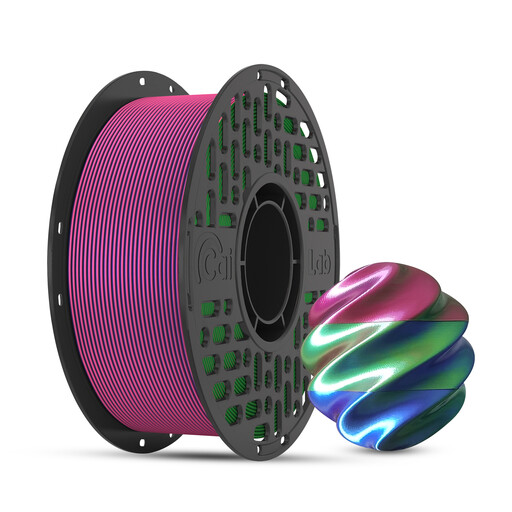
Why it stands out?: This tri-colour filament delivers a striking visual effect right out of the nozzle. The three colours (red, green, and blue) are fused into a single strand, allowing you to create parts whose colour shifts depending on the viewing angle. The Silk PLA finish adds an intense shine that enhances every detail of the model.
The pros?:
Who is it for? Ideal for creators, artists, and makers who want to produce decorative objects, toys, or artistic pieces with maximum visual impact, all without complex post-processing.
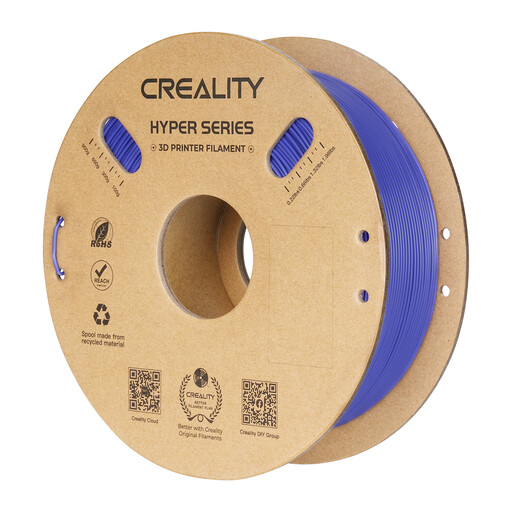
Why it stands out?: Specially formulated for next-generation 3D printers, the Creality Hyper PLA high-speed filament is engineered to maintain stable and precise extrusion even at speeds of up to 600?mm/s. Its composition ensures rapid cooling, a critical factor for preventing deformation during high-speed printing.
The pros?:
Who is it for? Owners of fast 3D printers (like Creality K1, Bambu Lab, etc.) who are looking to accelerate their production, whether for rapid prototyping or small-batch manufacturing.

Why it stands out?: The PETG filament from CaiLab represents an excellent balance between ease of use and mechanical performance. It offers much higher impact and heat resistance than PLA, while being less prone to warping than ABS. It is the material of choice for more technical applications.
The pros?:
Who is it for? Engineers, designers, and makers who need to create functional parts, protective enclosures, mechanical components, or any object that must withstand physical stress or a more demanding environment.
Our selection focuses on specific uses, but the universe of filaments is vast. If you're looking for a blue 3D printer filament in a different material, or if you simply want to explore other shades for your projects, a wide range of options is available to you.
Discover our full range of blue filaments
PLA filament is easier to print and ideal for aesthetic objects due to its rigidity and low deformation. PETG filament, on the other hand, is more durable, more flexible, and has better resistance to heat and chemicals, making it more suitable for functional parts subject to stress.
Filaments, especially PLA and PETG, are hygroscopic, meaning they absorb moisture from the air. Excessive moisture can degrade print quality (bubbles, rough surface, brittle filament). It is therefore advisable to store your spool of 3D filament in an airtight container or a resealable bag with desiccant packets to keep it dry.
Not necessarily. A high-speed filament is formulated to melt and cool very quickly. To take full advantage of it, your printer must be able to achieve these high speeds, which requires a powerful extruder, an efficient cooling system, and adapted firmware. It will work on a standard printer, but you won't get the speed benefit it was designed for. Always check for compatibility and recommended settings.