
Livraison le jour même ou le lendemain

Qualité garantie

Débloquez vos offres de bienvenue: Livraison GRATUITE | Jusqu'à -80 % | 30 jours d'essai gratuits à JoyPlus
Téléchargez l'application
Are your 3D prints ruined by stringing (those infamous "angel hairs"), bubbles, or catastrophic layer adhesion?? Before blaming your printer, take a closer look at your spools: the culprit is often moisture. Materials like PETG, TPU, Nylon, and even PLA are hygroscopic. Simply put, they absorb ambient moisture, which literally sabotages the quality of your prints.
A 3D filament dryer box is therefore an essential accessory for any maker, whether a hobbyist or a professional, aiming for flawless and consistent results. This guide is here to help you choose the perfect model for your needs by breaking down the criteria that matter and showcasing our top picks.
The market is flooded with dryers making various promises. To make the right choice, let's focus on the technical specifications that will truly make a difference in your print quality.
The core of the device is its heating system. Most recent models rely on PTC (Positive Temperature Coefficient) technology, known for its fast, stable, and safe heating. But the real secret lies in how that heat is distributed. A unit with 360° hot air circulation ensures the entire spool dries perfectly and evenly, leaving no damp spots. Let's be clear?: a simple static 3D filament oven will always be less effective than a forced-air system.
Check the device's capacity: how many spools can it hold, and of what size?? Most boxes are designed for a single 1?kg spool. Also, consider compatibility with your filament diameters. If you switch between 1.75?mm and 2.85?mm, a versatile model is essential. The ability to function as a 3D filament storage box is a significant advantage, as it keeps your spool dry between prints.
A good dehydrator for PLA or PETG filament must offer precise control over temperature and duration. Each material has its own requirements (e.g., ~55?°C for PLA, ~65?°C for PETG/ABS). An LCD screen displaying real-time temperature and humidity, combined with an adjustable timer, are invaluable features for automating the drying process with peace of mind and preventing overheating that can ruin the filament.
To help you find that perfect model and declare war on moisture, we've reviewed several devices. Here is one that particularly caught our eye.
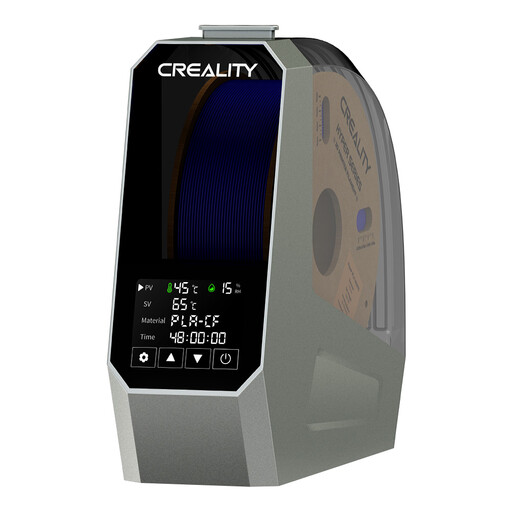
The Creality Space PI filament dryer is a 3D printing accessory that has everything to appeal to discerning makers.
What sets it apart?: Its main advantage is its 110?W PTC heating system, paired with a fan that ensures 360° hot air circulation. The result?: fast and perfectly uniform spool drying. The device offers presets for 12 filament types but also allows manual adjustment from 45?°C to 70?°C. With its programmable timer for up to 48 hours and a touchscreen displaying live humidity and temperature, it proves to be as practical as it is intuitive.
Key features?:
Who is it for???: It is primarily aimed at users of highly moisture-sensitive filaments like Nylon, PETG, ABS, or TPU. It will also delight makers who are keen to push the quality of their PLA prints to the maximum by eliminating every last trace of moisture.
Once your filament is perfectly dry, the quality of the material itself comes into play. A good filament guarantees smooth extrusion, vibrant colours, and rock-solid strength.
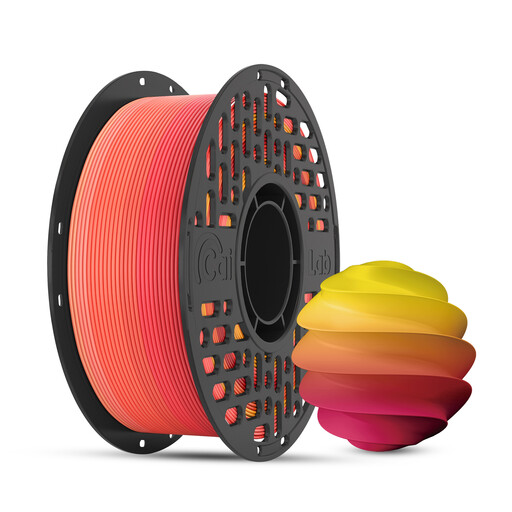
Perfect for creative projects, this PLA filament displays a superb colour gradient that makes every print unique. It is ideal for decorative objects, toys, or prototypes where aesthetics are paramount.
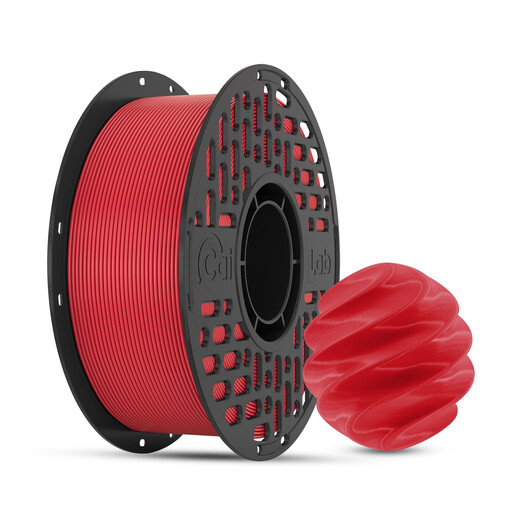
PLA+ is an enhanced version of standard PLA, distinguished by its better impact resistance and increased strength. This red filament from CAILAB is the ideal choice for functional parts that require more durability, without sacrificing the printing simplicity of PLA.
Looking for more specific materials or a wider range of colours and properties?? Our complete category is waiting for you. There you will find a curated selection to bring all your projects to life.
Discover our range of PLA+ filaments for 3D printers
A dryer box (or dehydrator) is designed to extract the moisture absorbed by 3D printing filaments. This moisture is responsible for numerous defects?: bubbles, stringing, poor layer adhesion, and much more fragile final objects. By drying your filament before use, you restore its original properties and ensure much higher quality prints.
Absolutely. Although PLA is less prone to absorbing moisture than PETG or Nylon, it will eventually absorb some, especially in a humid environment. "Wet" PLA becomes brittle and produces prints with a grainy surface. A quick run in a 3D filament dryer box at a low temperature (around 45-55?°C) will make all the difference.
Several tell-tale signs are unmistakable?: