
Livraison le jour même ou le lendemain

Qualité garantie

Débloquez vos offres de bienvenue: Livraison GRATUITE | Jusqu'à -80 % | 30 jours d'essai gratuits à JoyPlus
Téléchargez l'application
A 360 mm CPU watercooler appeals with its large radiator, ARGB fans and, on some models, an integrated screen. But a large format doesn't guarantee a compatible fit with your case or quiet operation. For gamers, content creators and users of powerful processors, it's best to rely on concrete criteria.
A 360 mm CPU watercooler may be compatible with Intel LGA 1851 and AMD AM5, yet impossible to install in your case. The radiator length, its thickness once the fans are mounted and the hose positioning all need to be checked.
Before placing your order, make sure to check:
An LCD screen built into the pump can display information or custom visuals. However, it often requires an internal USB connection and, sometimes, dedicated software. Meanwhile, an ARGB watercooling system typically needs a 3-pin 5 V connector compatible with your motherboard.
So check how many connectors you have available before choosing an AIO CPU kit packed with visual features. If simplicity is your priority, an air cooler will probably be more practical.
A high speed doesn't guarantee quiet operation. Noise levels also depend on the PWM curve, static pressure, blade design, the pump and your case's overall airflow. The dBA values quoted are useful for comparing spec sheets, but they don't reflect every real-world scenario.
The models featured here mainly support Intel LGA 1851/1700 and AMD AM5/AM4. However, you should still confirm compatibility with your processor and the version of the mounting kit supplied.
The stated thermal power, sometimes expressed as TDP, gives a point of comparison between different coolers. It doesn't replace checking your processor's specifications, the motherboard's power limits and your case's airflow. For a high-end build or one under sustained load, a 360 mm radiator offers a large surface area for heat exchange, provided you have a sufficiently spacious chassis.
Measure the intended mounting space, taking the radiator-and-fan assembly into account. A 360 mm model typically accommodates three 120 mm fans. Mounted at the front, it can alter the airflow reaching the graphics card. In the top position, you need to ensure there's enough clearance beneath the case panel.
The pump must also be installed according to the manufacturer's recommendations. An AIO kit is factory-sealed: do not open it or attempt to replace its liquid.
Choose PWM fans, which can automatically adjust their speed based on the CPU temperature. Also check for separate connectors for the pump, fans and ARGB. On some MSI models, integrated cabling helps reduce visible clutter.
Maintenance is limited compared with a custom loop. However, regularly dusting the radiator and fans helps maintain consistent airflow. In the event of a leak, switch off the computer immediately and unplug it.
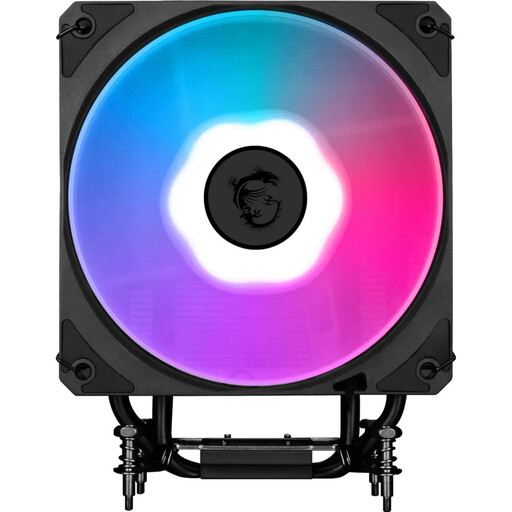
Why this choice suits this profile: this air cooler will suit those who want to avoid the pump, hoses and connections that come with a liquid system. With its stated height of 152 mm, it fits into many cases.
It avoids paying for a screen or unnecessary lighting. Thermal paste is pre-applied and installation uses a single 4-pin PWM connector.
Four 6 mm copper heat pipes, a 120 mm fan, Intel LGA 1700/1851 and AMD AM4/AM5 compatibility, plus ARGB lighting.
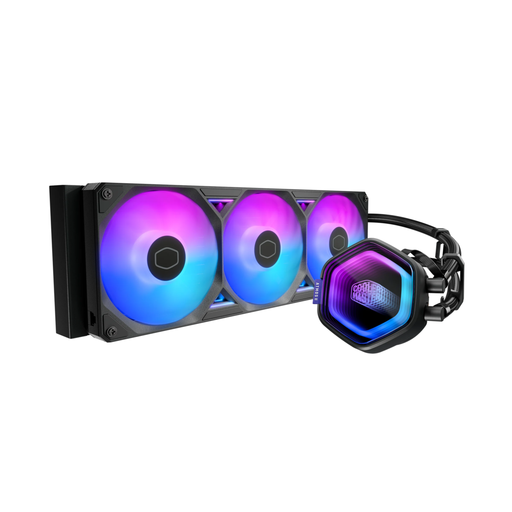
Why this choice suits this profile: it targets custom builds looking for an LCD screen, ARGB lighting and broad compatibility, without going down the custom water-cooling route.
Its offset brackets for LGA 1851 and pre-installed fans reduce installation uncertainties, provided you respect the recommended case dimensions.
An LCD screen, three SickleFlow Edge ARGB fans, a 394 × 119.2 × 27 mm radiator and support for Intel LGA 1851/1700 and AMD AM5/AM4.
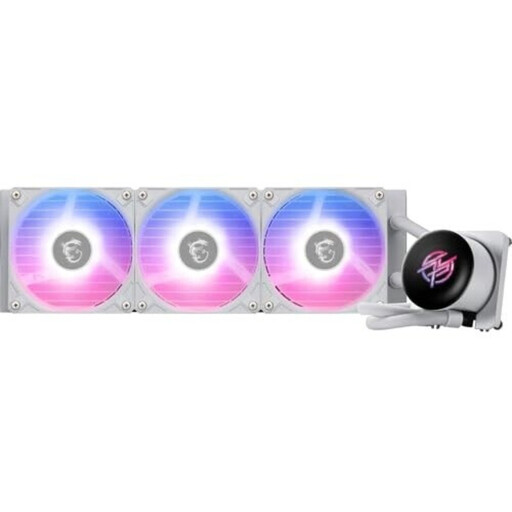
Why this choice suits this profile: its 2.1-inch screen and integrated cable system are aimed at content creators and users who want to monitor their machine or customise its appearance.
The spec sheet mentions pre-assembled fans and cables concealed within the tubing. Installation is therefore cleaner, but you still need to check software compatibility and your motherboard's connectors.
A 480 × 480 screen, a pump rated up to 3,400 RPM, 120 mm PWM fans and Intel LGA 1700/1851 and AMD AM4/AM5 compatibility.
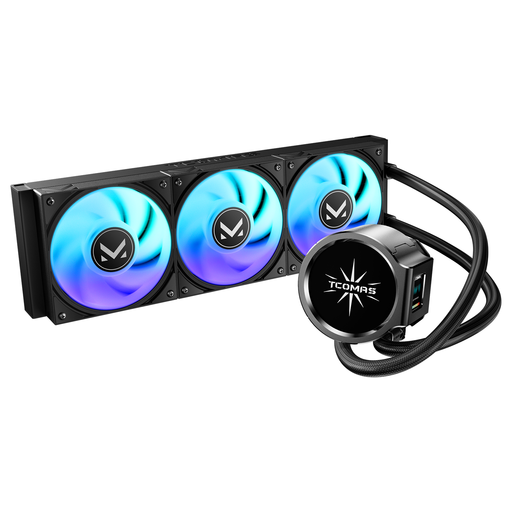
Why this choice suits this profile: its dual screens built into the pump and ARGB fans suit builds where aesthetics and customisation matter as much as performance.
The visual features are concentrated in the pump, without multiplying separate accessories. It's still essential to check the available space for the radiator and internal connections.
Dual display on the pump, ARGB fans and stated compatibility with Intel LGA 1851/1700 and AMD AM5/AM4.
We've put together a comprehensive list, updated in real time, of products that meet these demanding selection criteria and European safety standards.
No. You need to check the socket, the mounting kit supplied and your case dimensions. The models featured here generally state compatibility with Intel LGA 1851/1700 and AMD AM5/AM4, but the product manual remains the definitive reference before any installation.
Its lifespan depends on the pump, fans, installation quality and the environment it's used in. A sealed AIO must not be opened. Keep an eye out for unusual noises, temperatures and any signs of liquid. Regularly cleaning the radiator and fans also helps prevent dust build-up.
It adds the power consumption of the pump and several fans. The difference varies depending on PWM settings and the models chosen. An air cooler, like the MSI MAG Corefrozr AA13, gets by with simpler connectivity. Conversely, an LCD or ARGB model may require additional connections and software.