
Livraison le jour même ou le lendemain

Qualité garantie

Débloquez vos offres de bienvenue: Livraison GRATUITE | Jusqu'à -80 % | 30 jours d'essai gratuits à JoyPlus
Téléchargez l'application
A 360 mm ARGB AIO liquid cooler can improve thermal management for a gaming PC, creative workstation, or overclocking-focused build. However, the choice is not just about the number of fans or the pump lighting. Socket compatibility, radiator dimensions, and connectivity are equally important.
Here are the key points to check before placing your order, along with a selection of models available on Joybuy.
A liquid cooler may be compatible with your processor but impossible to install in your case. A 360 mm radiator is generally around 360 mm long, excluding its thickness, the thickness of the fans, and the space required for routing the tubes.
Before ordering, consult your case’s technical specifications and confirm that it has a 360 mm mounting position at the front, top, or side. Also check the clearance above the motherboard and look for potential conflicts with the memory modules.
A high speed, expressed in revolutions per minute, does not guarantee quiet operation or suitability for your particular use case. Airflow, static pressure, connector type, and control method also deserve your attention.
PWM fans adjust their speed according to the processor’s temperature. This allows you to maintain reasonable noise levels during office work, then increase airflow during video rendering or extended gaming sessions.
An ARGB pump, illuminated fans, or an LCD display integrated into the liquid cooler may require several connections. Check for a 5 V ARGB header, a PWM connector, and, for certain displays, an internal USB 2.0 header.
Control software is not always the same from one model to another. A particularly striking setup may therefore require more cables and configuration than expected.
For recent platforms, identify the supported sockets precisely. The models featured here list compatibility with Intel LGA 1851, Intel LGA 1700, AMD AM5, and AMD AM4. Some also support older Intel sockets, but this information should be confirmed on the product page.
The included mounting system plays an essential role: do not automatically reuse the mounting kit from an older cooler. A proper installation requires the correct backplate, suitable standoffs, and even pressure across the processor.
A 360 mm AIO kit generally includes a 360 mm radiator and three 120 mm fans. Measure the available space inside the case while accounting for the total thickness of the assembly. A front-mounted radiator can also alter airflow, while a top-mounted installation depends largely on the chassis width and the height of the memory modules.
The tubes should remain flexible enough to prevent excessive kinking. Never force the pump block against the motherboard or radiator during installation.
Some technical specifications list airflow in CFM and static pressure in mmH₂O. Airflow indicates the volume of air moved, while static pressure is especially useful when a fan must push air through a radiator.
For example, the LE100 360 Black lists PWM fans reaching up to 2,500 RPM, airflow of 81.8 CFM, and pressure of 3.2 mmAq, according to the manufacturer’s information. These figures help compare technical specifications, but they do not by themselves guarantee a specific temperature or noise level: the case, thermal paste, ambient temperature, and motherboard settings also matter.
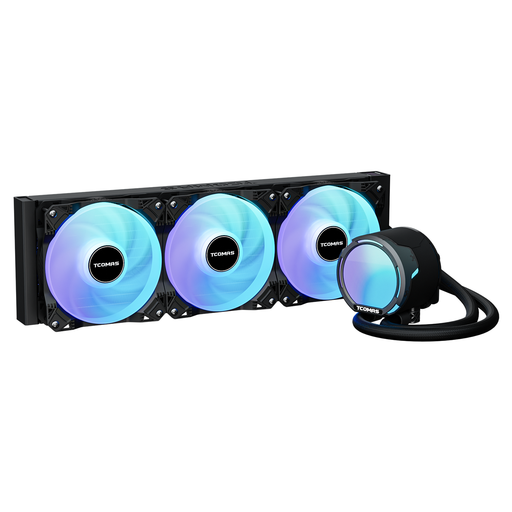
Why this model may suit you: It is designed for gamers and creators who want gaming-ready CPU cooling combined with ARGB backlighting, all within a black case.
The product page lists Intel LGA 1851/1700 and AMD AM5/AM4 socket compatibility, along with PWM control for adjusting fan speed.
Full-surface ARGB lighting, a three-phase pump, and fans reaching up to 2,500 RPM according to the product listing.
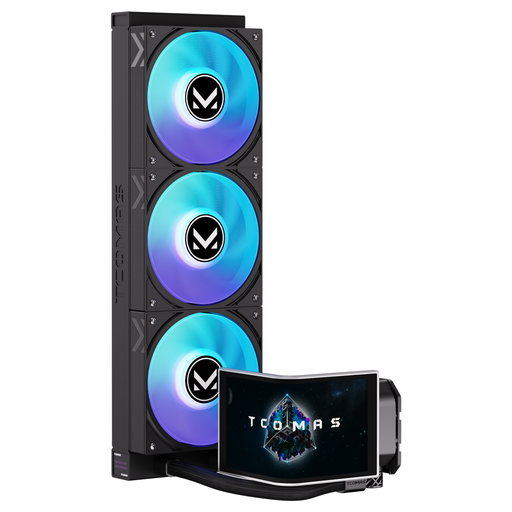
Why this model may suit you: Its 6.67-inch curved AMOLED display is designed for builds where personalised visuals take centre stage.
The customisable display is clearly identified in the product name, allowing you to check the required connections before purchasing.
A curved AMOLED display, advertised 3D visual effects, and compatibility with Intel LGA 1851/1700 and AMD AM5/AM4.
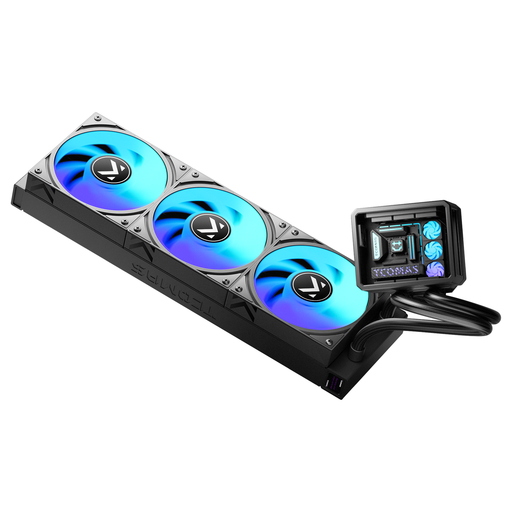
Why this model may suit you: It is well suited to builds whose cases can accommodate a large radiator and that call for an imposing pump head with ARGB lighting.
The product page specifies a thicker radiator; however, measuring the available chassis clearance remains essential.
An advertised thicker radiator, an oversized pump head, and ARGB fans, with support for Intel LGA 1851/1700 and AMD AM5/AM4.
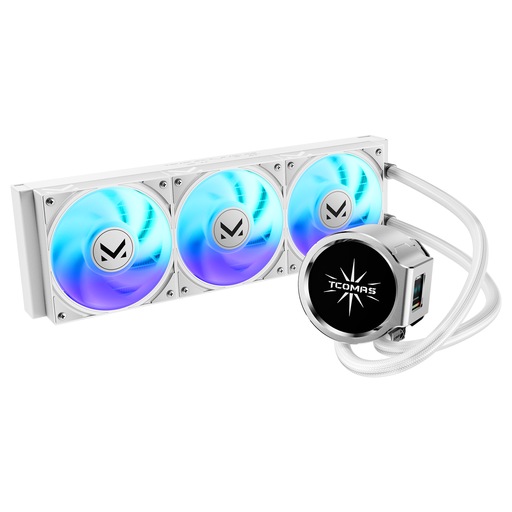
Why this model may suit you: Its white finish and dual-display pump blend naturally into a light-coloured gaming or creative build.
The round and square displays are specified on the product page, making it easier to compare them with your display requirements.
A dual-display pump, ARGB fans, and advertised compatibility with Intel LGA 1851/1700 and AMD AM5/AM4.
The 360 mm format requires more space, but accommodates three 120 mm fans. It can be a good fit for a system with a heavily loaded processor, provided the case supports this format.
A 240 mm AIO liquid cooler uses two fans and can simplify installation in a more compact chassis. The Cooler Master ML Core Nex Digital 240 is available in black and white. It features a digital display, pre-installed ARGB fans, and 400 mm tubes. According to the available information, it is listed as compatible with Intel LGA 1851/1700 and AMD AM5/AM4. Consult the 240 mm liquid cooling selection if your case cannot accommodate a 360 mm radiator.
Explore a regularly updated selection of liquid cooling solutions and compare sizes, sockets, displays, and ARGB features before making your choice.
No. Compatibility depends on the socket and the included mounting kit. The models in this selection list support for Intel LGA 1851, LGA 1700, AMD AM5, and AMD AM4, but always verify the information for your specific motherboard.
Its lifespan depends on the pump, fans, usage, and operating environment. Watch for unusual noises, temperature fluctuations, and signs that the pump is not working correctly. A sealed AIO circuit must not be opened by the user.
No. It is primarily a display and personalisation feature. To stay within budget and minimise the number of connections, a model with a conventional ARGB pump may be entirely sufficient. A display becomes worthwhile if you want to show system information or further customise the appearance of your build.