
Livraison le jour même ou le lendemain

Qualité garantie

Débloquez vos offres de bienvenue: Livraison GRATUITE | Jusqu'à -80 % | 30 jours d'essai gratuits à JoyPlus
Téléchargez l'application
A 360 mm AIO liquid cooler can help keep a powerful processor at a good temperature, while adding a polished touch to a gaming PC. But the size of the radiator isn't everything. Socket compatibility, available space in the case, noise levels and lighting control are all criteria to check before placing your order.
This guide from the Joybuy Product Recommendation Officer helps you compare the different options, without letting marketing arguments be your only guide.
A 360 mm radiator typically accommodates three 120 mm fans. That doesn't mean it can fit in any case. Check for a compatible 360 mm mounting position, usually at the front or on top, as well as the clearance above the motherboard and memory modules.
The pump block mounting also plays a key role. For a recent build, verify in black and white the support for an Intel LGA 1851 CPU cooler or an AMD AM5 CPU cooler. A spec sheet that only mentions LGA 1700 or AM4 sockets may require purchasing a separate mounting kit.
ARGB watercooling can enhance the look of a build, but colours and lighting effects alone tell you nothing about cooling performance. Also pay attention to fan speed, static pressure and airflow when these are specified.
Addressable lighting typically requires a compatible ARGB header on the motherboard, or a controller supplied with the kit. Without this check, the installation may end up with limited lighting, or even no synchronisation with other components.
An all-in-one CPU cooler generally operates as a sealed loop. So you don't need to regularly top up a reservoir, but the fans and radiator will still accumulate dust over time. A clogged radiator gradually loses efficiency and can force the fans to spin faster.
The noise levels quoted by manufacturers aren't always measured under comparable conditions. For a PC in a bedroom or office, prioritise PWM control and a fan curve adjustable from the BIOS.
Start by identifying your processor's socket. The models shown here support Intel LGA 1851, LGA 1700, AMD AM5 and AMD AM4, depending on the reference. Some are also compatible with LGA 1200 and LGA 115X sockets.
Socket compatibility doesn't guarantee the installation will be possible in your case, though. Also remember to check:
A 360 mm radiator is generally designed for three 120 mm fans. It requires more space than a 240 mm model, but offers a larger exchange surface for power-hungry processors, especially during gaming sessions, 3D rendering or video encoding.
Before buying, consult your case manual. A front installation can alter the airflow direction, while a top mount must leave enough room for components around the processor.
Spec sheets may mention a three-phase pump, a maximum speed of 2,500 RPM, an airflow of 81.8 CFM or a static pressure of 3.2 mmH₂O. This information is useful for comparing products, but it alone doesn't guarantee a specific temperature or noise level.
A watercooler with a screen adds a visual function: custom display, system data or animations. Check whether this screen requires dedicated software, an internal USB connection or an extra cable. The more sophisticated the system, the more you need to plan for cable management.
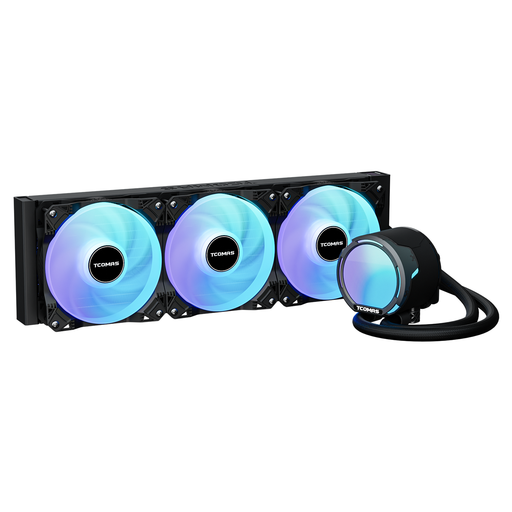
Why this choice suits this profile: this black version focuses directly on cooling and supports several Intel and AMD sockets. It's suitable for a first build with clearly detailed specifications.
The spec sheet states Intel LGA 1851/1700/1200/115X and AMD AM5/AM4 compatibility, plus PWM control. It's still essential to check the dimensions your case can accommodate.
Fans rated at 2,500 RPM, airflow of 81.8 CFM and static pressure of 3.2 mmH₂O, with ARGB lighting.
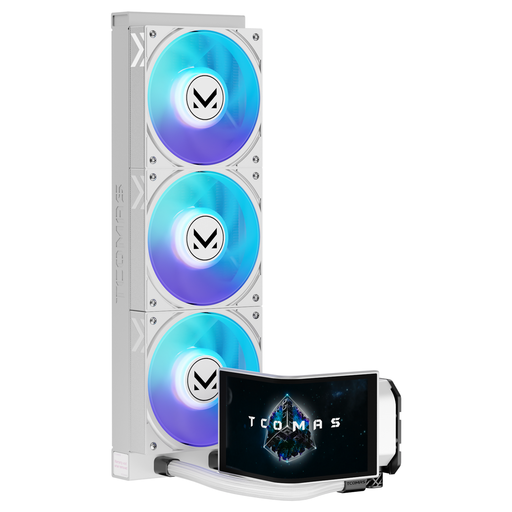
Why this choice suits this profile: its white finish and 6.67-inch curved screen are aimed at builds where the pump block's appearance matters as much as the internal layout.
The customisable screen provides a genuine function, rather than relying solely on lighting effects. Check the required software and internal connections before installation.
6.67-inch curved AMOLED screen, customisable 3D visual effects and compatibility with Intel LGA 1851/1700 and AMD AM5/AM4.
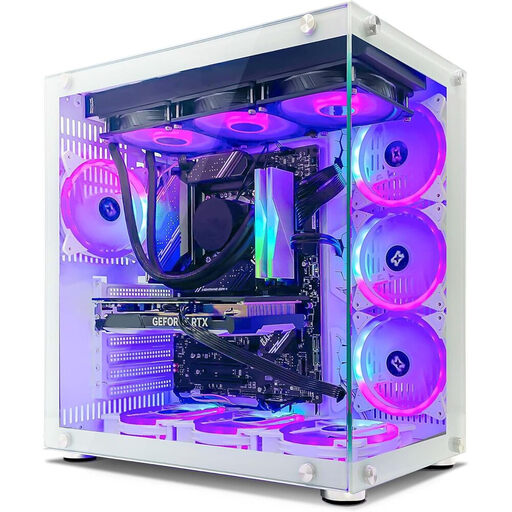
Why this choice suits this profile: this pre-built machine is aimed at gamers and creators who prefer to avoid selecting the processor, case and liquid cooling system separately.
The spec sheet details the integrated liquid cooling system, the ATX case and ventilation requirements. Allow at least 15 cm of free space around the vents.
Intel Core i7-12700KF, 32 GB DDR4 memory, 1 TB NVMe SSD, NVIDIA RTX 5060 Ti 8 GB graphics card, Wi-Fi 6E and ARGB lighting.
We've put together a complete, real-time updated selection of products that meet these demanding selection criteria and European safety regulations.
No. The case must have a mounting position compatible with three 120 mm fans and accept the combined thickness of the radiator and fans. Also check the clearance around the motherboard and memory modules.
It depends on component quality, PC usage and case maintenance. Even with a sealed loop, regularly dust the radiator and fans. Be alert to unusual noises, a sustained rise in temperatures or any sign of leakage. If something seems wrong, turn off the PC and unplug it before any intervention.
Its power consumption mainly comes from the pump and fans. The cost depends on their wattage and the number of hours of use. A well-tuned PWM curve can reduce their speed when the processor is under light load, while maintaining stronger airflow during gaming or video rendering.