
Livraison le jour même ou le lendemain

Qualité garantie

Débloquez vos offres de bienvenue: Livraison GRATUITE | Jusqu'à -80 % | 30 jours d'essai gratuits à JoyPlus
Téléchargez l'application
A 360 mm AIO CPU water cooler can be an excellent choice for a gaming PC, creative workstation or heavily used Intel Core or AMD Ryzen processor. However, a large radiator alone does not guarantee quiet operation or trouble-free installation. To make the right choice, you need to consider your case, socket, connections and how you actually use your machine.
A 360 mm AIO radiator generally accommodates three 120 mm fans. It is often between 394 and 397 mm long, without taking into account the space required for the tubes and screws. Some cases only support this format at the front, while others support it at the top. A few models simply do not support it at all.
Before placing your order, check:
A high speed can improve airflow, but it often comes with increased noise. Noise also depends on the shape of the blades, static pressure, PWM control and the pump.
When choosing a quiet water cooler, consider several factors: operating range, stated noise level, bearing type and the ability to adjust the fan curve in the BIOS or motherboard software. Figures provided by manufacturers remain technical specifications: results can vary depending on the case and ambient temperature.
ARGB, LCD screens and digital displays let you personalise your setup, but they can also add cables and software to manage. A screen may require an internal USB connector, while ARGB lighting needs a compatible 5 V header on the motherboard.
If your priority is temperature and quiet operation, a stripped-back pump block may be more suitable. If your PC’s appearance matters just as much as its internal layout, an LCD screen water cooler or an ARGB water cooler can make a real difference, provided you check which connectors are available.
Socket compatibility is essential. For a recent platform, look specifically for Intel LGA 1851 or AMD AM5 compatibility. Many models also support LGA 1700 and AM4 sockets, making future system upgrades easier.
The mounting kit must match the motherboard. Spacers, backplate and mounting system may differ depending on whether you are using an Intel or AMD platform. The Cooler Master ML 360 Atmos II LCD ARGB notably includes offset brackets for LGA 1851. Several products in this selection are also listed as compatible with LGA 1851, LGA 1700, AM5 and AM4 sockets.
A 360 mm radiator provides a substantial heat-exchange surface, but its performance mainly depends on how effectively air can pass through its fins. For a 360 mm CPU liquid cooling solution, keep an eye on the following:
Fans with high static pressure are particularly well suited to dense radiators. The be quiet! LIGHT LOOP 360mm includes three Light Wings LX PWM fans and an ARGB/PWM hub capable of bringing together several components. The be quiet! SILENT LOOP 3 360mm instead uses three Silent Wings 4 PWM fans and a three-chamber pump, with a cold plate specified at 1,800 mm².
An all-in-one water-cooling kit is not completely maintenance-free. You should regularly remove dust from the fins and fans, check the cables and look out for any signs of liquid. All maintenance must be carried out with the computer switched off and unplugged.
Some models have an accessible fill port and come with a bottle of coolant, including several be quiet! products. However, this operation should only be carried out by someone who understands the procedure. A pump must never run without liquid.
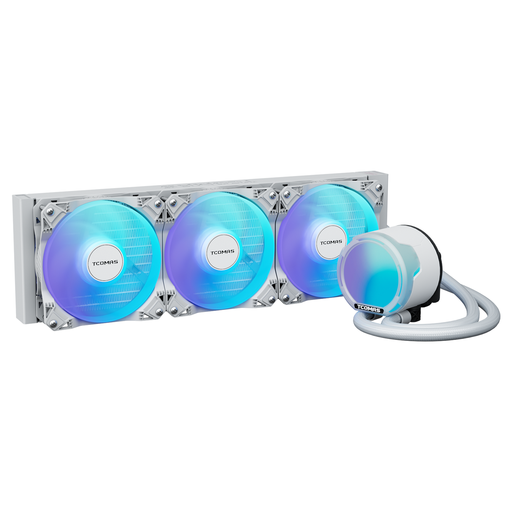
Why this model suits this profile: This product offers broad compatibility with Intel LGA 1851/1700/1200/115X and AMD AM5/AM4 sockets. Its integrated ARGB lighting makes it easy to personalise your first build.
The stated compatibility reduces the risk of buying a kit that is unsuitable for a common Intel or AMD platform. You still need to check your case dimensions.
360 mm radiator, three-phase pump and PWM fans specified at 2,500 rpm, with ARGB lighting.
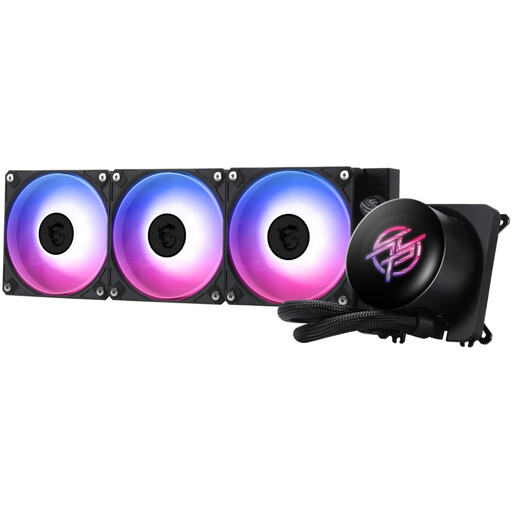
Why this model suits this profile: It is designed for users who want to display information or animations on the pump block, without installing an additional screen in the case.
The specifications state the 480 × 480 LCD resolution and the inclusion of an internal USB connector. This allows you to plan the required connections in advance.
2.1-inch LCD screen, pump specified at up to 3,400 rpm and pre-installed fans.
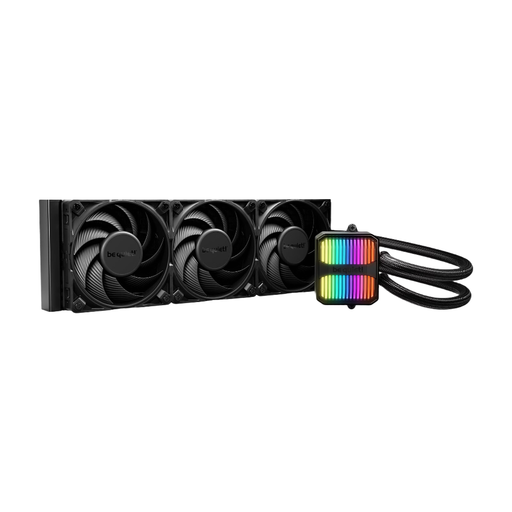
Why this model suits this profile: It is aimed at content creators, gamers and users looking for documented thermal management, with particular attention paid to reducing vibrations.
The three-chamber pump and Silent Wings 4 fans are described using precise specifications rather than a simple promise of quiet operation.
Cold plate specified at 1,800 mm², accessible fill port and three-year manufacturer’s warranty.
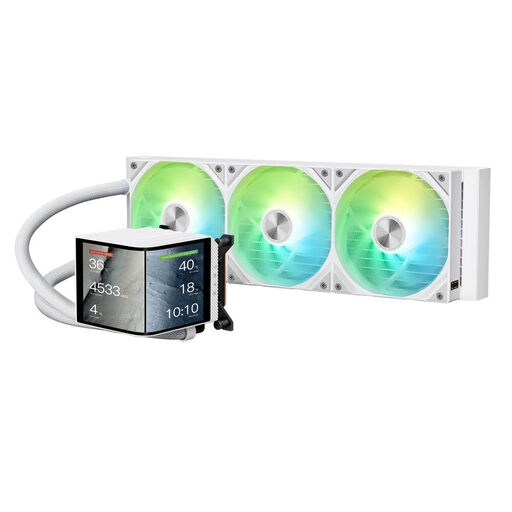
Why this model suits this profile: Its curved L-shaped screen and ARGB fans complement builds where the pump block’s visual appeal plays a central role.
The specifications detail the radiator dimensions, its thickness with the fans fitted, and the USB, PWM and SATA connections required.
Customisable curved screen via KANALI, 360 mm radiator and compatibility with Intel LGA 1851/1700/1200/115X and AMD AM5/AM4.
We have put together a complete, real-time updated selection of products that meet these exacting criteria, while complying with European safety regulations.
No. The radiator determines the cooling system’s format, while the mounting system depends on the socket. Check for LGA 1851, LGA 1700, AM5 or AM4 compatibility, depending on your motherboard. You should also consult the manufacturer’s instructions and check your case’s internal dimensions.
This depends in particular on the pump, frequency of use, dust levels and maintenance. Some models in the selection have a fill port and come with a bottle of coolant to extend their usable life. Inspect the fans, tubes and fittings regularly. In the event of a leak, switch off the PC immediately and unplug it.
Power consumption mainly comes from the pump, the three fans and, where applicable, the lighting or screen. PWM control allows their speed to be adjusted according to the processor’s workload. To avoid continuous operation at full power, create a suitable fan curve in the BIOS or your motherboard software.