
Livraison le jour même ou le lendemain

Qualité garantie

Débloquez vos offres de bienvenue: Livraison GRATUITE | Jusqu'à -80 % | 30 jours d'essai gratuits à JoyPlus
Téléchargez l'application
A 304 stainless steel frying pan can be a valuable addition to any everyday kitchen. However, construction, heat distribution and ease of use can vary considerably from one model to another. Single-layer stainless steel pans, triply stainless steel models, non-stick coatings and simple magnetic bases all have a real impact on cooking performance.
Before placing your order, three mistakes are particularly common:
304 stainless steel is widely used in kitchen utensils. It is generally presented as corrosion-resistant and suitable for food contact. However, a reliable product listing should provide more detail, including the pan’s construction, the composition of the base and the care instructions.
A single-layer frying pan does not heat in the same way as a pan with an attached base or a triply stainless steel frying pan. In the latter, an aluminium core is sandwiched between two layers of stainless steel. Aluminium helps distribute heat, while stainless steel forms the inner and outer surfaces. The presence of a multi-layer base therefore does not mean that the entire pan is made from a single material: remember to check the complete list of components.
The PURECOOK models featured below state that they are made from 304 stainless steel. Some product listings also refer to the Chinese GB 4806.9 standards and US FDA requirements. These references do not amount to general European certification: always check the compliance information, instructions for use and the identity of the responsible person established in the European Union.
For a stainless steel induction frying pan to work on an induction hob, its base must contain a magnetic section. Testing it with a magnet can provide an initial indication, but the manufacturer’s information remains the definitive reference.
An all-hob frying pan should specify which heat sources it supports: induction, gas, electric, ceramic and, where applicable, halogen. The diameter of the base is also important. On an induction hob, a base that is too small or poorly positioned may limit heating power.
Multi-layer construction is particularly useful when cooking requires an even temperature, such as for fried vegetables, fish, meat or sauces. However, you should still preheat the pan gradually and adjust the hob’s power accordingly.
A 28 cm frying pan is a versatile compromise for two to four portions, provided your hob can accommodate this diameter. A 20 cm model is better suited to an individual portion. Conversely, a 30 or 32 cm pan is more suitable for a family, but will also take up more storage space.
You should also check:
Even when a frying pan is advertised as dishwasher-safe, it will often retain its appearance for longer if washed by hand with a soft sponge and dried immediately. With stainless steel, it is best to avoid wire wool and abrasive products.
The models below meet different requirements. The features mentioned are those provided in the product listings; they do not constitute medical endorsement or a guarantee of cooking results.
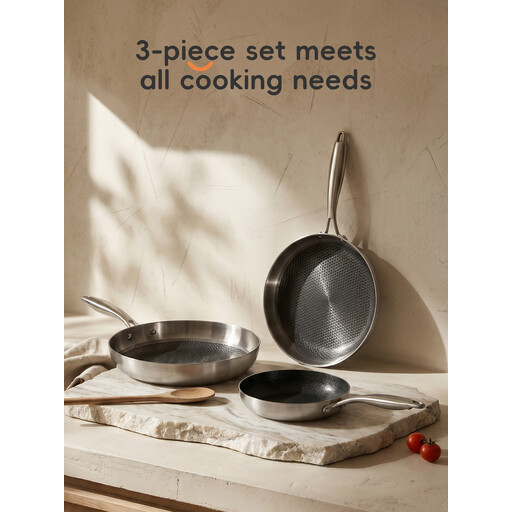
Why this choice suits this profile : With diameters of 20, 26 and 30 cm, these pans let you prepare anything from an individual portion to a family meal, without having to buy several models separately.
The product listing states that the pans have a magnetic composite base compatible with induction, gas and ceramic hobs. The different sizes also prevent you from using an oversized pan for small quantities.
Stated 304 stainless steel, rolled edges and three diameters. The manufacturer recommends washing by hand with a soft sponge.
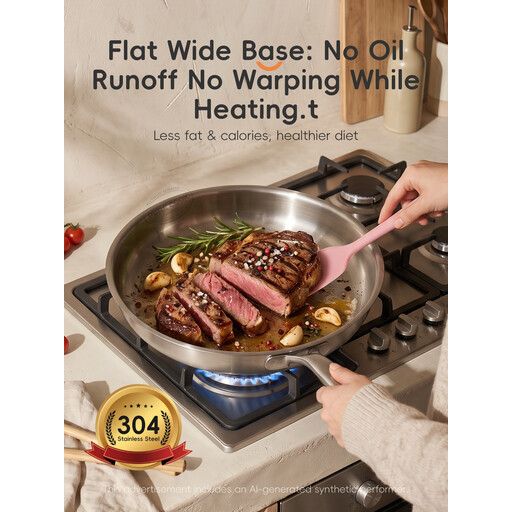
Why this choice suits this profile : Its three-layer construction, with an aluminium core, is designed to distribute heat more evenly across the entire surface of this 28 cm pan.
The product listing clearly distinguishes the 304 stainless steel layers from the aluminium core, rather than simply using a vague “stainless steel” description.
28 cm size, satin finish, stated compatibility with all hobs and dishwasher-safe according to the product listing.
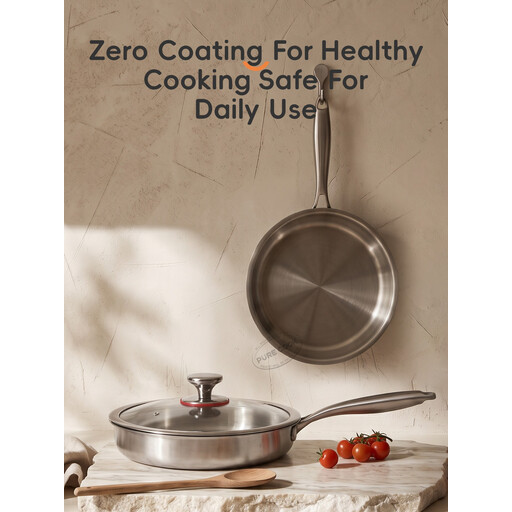
Why this choice suits this profile : Its glass lid lets you move from searing to simmering and then reducing in the same pan. A practical piece of cookware for family meals.
The product listing distinguishes between the materials used for the pan, lid and silicone seal. It also specifies the compatible heat sources and the precautions to take when handling the pan while hot.
304 stainless steel–aluminium–304 stainless steel construction, glass lid and stated compatibility with induction, gas, electric, ceramic and halogen hobs.
A non-stick frying pan generally makes it easier to cook eggs, pancakes and delicate foods, even with very little fat. However, its coating requires a few precautions: do not use metal utensils, do not overheat it when empty and do not clean it with an abrasive sponge.
304 stainless steel is more versatile, particularly for searing meat or deglazing the pan juices. However, it takes a little practice. Preheat the pan over a moderate heat, add the fat once the surface is hot, then allow the food to sear and release gradually before turning it. A stainless steel frying pan is therefore not naturally non-stick.
If you are buying your cookware from scratch, a stainless steel frying pan set can save you from making several separate purchases. If you already own a non-stick frying pan, a single 26 or 28 cm stainless steel model will often be enough to complement your cookware collection effectively.
We have brought together a complete, real-time selection of products that meet these exacting criteria, as well as the applicable European safety requirements.
Yes, provided it has a suitable magnetic base. The “304 stainless steel” designation alone is not enough to confirm induction compatibility. Check the product listing and, if necessary, test whether the base reacts to a magnet.
Heat the pan gradually, add a little fat, then place the food in it once the surface is hot enough. Avoid moving it straight away: it will release more easily after it has seared. However, take care not to exceed the correct temperature, as excessive heat encourages sticking and can leave marks that are difficult to clean.
Its lifespan depends on its thickness, construction, frequency of use and care. Dry it after every wash and avoid thermal shock and abrasive products. For models with a coating, such as hybrid or non-stick frying pans, you should also follow the coating’s specific limitations.