
Livraison le jour même ou le lendemain

Qualité garantie

Débloquez vos offres de bienvenue: Livraison GRATUITE | Jusqu'à -80 % | 30 jours d'essai gratuits à JoyPlus
Téléchargez l'application
Choosing 304 stainless steel cookware seems simple… until you start comparing thicknesses, multi-layer bases and promises of induction compatibility. Between products sold as plain "stainless steel", poorly identified coatings and awkward handles, one wrong choice can quickly prove costly.
Here are the key criteria to examine before buying a stainless steel cookware set, a frying pan or an accessory for everyday use in the UK.
The term 304 stainless steel refers to a grade commonly used for food-contact products. On its own, it tells you nothing about the thickness, build quality or other materials used.
A frying pan might, for example, combine several layers of stainless steel with an aluminium core to distribute heat more evenly. The handle, lid or seal may also be made from a different material. So it's best to check the full specification rather than stopping at the word "stainless".
A stainless steel frying pan or an induction-compatible stainless steel wok does not necessarily have a non-stick coating. Cooking with one requires gradual preheating, adding fat at the right moment and controlling the temperature.
To reduce sticking, a commonly recommended method is to heat the pan, lower the heat, then add a little fat before placing the food in. Excessive heat can cause food to stick or leave marks.
Induction compatibility generally depends on whether the base is magnetic. A utensil may work on gas, electric and ceramic hobs without working on induction. The presence of a suitable base must therefore be explicitly stated.
Diameter also matters: a small pan placed on a large zone can heat unevenly, while a large wok or stockpot needs to sit stably on the hob.
304 is a grade of stainless steel suitable for many cooking uses. Before buying, check in particular:
An uncoated utensil, like certain models of wok or stainless steel saucepan, can suit those who prefer to avoid the special care of a non-stick surface. Conversely, a coating makes some types of cooking easier but usually requires a few extra precautions.
A tri-ply structure, made up of several layers of stainless steel around a conductive core, aims to improve heat distribution. This design is particularly useful for a frying pan, sauté pan or wok used on induction.
However, you need to distinguish a true multi-layer construction from a simple bonded base. Both can be effective, but their weight, responsiveness and heating behaviour may differ.
The diameter and capacity should suit the number of people you're serving and the space you have available:
For a family, a stainless steel stockpot, a multi-tier steamer or a large saucepan can prove more useful than a very large set containing pieces you rarely use.
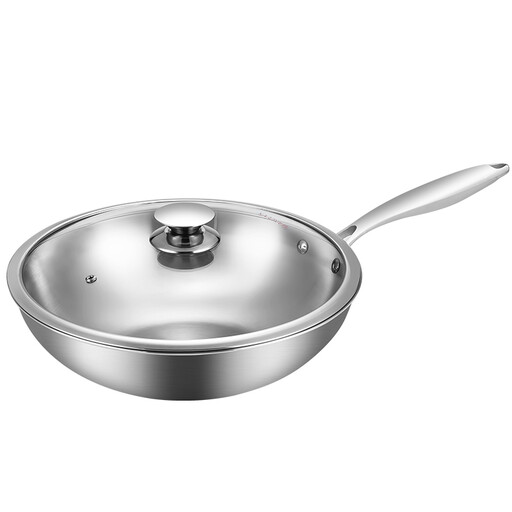
Why this choice suits this profile: its 28 cm diameter works well for everyday cooking. Its stated compatibility with induction, gas, electric and ceramic hobs means it can easily fit into an existing kitchen.
The specification clearly states it is a 304 stainless steel construction with no non-stick coating. The user therefore knows they will need to control the temperature and amount of oil.
A glass lid, a composite base and stated dishwasher compatibility. Hand washing is still recommended to preserve its appearance.
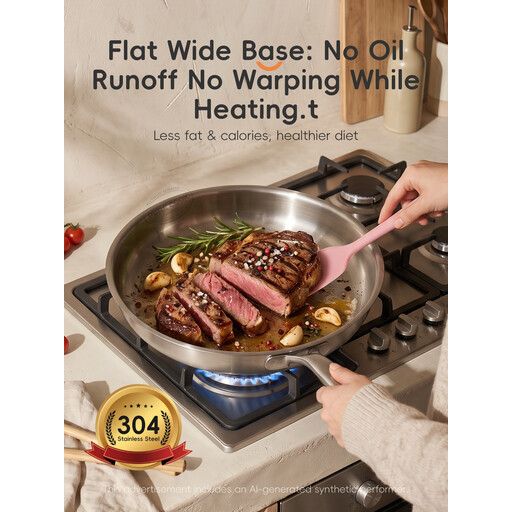
Why this choice suits this profile: its design with an aluminium core is aimed at cooks who want more even heat distribution, whether for searing meat, reducing a sauce or preparing a family meal.
The specification details the tri-ply structure rather than just saying "stainless steel". Compatibility with all hob types is also stated.
A pouring rim, a satin finish, stated oven use up to 220 °F (around 105 °C) and dishwasher care according to the product specification.
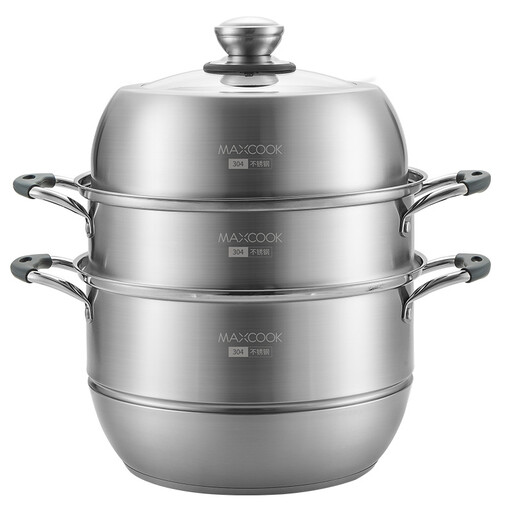
Why this choice suits this profile: its three tiers allow you to steam several foods at once. A format well suited to families and those who prepare their meals in advance.
Compatibility with induction, gas, electric and ceramic hobs is clearly stated. The heat-resistant silicone handles are also identified.
A glass lid, 304 stainless steel construction and a 28 cm format. Hand washing is recommended.
To keep a stainless steel saucepan, a stainless steel stockpot or a stainless steel mixing bowl in good condition, allow the pieces to cool before rinsing off any residue, then use a soft sponge and mild washing-up liquid. White marks caused by minerals in the water can usually be treated with a little white vinegar, followed by a thorough rinse.
Avoid thermal shock: never plunge a hot pan into cold water. After washing, dry the pieces to minimise water spots. Wooden handles, seals and certain lids require special care.
To complete a family kitchen, accessories like a stainless steel oil dispenser, a stainless steel food flask, stainless steel barbecue skewers or unbreakable stainless steel tableware can prove handy. Just remember to check their secondary materials and cleaning instructions.
304 is a grade commonly used for food-contact surfaces. However, you should check the product specification: handles, seals, coatings and accessories may be made from other materials.
Preheat the pan gradually, use a medium heat and add the fat before the food. Avoid turning or moving meat or vegetables immediately: given time for a crust to form, the food will usually release more easily.
No. Recommendations vary between models. Some woks and frying pans are stated as dishwasher safe, while pieces with wooden, silicone or Bakelite handles may need hand washing. Before buying, the product specification remains the best reference.