
Livraison le jour même ou le lendemain

Qualité garantie

Débloquez vos offres de bienvenue: Livraison GRATUITE | Jusqu'à -80 % | 30 jours d'essai gratuits à JoyPlus
Téléchargez l'application
As a product expert at Joybuy, my job is to source the best workshop equipment. And I've seen my fair share of jacks! Among them, one tool stands out as a cornerstone of safety and efficiency: the hydraulic trolley jack. Choosing a 3-tonne model? You might think it's child's play. However, the market is a veritable minefield, where a poor choice can quickly turn an investment into a disappointment, or even a danger.
To avoid falling into this trap, you need to learn how to decode spec sheets and ignore the siren song of marketing. We'll explain the pitfalls to avoid and the criteria that truly matter.
To make the right choice, rely on objective data. Here are the three non-negotiable parameters to scrutinize before choosing your 3-tonne car jack.
A capacity of 3 tonnes (3000 kg) doesn't mean your vehicle has to weigh 3 tonnes. It indicates the maximum load the jack can lift safely. For peace of mind, the golden rule is to choose a jack with a capacity at least 1.5 times the weight you actually intend to lift. Since a jack only lifts one corner or half of the vehicle, a 3-tonne model offers an excellent safety margin for most cars, estates, and SUVs. This is a crucial point for a workshop jack intended for regular use.
This is arguably THE key criterion for versatility.
A good garage jack must combine stability and mobility.
Rather than an endless list, we've chosen to present one model that checks all the boxes: versatility, sturdiness, and reliability. A jack that suits both the DIY mechanic and the small professional garage.
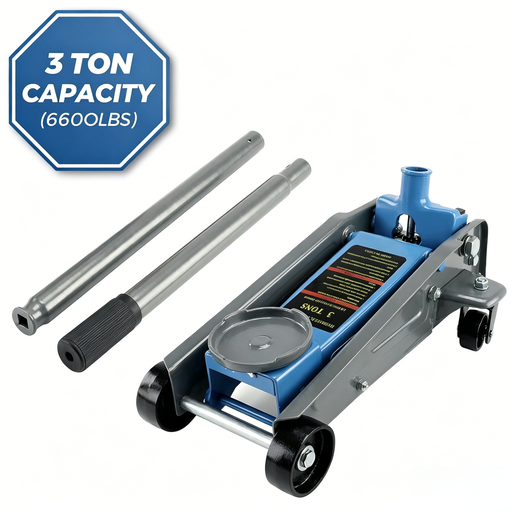
Who is it for? Perfect for those who work on multiple vehicle types (saloons, SUVs, etc.) and are looking for a single, reliable tool for all their jobs, from simple wheel changes to more advanced repairs.
Its lifting range (from 135 mm to 460 mm) ensures compatibility with most vehicles, thus avoiding the main pitfall of incompatibility. Its robust steel construction and steel wheels guarantee stability and durability, a far cry from flimsy, low-end models.
Its strength? The combination of a 3-tonne capacity, a wide lifting range, and 360° swivel casters. The result: unmatched manoeuvrability and versatility for the garage or workshop.
Discover our full selection of products that meet our quality criteria and safety requirements.
Absolutely. This is a non-negotiable safety rule. A car lifting jack is a lifting device, not a holding device. Its sole function is to raise the vehicle. Once lifted, the vehicle must be secured on jack stands rated for the load before any work is done underneath it.
The easiest way is to check your vehicle's manual for its Gross Vehicle Weight Rating (GVWR). That said, a 3-tonne jack is generally more than sufficient for most SUVs on the market. Remember that you are only lifting a portion of the total weight (about 50-60% on one axle). The 3-tonne capacity therefore gives you a very comfortable safety margin.
Its longevity depends on its build quality, frequency of use, and, most importantly, its maintenance. A well-maintained heavy-duty steel jack (oil level, bleeding the hydraulic system, regular cleaning) can serve you faithfully for many years. One last tip: avoid storing it outdoors or in a damp environment to protect it from rust.