
Livraison le jour même ou le lendemain

Qualité garantie

Débloquez vos offres de bienvenue: Livraison GRATUITE | Jusqu'à -80 % | 30 jours d'essai gratuits à JoyPlus
Téléchargez l'application
Whether you're a weekend mechanic or a seasoned pro, working on your vehicle—even for a simple oil change or tyre swap—demands reliable and safe tools. The 3-tonne hydraulic jack is the cornerstone of the workshop for many enthusiasts, offering the perfect balance of lifting power and versatility.
This guide breaks down the essential criteria to check before you buy and presents our selection of the best models for 2026, whether you're pampering a lowered sports car or a family SUV.
Choosing a 3-tonne lifting jack is about more than just its load capacity. Other, equally crucial factors determine its ease of use and your day-to-day safety. Here are the key points to inspect in detail.
The lifting range, or the span between the jack's lowest and highest positions, is the first criterion to validate.
The jack's design plays a crucial role in its longevity and ease of handling.
Often considered minor details, these elements can transform the user experience.
We have scrutinised several models to select three that meet distinct needs, from the passionate DIYer to the semi-professional user.
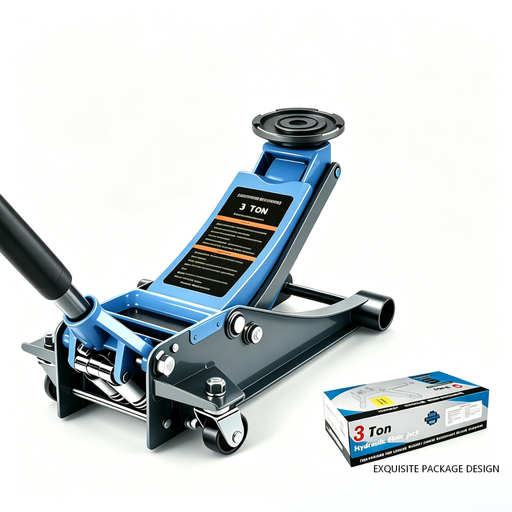
Why it stands out
This model ticks a lot of boxes. Its hybrid aluminium and steel design gives it excellent durability while remaining much more manageable than an all-steel model. Its dual-pump system ensures a rapid lift, a valuable advantage for those who perform frequent operations. Finally, its lifting range (from 80 mm to 465 mm) gives it formidable versatility.
Pros
Who is it for? The ideal choice for enthusiasts who juggle multiple vehicles (including sports cars) and want an efficient, fast tool. A solid choice for the demanding home mechanic.
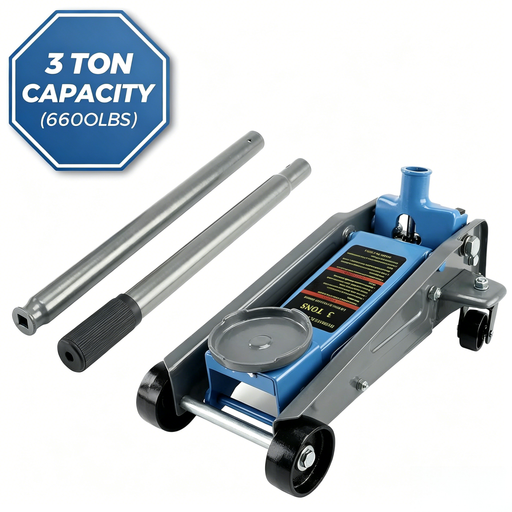
Why it stands out
This jack embodies pure robustness and reliability. Made entirely of steel, it is built for heavy-duty use in the workshop. Its lifting range (from 135 mm to 460 mm) makes it compatible with almost all passenger cars and SUVs. Its wheels, including two 360° swivels, ensure excellent manoeuvrability around and under the vehicle.
Pros
Who is it for? Perfect for the user seeking an indestructible garage jack for the regular maintenance of their car or SUV. A pragmatic choice for those who prioritise robustness above all else.
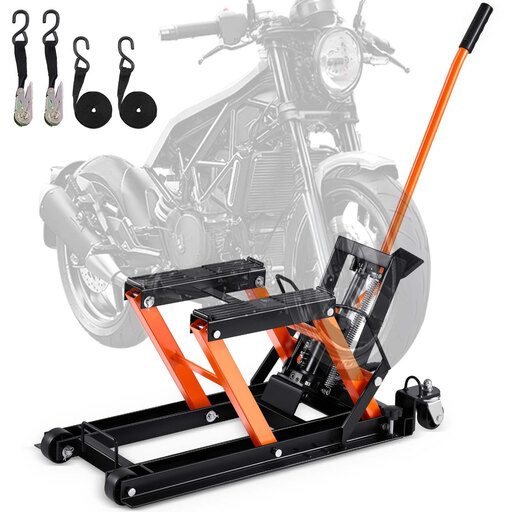
Why it stands out
Note the category change: this product is a specialised tool. This is not a car jack, but a hydraulic motorcycle lift. With its 700 kg capacity and wide, non-slip platform, it is designed to lift a motorcycle by the frame, holding it perfectly stable for safe work. The lift is operated via a hydraulic foot pedal, which keeps both hands free to guide and stabilise the bike.
Pros
Who is it for? Exclusively for bikers who maintain their own machines. This tool allows you to work at a comfortable height and in complete safety, something impossible to guarantee with a standard car jack.
Our selection covers the most common needs, but every workshop is unique. If you're looking for a different lifting capacity, a more compact bottle jack, or any other equipment for your garage, other solutions are available.
? Discover our full range of lift kits to find the right tool for your workshop.
1. Is a 3-tonne jack sufficient for my SUV? Yes, and with a very comfortable safety margin. A 3-tonne jack can lift up to 3,000 kg. However, when you lift a vehicle by one corner, you are only supporting a fraction of its total weight (usually well under half). A 3-tonne capacity is therefore more than sufficient for almost all SUVs and passenger cars, whose total weight rarely exceeds 2.5 tonnes.
2. Should I use jack stands with a hydraulic jack? Absolutely. This is a non-negotiable safety rule. A hydraulic jack is a lifting device, not a support stand. Once the vehicle is lifted, it is imperative to secure it with suitable jack stands before getting underneath or starting work. A hydraulic circuit, even a new one, can always fail.
3. What is the difference between a trolley jack and a bottle jack? The trolley jack, like those in our selection, is characterised by its long, low-profile chassis mounted on wheels. It is very stable, easy to position, and offers a wide lifting range. The bottle jack, on the other hand, is vertical and much more compact (it gets its name from its shape). While easier to store, it is less stable due to its smaller support base. It is often found as an emergency jack in heavy goods vehicles or for specific applications. For a home workshop, the trolley jack remains the most practical and safest choice.